From Ticket-Taking to Agentic Engineering
The ticket-driven SDLC is breaking under AI. By treating context as infrastructure, we shift from writing code to building the systems that produce it.
I remember the friction when we scaled our AI automation transformation to 33 production initiatives in a single year. We assumed the bottleneck would be model capability. It wasn’t. The real friction came from how we instructed the models and how we verified their work. We were treating AI like a junior developer taking tickets, expecting it to simply write the code we asked for. But that model breaks under the weight of AI generation. To actually reclaim the ~29,000 work-hours annually that we eventually did, we had to stop acting as human debuggers and start treating the AI as an engine that required a strict, engineered framework around it.
The assumption in most organizations is that the ticket-driven Software Development Life Cycle (SDLC) is the permanent shape of software work. You write a ticket, a developer implements it, and a reviewer checks it. But when implementation takes minutes instead of weeks, the traditional SDLC buckles. We are moving from a world of syntax to a world of intent, and that shift demands a complete rebuilding of how we produce software.
Key takeaways
- Structure scales, vibes don’t: Casual prompting works for prototypes, but production systems require the discipline of agentic engineering, formal specifications, deterministic tests, and strict guardrails.
- Design the factory, not the widget: The developer’s role shifts from writing boilerplate syntax to designing the system, the context, the tools, and the orchestration, that produces the code.
- Solve the 80 percent problem with evaluation: Models can rapidly generate 80% of a feature, but edge cases demand deep context. Automated evaluation suites are the only sustainable way to cross the finish line.
- Manage context as a financial lever: In a token economy, dumping entire repositories into a prompt is financially unviable. Dynamic context and intelligent model routing are required to control operational costs.
The spectrum from vibe coding to engineering
The transition from writing syntax to expressing intent is already happening. According to a 2026 industry report by Index.dev and GetPanto, 85% of professional developers now use AI coding agents regularly, with an estimated 41% of all new code being AI-generated. But how that code is generated matters deeply.
As Addy Osmani, Shubham Saboo, and Sokratis Kartakis outline in their 2026 paper, The New SDLC With Vibe Coding, there is a wide spectrum of AI-assisted development. On one end is “vibe coding.” In this mode, a developer writes a casual natural-language prompt, accepts the output, and manually checks if it seems to work. When it breaks, they paste the error message back into the chat. It is fast, unstructured, and entirely reliant on the human being in the loop to catch mistakes.
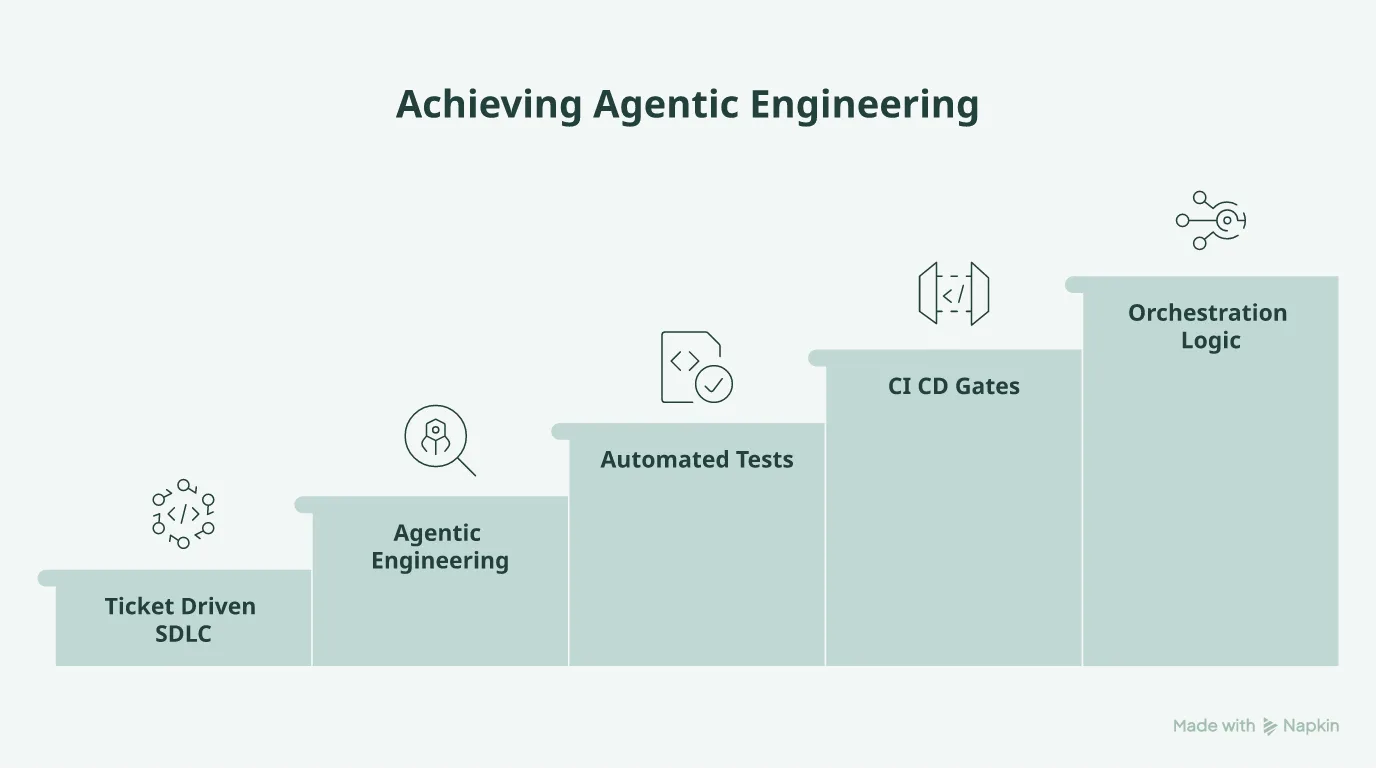
On the other end of the spectrum is agentic engineering. This requires formal specifications, automated test suites, CI/CD gates, and comprehensive architectural reviews. When we were rolling out our automation initiatives, we learned quickly that vibe coding does not survive contact with production. You cannot vibe code a system that handles real user data or financial transactions. Agentic engineering treats the AI as a powerful implementation engine that operates strictly within human-designed constraints.
Designing the factory model
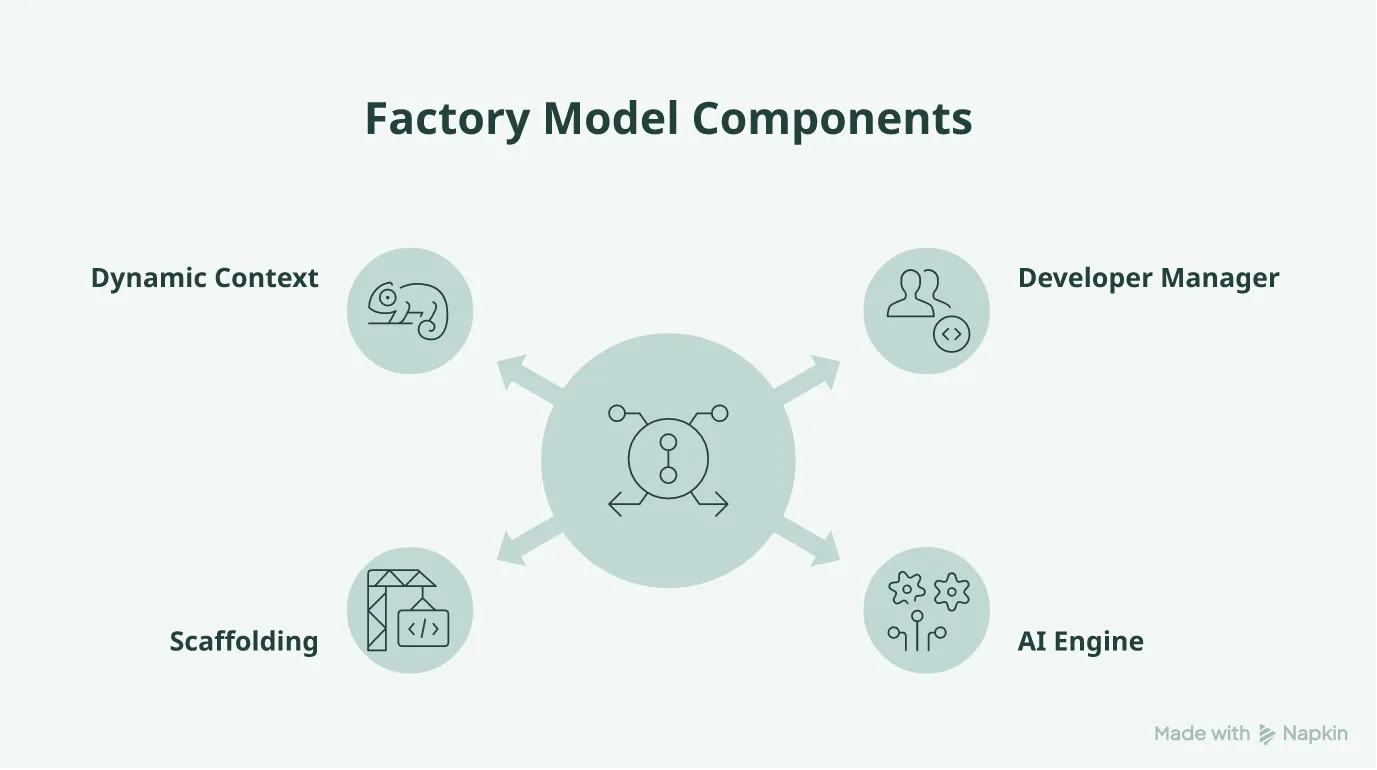
The breakthrough happens when you stop trying to write the code and start building the system that builds the code. Osmani and his co-authors introduce the “factory model” to explain this shift. The modern developer is no longer the assembly line worker assembling widgets by hand; they are the factory manager designing the assembly line and ensuring quality control.
If the developer is the factory manager, the AI model is just the raw engine on the factory floor. An engine on its own cannot manufacture a product. It needs belts, gears, and safety sensors. In agentic engineering, this surrounding machinery is the scaffolding.
In our own rollout, this was exactly the shift we had to make. We couldn’t manually review every line of code generated across dozens of distinct workflows. We had to invest our engineering time in the scaffolding itself: the instructions and rule files (like AGENTS.md), the specific tools the agent could call, the isolated execution sandboxes, and the orchestration logic. The scaffolding is what keeps the agent focused, secure, and productive. Without a strong scaffolding, you are simply relying on the model’s baseline capabilities, which leads directly to unpredictable outputs and mounting technical debt.
The 80 percent problem and the verification bottleneck
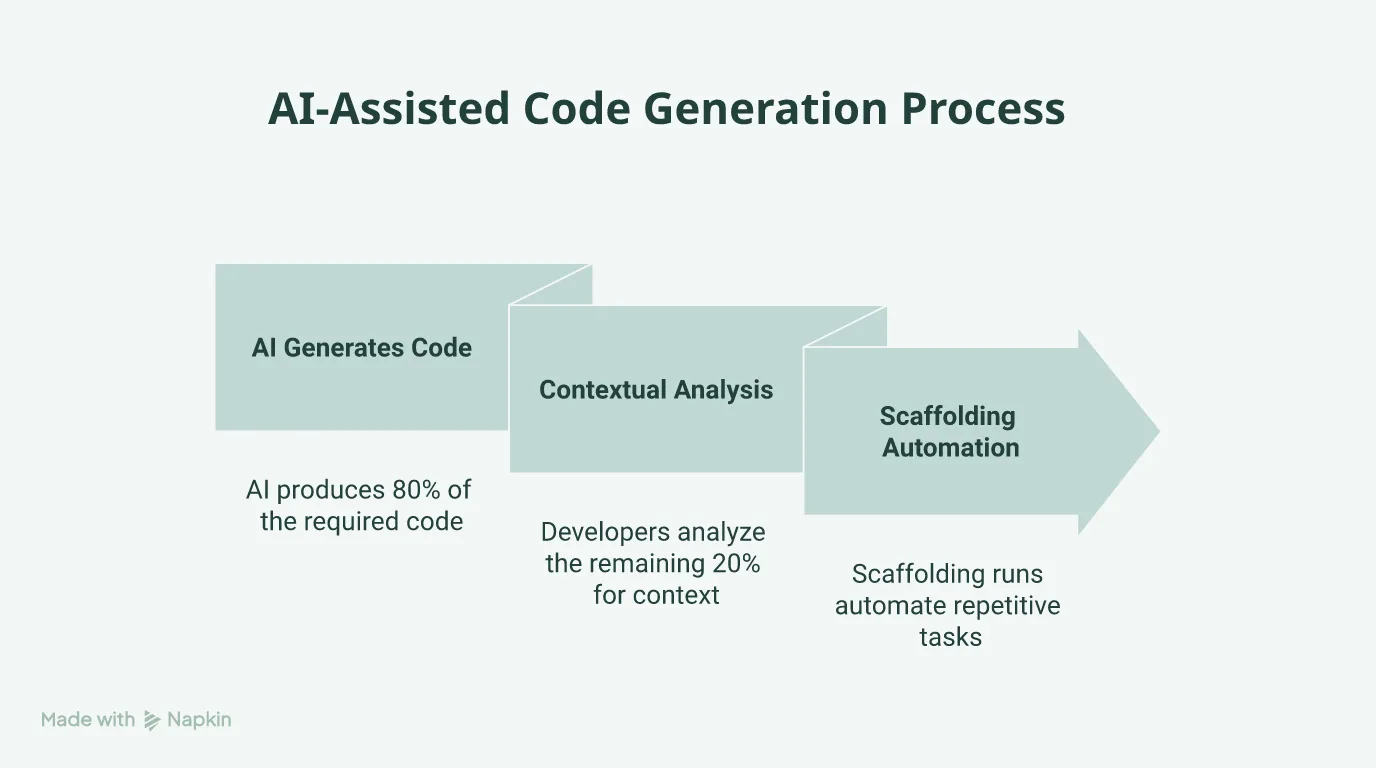
There is a known trap in AI-assisted development: the 80 percent problem. An agent can rapidly generate 80% of the code for a feature, but the remaining 20%, the edge cases, error handling, integration points, and subtle correctness requirements, demands deep contextual knowledge that models often lack.
In fact, a 2026 study by METR found that experienced developers using AI assistants actually took 19% longer on certain tasks. The delay came largely from the time spent verifying, debugging, and correcting the AI’s output. The nature of AI errors has evolved from simple syntax mistakes to insidious conceptual failures that look right at a glance but fail under pressure.
We saw this play out firsthand. To hit our target of 33 production deployments, we had to stop acting as the primary debugging layer for the agent. The solution was to wire tests and evaluations directly into the feedback loop. Testing in an agentic workflow relies on the scaffolding to facilitate autonomous self-correction. When the agent writes a function, the scaffolding provides the execution environment to run the automated tests. If a test fails, the orchestration logic captures the error and routes it back to the model for another attempt.
We had to move from acting as “conductors”, providing hands-on, real-time direction in the editor, to acting as “orchestrators,” operating at a higher level of abstraction. We defined goals, designed the evaluation criteria, and reviewed the final verified output. As part of Scaling AI From Experiment to Infrastructure Inside a Product Org, this shift in posture is what allows a small team to maintain high velocity without sacrificing quality.
Context engineering as a financial strategy
In the token economy, context engineering isn’t just a technical requirement; it is a core financial strategy. Every interaction with a Large Language Model incurs a cost based on input and output tokens. The 2026 Google paper emphasizes that the operational expenditure of vibe coding is massive and compounds quickly. Developers often dump massive, unstructured files into the context window and repeatedly ask the model to fix its own unverified mistakes. This creates an expensive prompting loop with low first-pass success rates.
Agentic engineering flips this economic model. It requires a deliberate, upfront investment of engineering time before a single line of production code is generated. You accept a higher capital expenditure to design the API schemas, build deterministic test suites, and structure the dynamic context.
Instead of passing an entire 100,000-token repository into every prompt, which is financially unviable at scale, you use dynamic context. Agent skills load procedural knowledge only when the task calls for it. You use intelligent model routing, sending complex architectural tasks to large frontier models, while routing deterministic test generation and code review to smaller, faster, and significantly cheaper models.
The barrier to creating software will continue to fall, and the human role is evolving directly into one of judgment and direction. Generation is largely a solved problem. The builders who can define precise specifications, evaluate output critically, and design effective systems of constraints are more valuable than ever. The new SDLC is built on verification, judgment, and direction.
When we mapped out the architecture for those 33 initiatives, we had to confront the reality that AI generation is fast, but verification is painfully slow if left to humans. Every pull request generated by an agent needs to be checked for hallucinated dependencies, inadequate error handling, and subtle correctness gaps that look right at a glance. We built specific deterministic rules to catch these issues before they reached human reviewers. For example, any code that modified our database schema had to pass a strict migration linter before a human even saw it.
This required a cultural shift on the engineering team. We had to stop treating AI-assisted development as a productivity feature and start treating it as an engineering investment. You have to build the production substrate before you try to scale. That means setting the bar at the evaluation stage, not the demo stage. A working demo proves an agent can succeed once. A passing evaluation suite proves it succeeds reliably. By treating the scaffolding as a shared team asset, maintaining system prompts, tool libraries, and evaluation pipelines in version control, we were able to compound our wins across the organization.
References
- Osmani, A., Saboo, S., & Kartakis, S. (2026). The New SDLC With Vibe Coding: From ad-hoc prompting to Agentic Engineering. Google.
- Index.dev & GetPanto. (2026). AI Coding Assistant Statistics 2025-2026.
- METR. (2026). Uplift Update: Measuring the Impact of AI Coding Tools.
Frequently asked questions
What is the difference between vibe coding and agentic engineering?
Vibe coding relies on casual natural-language prompts, disposable code, and manual testing, keeping the human in a constant trial-and-error loop. Agentic engineering treats the AI as an implementation engine constrained by formal specifications, automated test suites, and deterministic guardrails.
How does AI change the software development life cycle (SDLC)?
AI compresses the implementation phase from weeks to hours, shifting the primary bottleneck to requirements gathering, architecture, and verification. The developer's role moves from writing syntax to designing the system and evaluation criteria that produce the code.
What is the 80% problem in AI-assisted development?
The 80% problem refers to the reality that AI agents can quickly generate 80% of a feature, but struggle with the remaining 20%, edge cases, error handling, and subtle business logic. Solving this requires upfront investment in automated evaluation suites rather than manual human debugging.
Why is context engineering considered a financial strategy?
Every token sent to an LLM incurs a cost. Instead of dumping entire repositories into every prompt (which is expensive and noisy), context engineering uses dynamic loading and intelligent model routing to send only the necessary information, drastically lowering the operational cost of AI development.