Critical Thinking With AI Is a Separate Skill, and It Can Be Measured
General critical thinking doesn't transfer to AI use. For product teams, AI literacy is a testable requirement, not an abstract aspiration.
When organizations roll out generative AI tools, the standard guidance usually includes a vague mandate to “think critically” about the outputs. The underlying assumption is that critical thinking is a general cognitive capacity, if a user is a rigorous thinker in their daily work, they will naturally apply that same rigor to an AI chat interface.
That assumption is false.
Key takeaways
- General critical thinking does not automatically transfer to generative AI use; the conversational fluency of models often bypasses standard cognitive heuristics.
- Providing equal access to AI tools does not create equal outcomes; studies show that AI usage intensity alone yields zero performance benefit without specific evaluative digital literacy.
- Product teams must adopt the AI Evaluator Threshold by designing explicit friction and verification steps into interfaces rather than relying on the user’s innate critical thinking.
The Evaluator’s Disconnect
Recent empirical work validating a specific “Critical Thinking in AI Use Scale” reveals a stark discontinuity: the ability to evaluate a standard text or data source does not automatically carry over to generative AI. Across six robustly designed studies, researchers demonstrated that AI-specific critical thinking, particularly the motivation to verify opaque outputs, functions independently of general cognitive traits.
Traditionally, critical thinking involves analyzing explicit arguments supported by accessible evidence and transparent reasoning. Generative AI fundamentally breaks this model. Because large language models produce highly fluent, confident, and conversational text, they bypass the cognitive heuristics we normally use to detect flawed reasoning or factual errors. We are biologically wired to associate linguistic fluency with factual accuracy and authority. Even highly educated, analytically rigorous professionals often suspend their critical faculties when presented with a synthesized answer that looks structurally perfect.
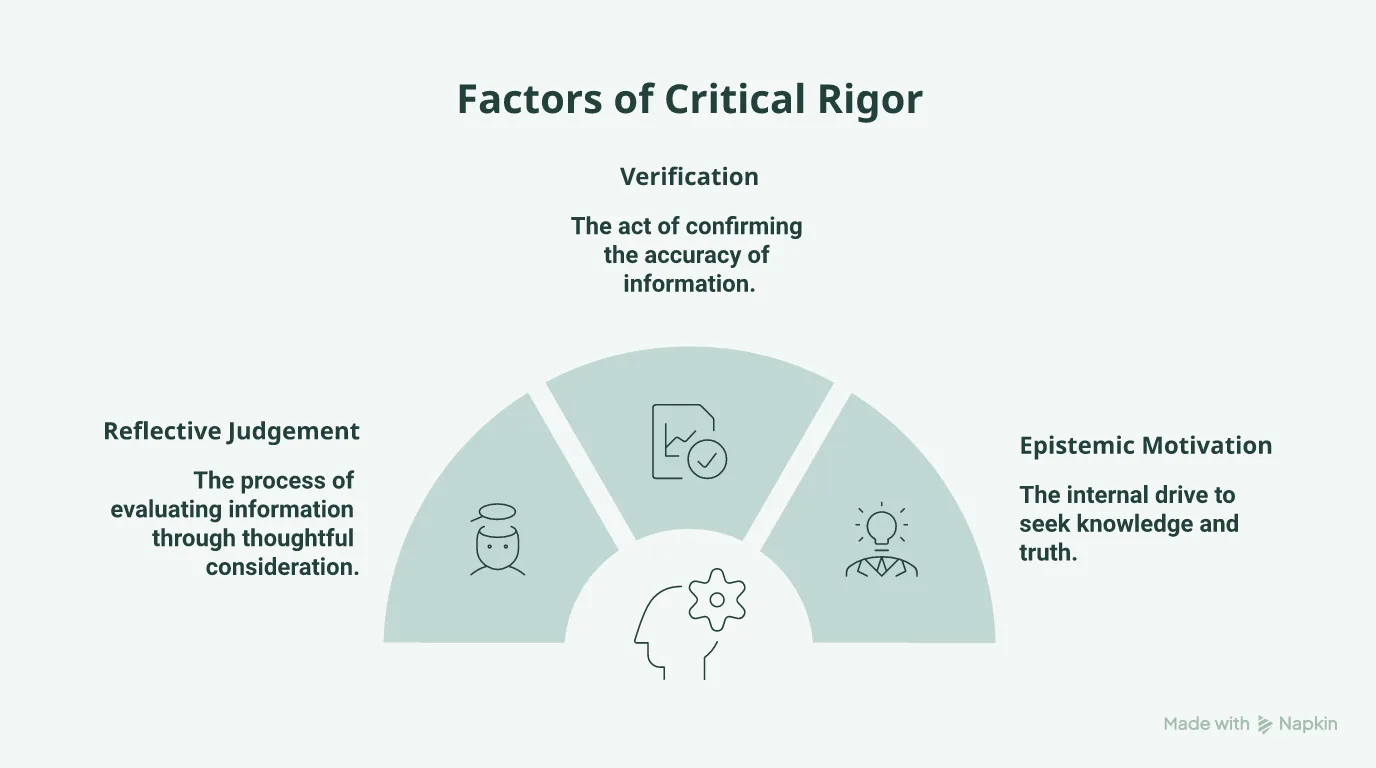
The researchers identified three specific dimensions that make up critical thinking in AI use: reflective judgement (deciding what to believe based on the context and likely consequences), verification (cross-checking the AI’s claims against accessible external sources), and epistemic motivation (the willingness to invest cognitive effort rather than settling for a premature, superficial answer).
Without all three dimensions working in tandem, even the smartest users fall victim to automation bias, treating probabilistic text generation as a definitive oracle. The validation of this scale proves that general cognitive aptitude does not protect users from AI hallucinations. Instead, what protects them is a specific, trainable mindset oriented towards relentless verification. When users lack epistemic motivation, they accept whatever the model produces because it sounds correct, effectively outsourcing their judgement to an algorithm that cannot actually reason.
The study’s own mediation model makes the shape of that disconnect plain.
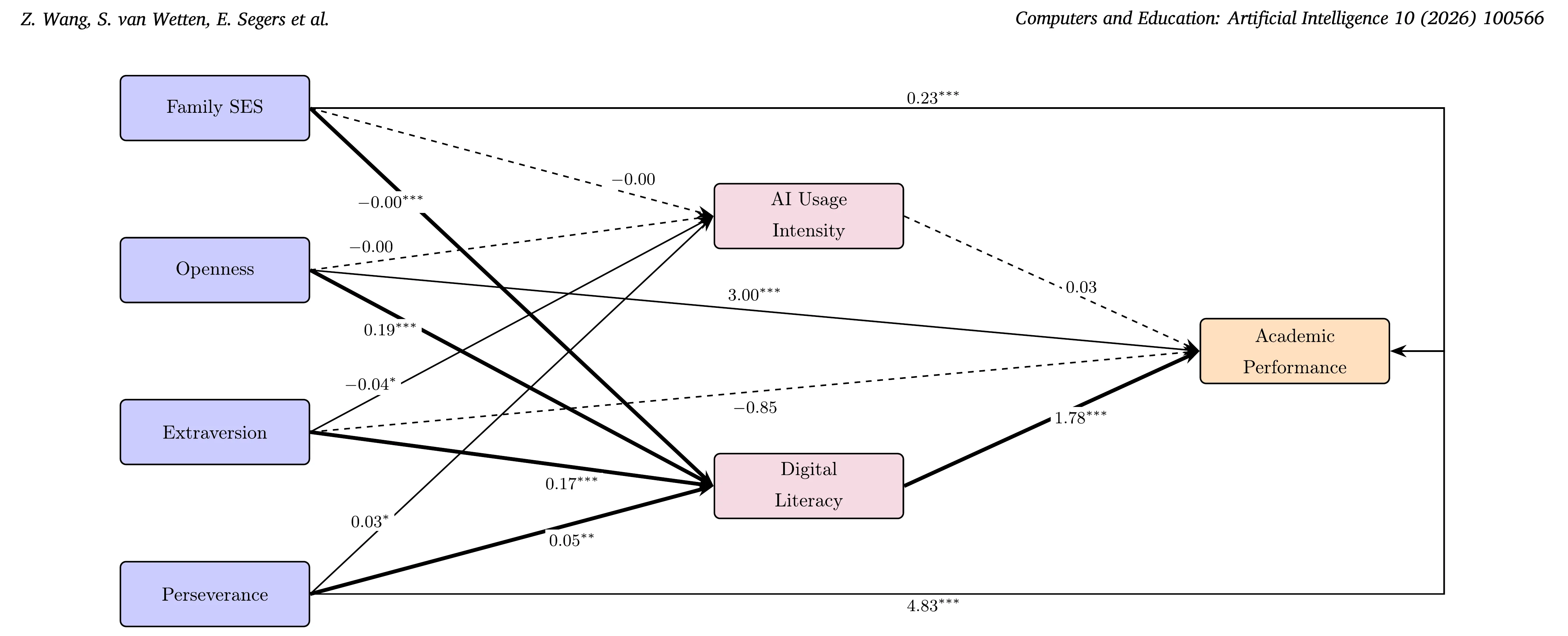
Exhibit 1. A parallel mediation model of 4,497 students showing that digital literacy drives academic performance, while raw AI usage intensity does not. Source: Wang, Z., van Wetten, S., Segers, E., et al. (2026). Decoding divides: The role of socioeconomic status and personality traits in AI divides and educational inequality. Computers and Education: Artificial Intelligence, p. 6.
The AI Usage Illusion
This cognitive gap is further complicated by structural and socioeconomic factors. Research into AI divides demonstrates that simply providing access to advanced tools does not equalize outcomes.
In a recent study of 4,497 primary school students in the Netherlands, researchers found that digital literacy, specifically the ability to effectively navigate, evaluate, and employ AI tools, significantly correlated with academic performance (B = 1.78). In stark contrast, raw AI usage intensity had absolutely no effect on performance. The data proved that merely exposing users to smart learning tools is insufficient; what matters is the underlying competency to convert that exposure into tangible gains.
Furthermore, the study revealed that users from different backgrounds approach these systems with varying levels of trust, skepticism, and cognitive reliance. Interestingly, socioeconomic status had a practically negligible direct effect on digital literacy (B = -0.00). Instead, personality traits like openness and perseverance were much stronger predictors of who developed the critical skills necessary for AI environments.
This means the skills required to engage critically with AI are not automatically granted by background, education level, or mere access to the technology. When organizations simply hand out AI tool licenses and assume productivity will follow, they are actually exacerbating a hidden divide. The users who already possess high digital autonomy and perseverance will figure out how to verify and leverage the tool, while everyone else will fall into a pattern of passive acceptance.
When we treat critical thinking as a monolithic trait, we ignore the reality that AI chatbots don’t automatically build independent users, in fact, without structural guardrails, they often encourage passive consumption and over-reliance. Providing a blank chat box does not teach users how to interrogate its outputs.
The AI Evaluator Threshold
For product leaders and organizations, this shifts the paradigm. If critical thinking in AI use is a distinct, measurable skill, it ceases to be an abstract aspiration for a company values statement. It becomes a concrete product requirement.
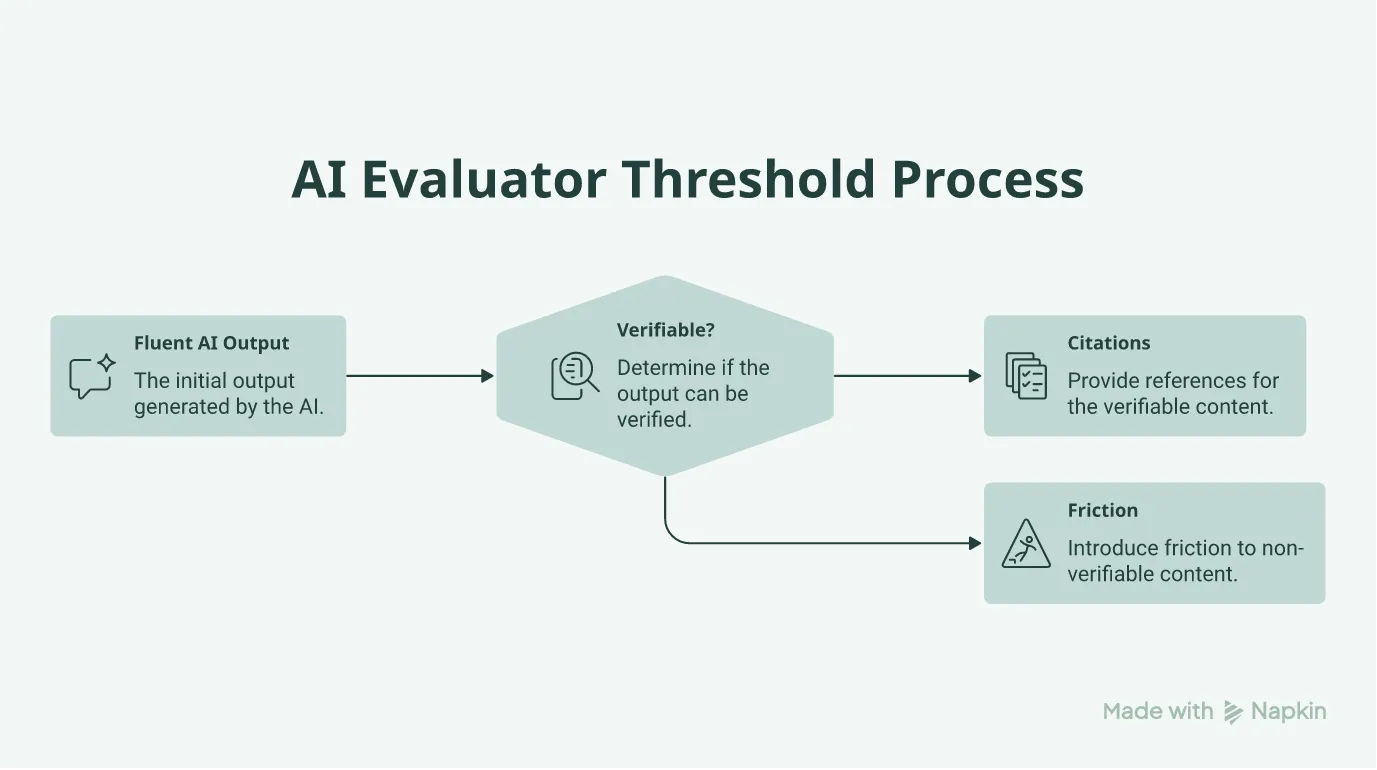
We can no longer treat the user’s brain as the final safety layer. If the skill is separate and requires explicit epistemic motivation, we must design the product to actively elicit it. We can codify this as The AI Evaluator Threshold: If a generative model’s output cannot be verified via an accessible external source, the interface must default to enforcing friction.
This means integrating explicit citation requirements, forced verification pauses, and evaluative steps directly into the decision infrastructure of the application itself. Rather than presenting a clean, authoritative block of text, the interface should surface confidence scores, link to foundational sources, and occasionally force the user to synthesize the final answer themselves.
We must design interactions that make passive consumption difficult. Consider how we design for security: we don’t just ask users to choose strong passwords, we enforce complexity rules at the system level. The same logic applies here. For example, forcing users to click through to a cited source before they can accept a generated claim, or requiring them to explicitly confirm they have verified the output before it is committed to a final document. By embedding these friction points into the user journey, we compensate for the cognitive heuristics that conversational fluency naturally bypasses. We force the brain to switch from passive reading to active evaluation.
When we acknowledge that AI critical thinking is a distinct, trainable, and testable capability, we can stop hoping for rigorous users and start building rigorous systems. The responsibility for critical evaluation shifts from the user’s innate abilities to the structural design of the interface.
References
- Lau, G. R., et al. (2026). Understanding critical thinking in generative artificial intelligence use: Development, validation, and correlates of the critical thinking in AI use scale. Computers in Human Behavior Reports.
- Wang, Z., van Wetten, S., Segers, E., et al. (2026). Decoding divides: The role of socioeconomic status and personality traits in AI divides and educational inequality. Computers and Education: Artificial Intelligence.
Frequently asked questions
Does general critical thinking automatically transfer to AI use?
No. Empirical validation of critical thinking scales for AI use shows that the fluency and conversational confidence of generative models often bypass our standard cognitive heuristics, making AI-specific critical thinking a distinct skill.
How do socioeconomic factors influence critical engagement with AI?
Research into digital divides indicates that providing equal access to AI tools does not lead to equal critical engagement. Users from varying backgrounds exhibit different baselines of trust and skepticism, which affects how heavily they rely on AI outputs.
What does this mean for product teams building AI tools?
It means AI literacy cannot be left entirely to the user. Products must be designed with built-in friction and evaluative steps, a structured decision infrastructure, that actively prompts users to verify and critique the AI's generated content.