Why AI Chatbots Don't Automatically Build Independent Users
Giving struggling users an AI assistant won't automatically make them independent. Without emotional engagement, the technology often falls flat.
A user logs into your newly launched, enterprise-grade data analytics platform. They are not a data scientist; they are a mid-level manager trying to pull a simple cohort retention report. Staring at a complex dashboard of empty pivot tables and SQL query builders, they freeze. This is the exact friction point your team anticipated. To solve it, you deployed a conversational AI assistant designed to scaffold these exact users. The user clicks the shiny AI button, asks “How do I build a retention report?”, receives a perfectly accurate, multi-step set of instructions, and immediately closes the tab. The tool worked flawlessly, but the user didn’t learn a thing.
The prevailing assumption in product strategy right now is that AI fixes this capability gap. If you have users who are struggling to adopt a complex workflow, dropping an AI assistant or chatbot into the interface is supposed to bridge the divide. The logic is straightforward: the AI provides immediate, personalized support, scaffolding the user until they become independent, self-regulated actors within the system.
This is an overcorrection. We are confusing the presence of a technical capability with the motivation to use it.
Recent data suggests that the mere presence of an AI tutor or assistant does not automatically translate into user independence. In fact, for the exact cohort of users who need the most help, the low-proficiency, low-adoption segment, the mechanics of how they interact with the AI matter far more than the technical accuracy of the AI itself.
Key takeaways
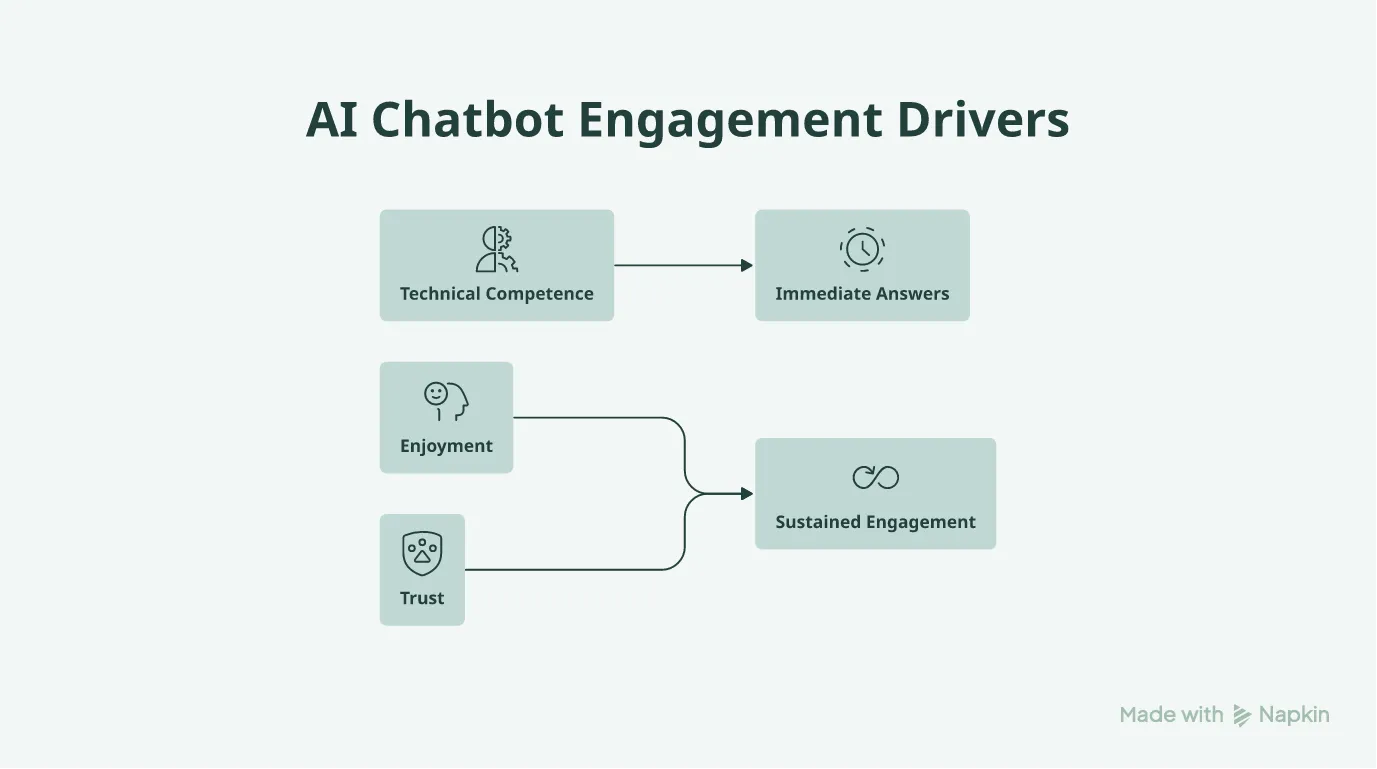
- Competence isn’t enough: For low-proficiency users, the technical accuracy of an AI assistant is the weakest predictor of them developing independent, self-regulated behaviors.
- Enjoyment drives independence: Positive emotional engagement is the strongest catalyst for sustained, independent use. Enjoyment is a functional requirement, not a decorative feature.
- Trust enables autonomy: Users must feel secure in the AI’s guidance. A safe, predictable environment where users can make mistakes without judgment is essential for building trust.
- Social presence is merely a scaffold: A human-like, friendly AI tone helps create a supportive environment, but it does not directly drive user independence on its own.
The limits of technical competence
When product teams design AI assistants, the default optimization metric is usually competence. We focus on accuracy, latency, and the AI’s ability to correctly parse a prompt and deliver a precise answer. We instrument dashboards to track whether the LLM hallucinated or provided the correct JSON payload. We assume that if the tool is competent, the user will eventually internalize that competence.
A 2026 study analyzing user interactions with AI chatbots found a surprising divergence from this assumption. When examining low-achieving users interacting with AI systems designed to build self-regulated learning, perceived competence was the weakest predictor of independent, self-regulated behavior.
In other words, simply providing a tool that gives the right answers did not make struggling users any better at regulating their own progress or setting their own goals. For users who are already lagging behind, the cognitive load of formulating the right prompts and interpreting the AI’s responses can actually be a barrier. They might use the tool to get an immediate answer to bypass their current blocker, but they don’t necessarily convert that interaction into a long-term strategy for independence.
This creates a paradox: the users who most need the AI to help them become independent are the least likely to experience it that way if the product is optimized solely for task competence. A perfectly accurate response that is overly dense, intimidating, or robotic will solve the immediate micro-task but fail entirely at the macro-goal of upskilling the user.
Why enjoyment outranks utility for struggling users
If competence isn’t the primary driver of independent behavior, what is?
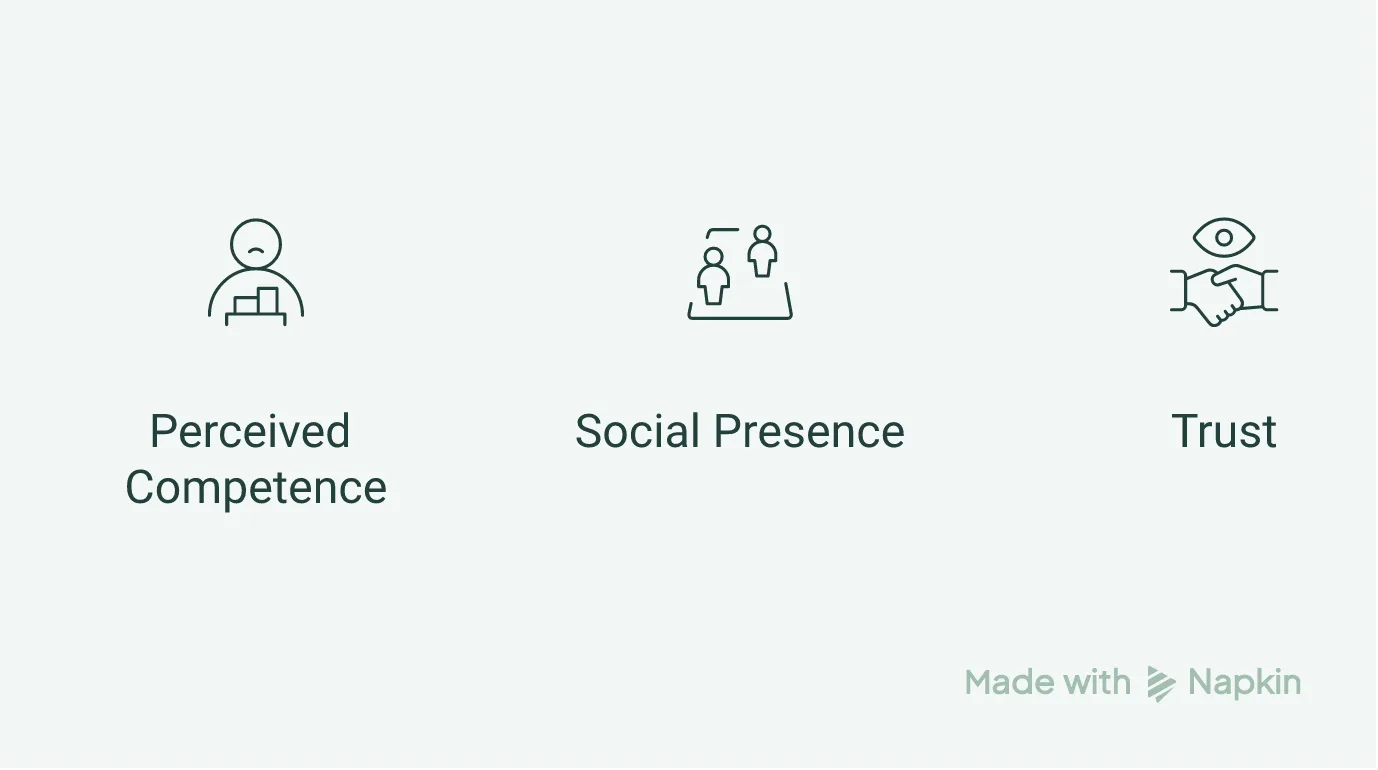
The same 2026 research identified a completely different primary driver: enjoyment. Among the factors studied, which included trust, social presence, and perceived autonomy, enjoyment emerged as the strongest predictor of users developing self-regulated, independent behaviors.
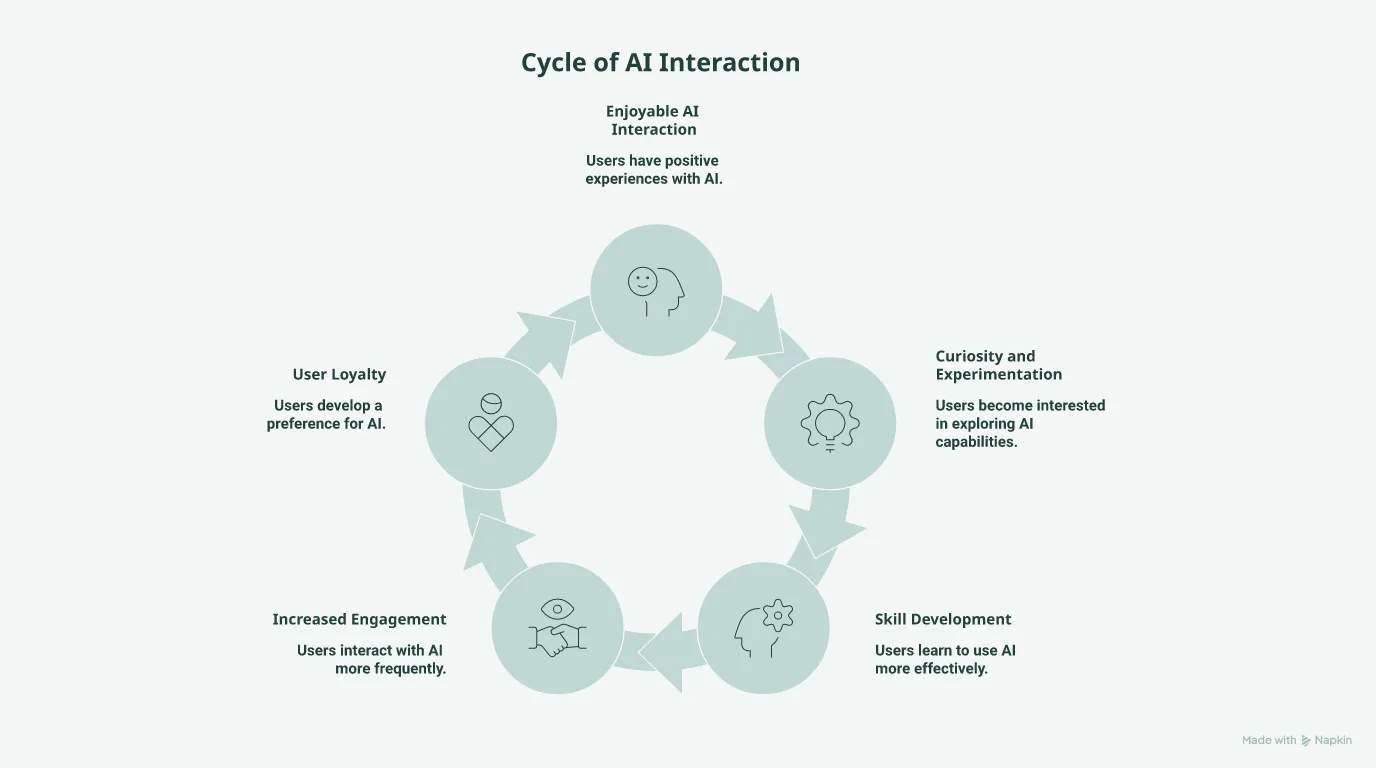
This challenges the typical utilitarian view of B2B or complex SaaS products. We often treat enjoyment as a nice-to-have, a layer of polish applied only after the core utility is proven. But for users who lack intrinsic confidence or proficiency in a domain, enjoyment is not decorative. It is the functional mechanism that sustains engagement long enough for learning and independence to occur.
What does an “enjoyable” AI interaction look like in a complex software environment? It is not about adding animated confetti or gamified badges. It is about creating interactions that feel dynamic, responsive, and low-stakes.
Consider a user trying to write a complex automation script. An enjoyable AI interaction might offer proactive, conversational hints rather than dumping a block of code. It might use progressive disclosure, revealing complexity only as the user asks for it, turning a daunting task into a manageable back-and-forth dialogue. When a user enjoys the interaction, they are more likely to experiment. They ask more questions, they test boundaries, and they reflect on the feedback they receive. This curiosity-driven engagement is the prerequisite for self-regulation. Without it, the AI is just a transactional vending machine for answers, rather than a partner in building user capability.
Designing trust into the AI experience
Enjoyment cannot exist in a vacuum; it requires a foundation of trust. If a user feels that the AI is unreliable, opaque, or overly restrictive, their sense of autonomy is weakened.
The data confirms that trust in AI is a significant predictor of self-regulated behavior. Users need to feel secure in relying on the AI’s guidance, particularly when they are navigating unfamiliar or complex tasks. This means that trust is not just about data privacy or system uptime; it is about predictability and transparency in the interaction itself.
For product leaders, this means we must deliberately design trust into AI products. We have to consider how the system fails, how it communicates uncertainty, and how it handles user errors.
Imagine an AI assistant that hallucinates a step in a critical workflow. If the system hides its uncertainty, the user’s trust is shattered the moment they encounter the error. Conversely, if the AI clearly signals its confidence level (“I’m 80% sure this query is right, but you should verify the date range”), it builds a safer environment. When an AI system provides a safe, private environment where users can make mistakes without fear of judgment, it actively fosters the kind of trust that leads to sustained, independent use.
Social presence as a scaffold, not a solution
The concept of “social presence”, the degree to which an AI feels human-like or socially responsive, is frequently touted as a silver bullet for engagement. The assumption is that if we make the chatbot friendly enough, give it a persona, or tune it to sound empathetic, users will naturally engage more deeply.
The reality is more nuanced. The research indicates that while social presence is positively associated with a user’s sense of autonomy, competence, and relatedness, it does not directly predict self-regulated, independent behavior.
Social presence is a scaffold. It creates a supportive atmosphere that helps users feel connected and less isolated when dealing with complex tasks. It makes the environment feel less sterile and more forgiving. But on its own, a friendly tone is insufficient to drive a user from dependence to independence. A chatbot can be incredibly polite while still failing to empower the user. The social presence must serve the broader goals of building trust and facilitating an enjoyable, low-friction experience.
It is the combination of these factors, enjoyment, trust, and a supportive social presence, that ultimately satisfies the user’s basic psychological needs, giving them the motivational foundation required to act independently.
The product mandate: Optimizing for independence
We need to rethink the metrics we use to evaluate AI assistants. If our goal is to build users who are capable, self-regulated, and independent, we cannot simply measure the speed, accuracy, or deflection rate of the AI’s responses.
We must measure the user’s trajectory. Are they asking better, more sophisticated questions over time? Are they relying on the AI for complex reasoning and strategy rather than basic task execution? Are they exhibiting signs of self-regulation, such as setting their own goals, recovering from their own errors, and monitoring their own progress?
As we integrate AI more deeply into our products, especially in contexts like building a financial OS, the mandate is clear. We cannot just bolt an LLM onto a complex workflow and expect the user capability gap to close automatically. We must design for the psychological realities of our users, prioritizing the emotional engagement and trust that actually drive true, lasting independence.
References
- Hsieh, C.-C., Bali, S., Chiu, T. K. F., Yen, A.-C., Liu, M.-C., Chen, T.-C., & Ardhyantama, V. (2026). Understanding the role of AI Chatbots in English self-regulated learning: A dual-stage structural equation modeling and artificial neural network approach. Acta Psychologica, 266, 106834. https://doi.org/10.1016/j.actpsy.2026.106834
Frequently asked questions
Why doesn't a highly accurate AI automatically make users more capable?
For struggling users, the cognitive load of interacting with an AI can be a barrier. Even if the AI gives perfect answers, users may treat it transactionally rather than internalizing the skills needed for independent, self-regulated behavior.
What is the strongest predictor of a user developing independent skills with AI?
Enjoyment is the strongest predictor. When the interaction feels dynamic and low-stakes, users are more likely to experiment, reflect on feedback, and engage deeply enough to build their own capabilities.
How does social presence affect user independence with AI?
A human-like or friendly tone creates a supportive environment that fosters a sense of autonomy and connection, but it does not directly drive independence on its own. It acts as a scaffold that supports trust and enjoyment.