How Buy Now, Pay Later Really Changes Purchase Behavior
BNPL undeniably drives larger orders and reaches new buyers. But when consumers underestimate the costs, the short-term growth masks long-term risk.
Retailers are flocking to ‘Buy Now, Pay Later’ (BNPL) integrations because the initial numbers are undeniable: conversion rates spike and average order values climb. It looks like the perfect, frictionless growth lever. But there is a tension in the data. The very mechanics that make BNPL so effective at driving sales, lowered payment salience and delayed consequences, are the same mechanics that lead consumers to make suboptimal choices. We treat BNPL as a clean optimization for the checkout flow, but the evidence suggests it is a much more complex product decision with two faces.
Key takeaways
- The growth is real, but concentrated. BNPL demonstrably increases online spending, but the lift is driven almost entirely by low-ticket items and younger, lower-income users.
- Ignorance drives the upside. A significant portion of BNPL’s conversion lift comes from consumers underestimating the true cost of the credit, leading to excessive upgrades and purchases they cannot actually afford.
- The competitive trap. Offering BNPL isn’t a guaranteed win in a competitive market; it often leads to higher baseline prices for all users, penalizing those who pay upfront.
- Brand risk is the hidden cost. Optimizing only for the initial conversion ignores the long-term churn and brand damage caused when users face unanticipated financial distress.
The undeniable lift in order size
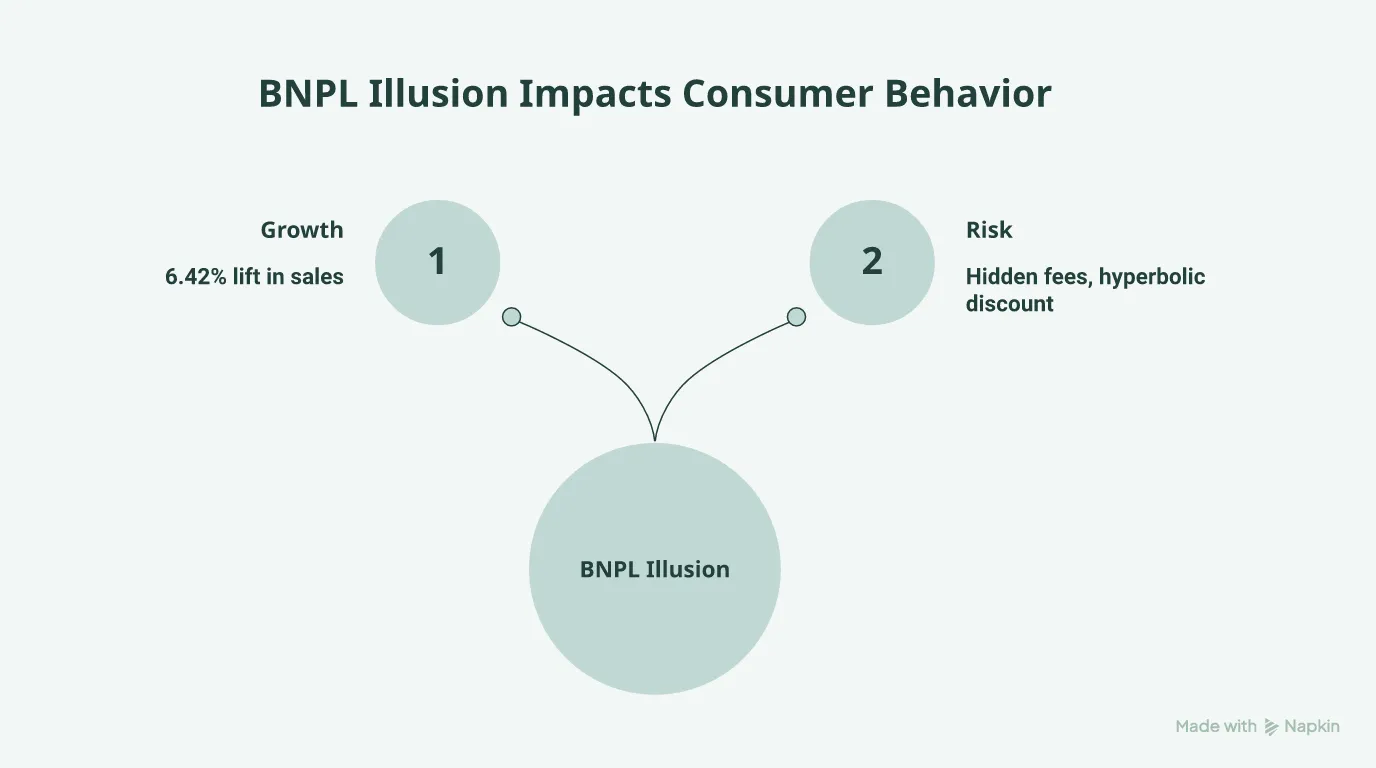
The primary argument for integrating BNPL is that it expands the market and increases the size of the basket. The data shows this is absolutely true, but the composition of that growth is revealing. A 2024 study analyzing actual online purchase data found that BNPL adoption leads to a 6.42% increase in online spending compared to non-adopters.
However, this increase isn’t distributed evenly. The evidence indicates that the spending lift is predominantly driven by low-ticket items. Furthermore, the customers driving this growth tend to be younger, have lower incomes, and exhibit lower brand loyalty. In essence, BNPL acts as a liquidity injection for segments that are otherwise constrained, turning browsing into immediate purchasing. For a product leader looking to boost short-term metrics, this looks like a resounding success.
The cost of underestimation
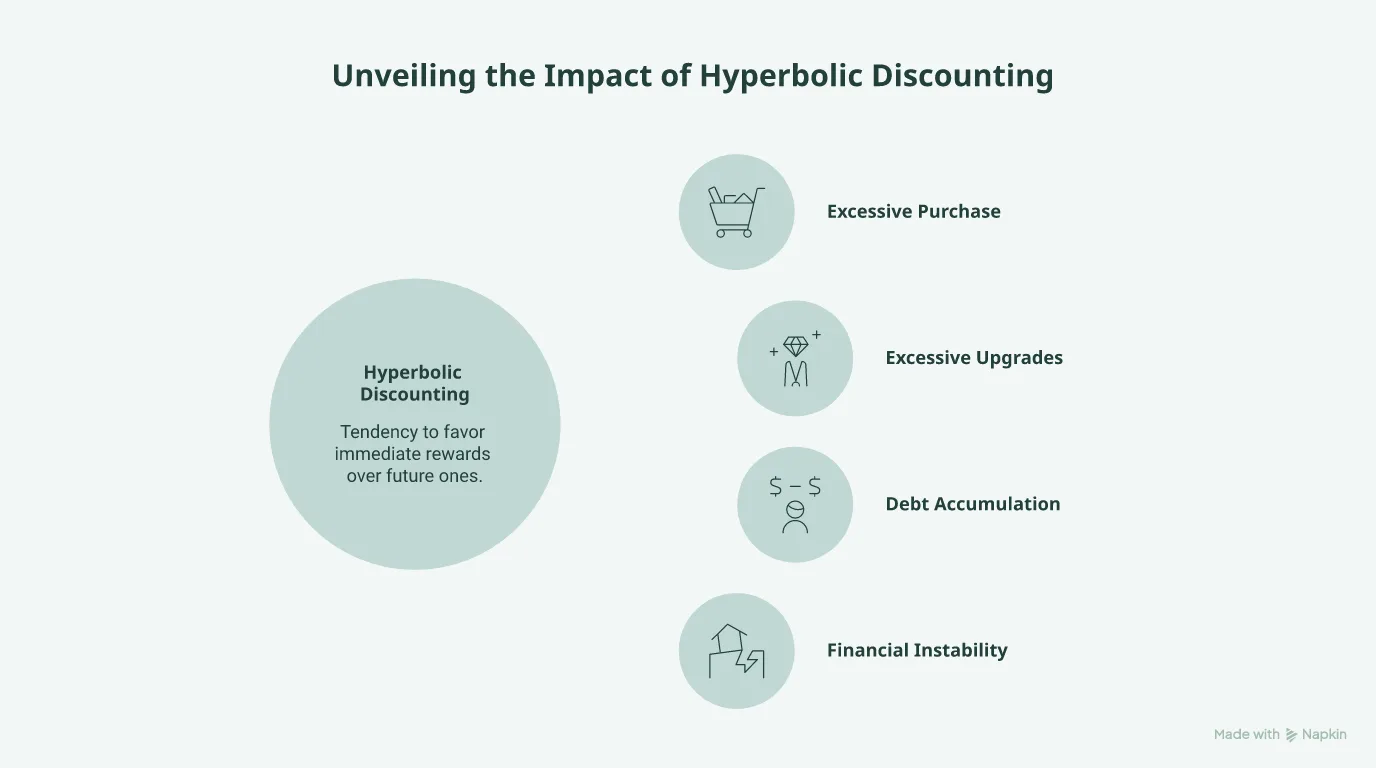
The uncomfortable truth about BNPL’s effectiveness lies in why it works so well. The mechanism relies heavily on what behavioral economists call hyperbolic discounting: consumers heavily weight the immediate gratification of the purchase while discounting the delayed pain of the installments.
A 2024 competitive analysis of BNPL markets highlights the danger in this dynamic. The research shows that a significant portion of BNPL’s market expansion occurs because consumers underestimate the actual costs of the service, such as late fees, the hassle of returns, and the friction of managing multiple installment schedules. When consumers ignore these costs, the study found it leads to two distinct negative outcomes: “excessive purchase” (buying products they should have avoided entirely) and “excessive upgrades” (choosing a premium product over a standard one they could actually afford). The conversion spike we celebrate in the analytics dashboard is often fueled by consumer miscalculation.
The competitive pricing trap
The assumption is that offering BNPL is always a competitive advantage. If your rival offers it and you don’t, you lose the liquidity-constrained market. But the strategic reality is much more complicated.
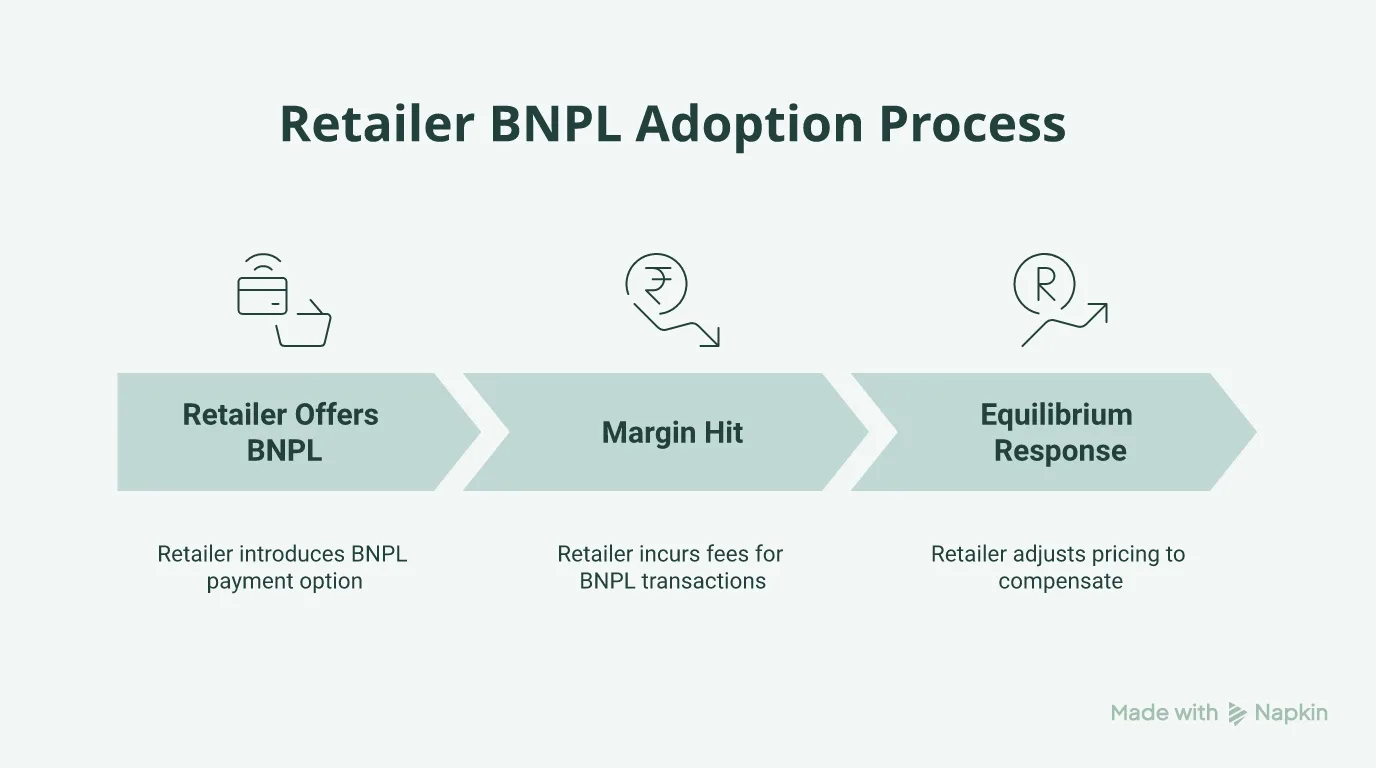
Because BNPL providers charge retailers a significant fee (often 2% to 8% of the transaction), retailers must offset that cost. The competitive analysis shows that when firms offer BNPL, the equilibrium response is to raise the baseline retail price for the product. This means that all consumers, even the ones paying upfront with cash or traditional credit, end up subsidizing the cost of the BNPL program.
Furthermore, the data suggests that in some competitive scenarios, the optimal move is actually to let your competitor offer BNPL while you abstain. The firm offering BNPL takes on the margin hit and raises prices, allowing the non-BNPL firm to compete more effectively on baseline price while still benefiting from the generally elevated price ceiling in the market.
Designing for the long term
Most businesses optimize for the metric they can measure, not the outcome they actually want. With BNPL, it is incredibly easy to measure the immediate lift in checkout conversion and average order value. It is much harder to measure the delayed churn, the customer support tickets regarding installment disputes, and the erosion of brand trust when a user feels financially overextended.
The strategic question is whether the short-term volume is worth the long-term risk. I’d argue that product teams need to evaluate BNPL not just as a payment gateway, but as a feature with severe downstream consequences. If your growth relies on your users misunderstanding their own financial constraints, that growth is fragile. The organizations that succeed in the long run will be those that figure out how to offer flexibility without relying on cognitive blind spots to drive their metrics.
References
- Kumar, A., Salo, J., & Bezawada, R. (2024). The effects of buy now, pay later (BNPL) on customers’ online purchase behavior. Journal of Retailing, 100, 602-617. https://doi.org/10.1016/j.jretai.2024.09.004
- Desai, P. S., & Jindal, P. (2024). Better with buy now, pay later?: A competitive analysis. Quantitative Marketing and Economics, 22, 23-61. https://doi.org/10.1007/s11129-023-09271-y
Frequently asked questions
How much does BNPL actually increase online spending?
Research indicates that adopting BNPL can increase a customer's online spending by roughly 6.42%. This growth is heavily concentrated in low-ticket items and is primarily driven by younger, lower-income demographics.
Why does BNPL lead to suboptimal purchases?
BNPL exploits present bias, where users focus on the immediate gratification and underestimate the future costs and hassle of installments. This underestimation frequently leads to excessive upgrades and purchases that users cannot genuinely afford.
Does offering BNPL guarantee a competitive advantage?
No, the strategic reality is complex. Offering BNPL introduces merchant fees that typically force retailers to raise baseline prices, which means cash buyers end up subsidizing the BNPL users, potentially hurting the brand's broader price competitiveness.