Unlearning as the Hidden Engine of Digital Transformation
When digital transformation stalls, the problem isn't usually missing capability. It's the refusal to discard the obsolete routines standing in the way.
You fund a new digital initiative, hire specialized data talent, and launch the pilot program, but six months later, the core business operates exactly as it did before. The tools changed, but the outcomes didn’t. It is easy to assume that when transformation stalls like this, the required capability must simply be missing.
But what if the capability is already there, and the present simply refuses to move?
When I look at incumbents struggling to adapt, the friction rarely comes from an inability to learn new things. It comes from an inability to unlearn. Old, entrenched routines act as an organizational immune system, rejecting new operational logics before they can take root. Until those legacy routines are actively dismantled, new digital capabilities have nowhere to land.
Key takeaways
- Unlearning precedes capability: Discarding obsolete beliefs and routines is the mandatory first step before dynamic capability can actually take hold.
- Learning is not unlearning: Acquiring new knowledge expands the capability base, but unlearning breaks the path dependence that prevents new knowledge from being applied.
- Dynamic capability is the bridge: Clearing out old routines creates operational space, but you need sensing, seizing, and reconfiguring capabilities to turn that space into business model innovation.
- The environment dictates the efficiency: In markets with dysfunctional competition, the perceived risk of abandoning old routines goes up, stifling the transformation process.
- Support mechanisms provide legitimacy: External financial support or policy backing reduces internal resistance, making it safer to discard entrenched models.
The Fallacy of Additive Transformation
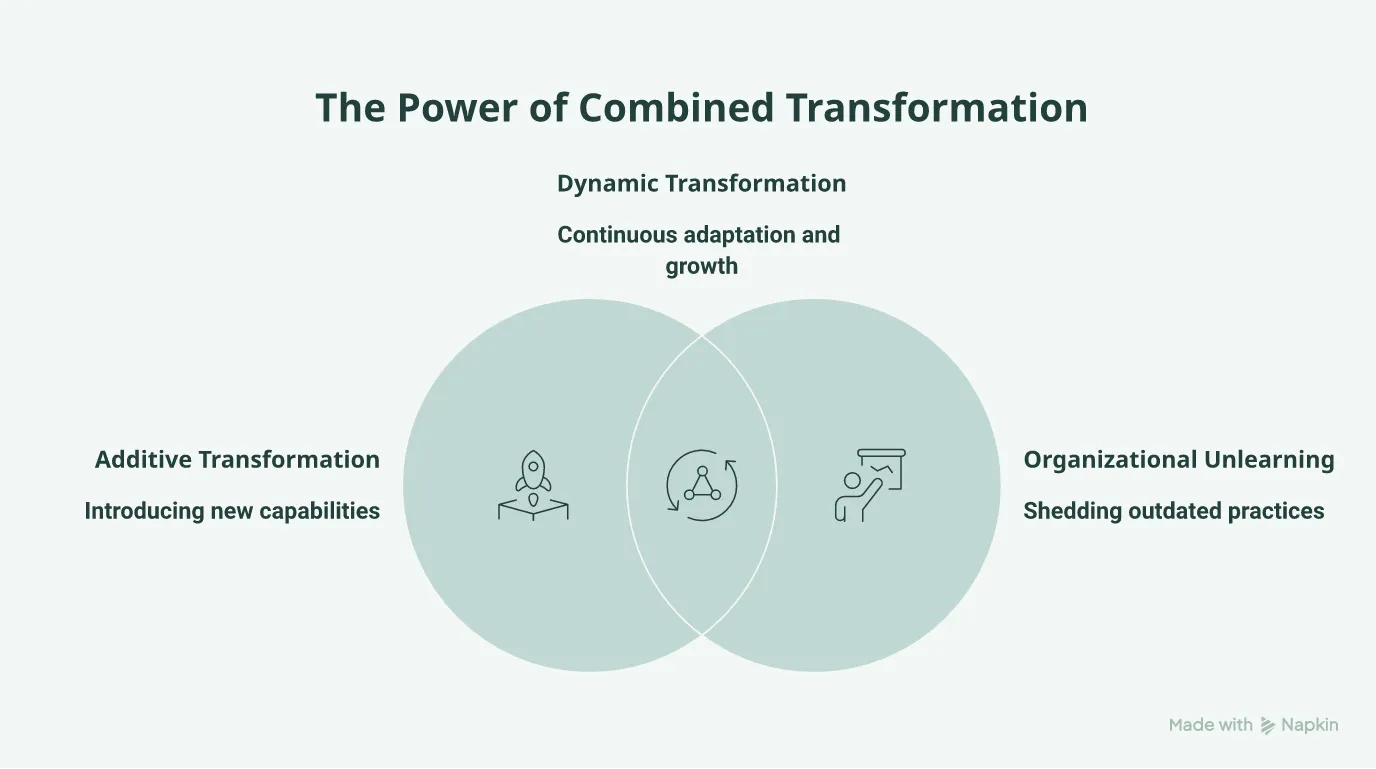
Organizations often treat digital capabilities as layers they can stack on top of their existing operations. But a 2026 study of 207 manufacturing firms found that simply acquiring new knowledge isn’t enough to drive digital business model innovation. The researchers demonstrated that organizational unlearning, the deliberate discarding of obsolete cognitive schemas and routines, is a critical antecedent to digital transformation.
The data shows that unlearning has a significant direct effect on digital innovation, explaining a substantial portion of the variance in successful transformations. It creates the cognitive and operational space necessary to perceive and pursue new opportunities. When organizations try to skip this step, they end up bolting digital tools onto analog workflows. The resulting friction inevitably degrades performance and stalls scaling efforts.
The study utilized a two-wave time-lagged design over a year to measure how these firms translated technological adoption into meaningful shifts. The findings highlight a stark reality: digital transformation is fundamentally different from traditional business model changes. Traditional shifts often rely on episodic strategic planning, but digital adaptation requires a high-frequency, iterative process. You cannot sustain an iterative process if your foundational operating logic remains anchored in legacy, linear methodologies.
The automotive industry offers a clear example of this dynamic. When legacy automakers attempt to transition to connected ecosystems, those who merely add a software division fail. Success, as seen in industry leaders who established dedicated connectivity hubs, requires actively dismantling the deeply entrenched, hardware-first product development routines. You must unlearn the old sequence of value creation before the new ecosystem-centric model can function.
Why Learning Is Not Unlearning
It is tempting to view unlearning simply as the inverse of learning, or perhaps a byproduct of it. However, the evidence suggests they are distinct, interdependent processes that serve entirely different functions in organizational renewal.
Organizational learning focuses on acquiring, assimilating, and integrating new knowledge. It expands the firm’s knowledge base. Through deliberate learning and experience accumulation, an organization might figure out how a new platform architecture operates or how to use user-generated data. But knowing how to do something new does not automatically stop an organization from doing things the old way.
Unlearning, conversely, creates the cognitive and behavioral space necessary for reconfiguration. It weakens path dependence and reduces the cognitive inertia that blocks strategic renewal. If learning provides the fuel, unlearning clears the engine. The research illustrates that without the deliberate dismantling of obsolete beliefs, newly acquired knowledge remains theoretical. The organization continues to default to its comfortable, misaligned routines whenever it faces pressure.
How Dynamic Capability Bridges the Gap
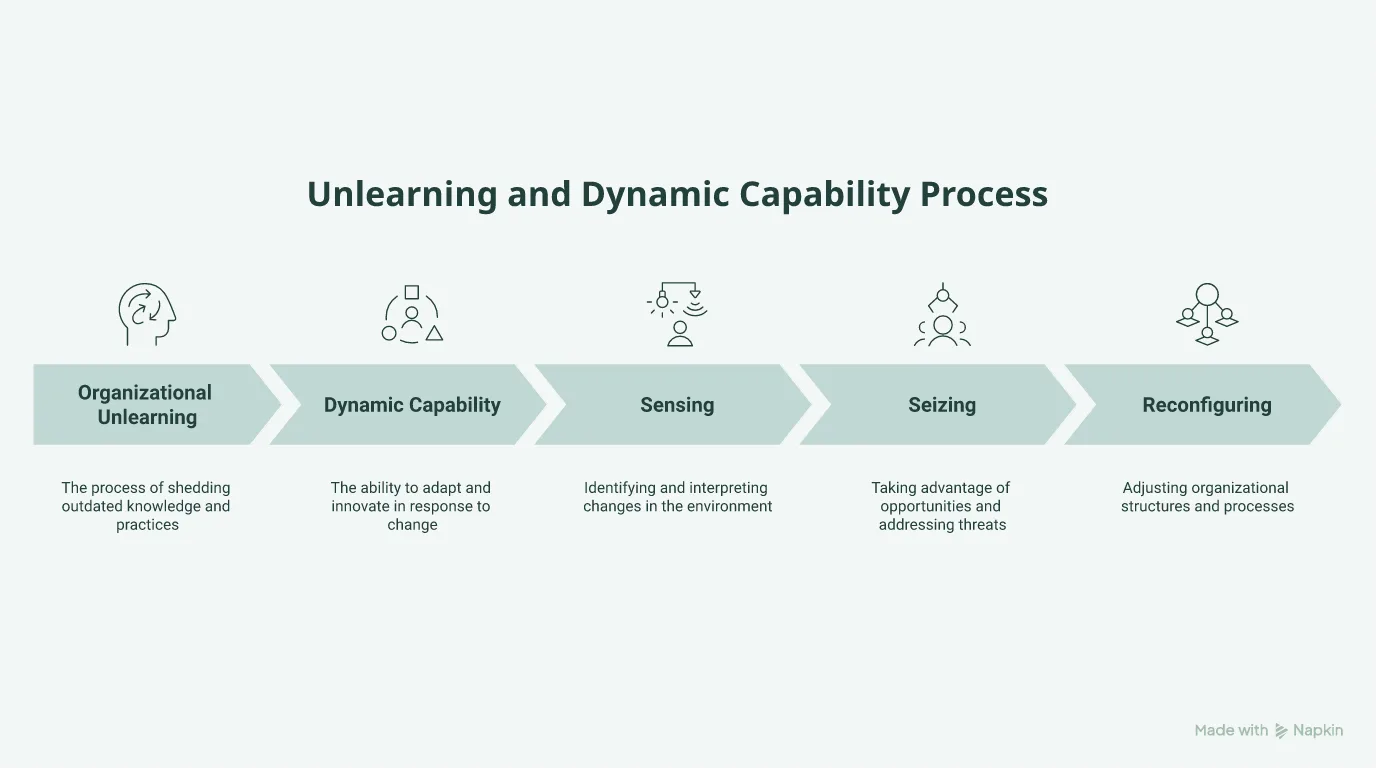
Clearing out the old is necessary, but it isn’t sufficient on its own. The study emphasizes that dynamic capability acts as the critical bridge mechanism, turning the potential unlocked by unlearning into concrete strategic action.
Once unlearning creates latent cognitive space, dynamic capabilities translate that space into actionable renewal across three dimensions:
- Sensing: By challenging entrenched cognition, organizations can overcome the blind spots that hide emerging market threats and data-driven opportunities. Unlearning obsolete beliefs allows firms to scan the environment and recognize signals they would have previously ignored.
- Seizing: Discarding outdated routines allows organizations to absorb external knowledge and integrate it into existing processes without immediate rejection. This enables the rapid adaptation of products and services to capture new digital value.
- Reconfiguring: The ongoing removal of rigid structures equips an organization to realign resources and optimize competencies continuously. This sustained agility is what prevents core competencies from calcifying into core rigidities.
The structural equation modeling in the study showed that dynamic capability strongly mediates the relationship between unlearning and digital business model innovation. The indirect effect was statistically significant, proving that without the higher-order capacity to sense, seize, and reconfigure, the operational space created by unlearning simply remains a void.
The Friction of the External Environment
Even when an organization commits to unlearning, the external environment can actively resist that change. The research points to two countervailing institutional forces that moderate this process: dysfunctional competition and financial support.
Dysfunctional competition, characterized by opportunistic imitation, weak intellectual property protection, and unreliable information, severely dampens the unlearning-capability pathway. The data indicates that in these environments, the perceived risk of abandoning established, defensive routines is simply too high. It raises transaction costs and diverts managerial attention back to short-term survival. When the market rewards short-term maneuvering over long-term capability building, the efficiency of converting unlearning into new dynamic capabilities collapses.
Conversely, external financial support (like government grants, subsidies, or tax incentives) amplifies the transformation. It isn’t just about the financial buffer; it’s fundamentally about legitimacy. A visible external endorsement reduces internal resistance, signaling to the organization that the strategic shift is valid and supported. This compensates for efficiency losses and makes the risk of unlearning acceptable. It gives managers the cover they need to dismantle the old engine while building the new one.
Designing for Subtraction
For product leaders driving transformation, the implication is clear: you have to design for subtraction before you design for addition. Transformation requires tearing down the scaffolding of the past so the capabilities of the future have room to stand.
If you want a team to adopt an autonomous, data-driven workflow, you cannot simply introduce the new tooling and hope it displaces the old habits. You have to actively audit and dismantle the legacy processes that keep the old behaviors comfortable.
You need to stop asking what new capabilities to build, and start asking what old certainties to destroy. Because if the present refuses to move, the future cannot arrive.
References
- Zhang, F., Wang, J., Kang, M., & Zhu, L. (2026). Leveraging organizational unlearning for digital business model innovation: the roles of dynamic capability and institutional forces. International Journal of Operations & Production Management, 46(7), 1223-1247. https://doi.org/10.1108/IJOPM-10-2025-1032
Frequently asked questions
What is organizational unlearning?
Organizational unlearning is the deliberate process of discarding obsolete beliefs, cognitive schemas, and operational routines. It is required to break path dependence and create the cognitive space necessary for new capabilities to take root.
How is unlearning different from organizational learning?
While organizational learning expands a firm's knowledge base by acquiring new information, unlearning clears the way for that knowledge to be used. Learning adds new tools, but unlearning dismantles the old habits that prevent those tools from being adopted.
Why does digital transformation often stall even after new technology is adopted?
Transformation stalls because organizations treat it as an additive process, layering new tools over entrenched legacy routines. Until those old routines are unlearned, they act as an immune system that rejects new operational models.
How does market competition affect an organization's ability to innovate?
A 2026 study found that dysfunctional competition, like weak IP protection and opportunistic behavior, increases the perceived risk of abandoning old routines. This diverts focus to short-term survival and stifles the development of long-term dynamic capabilities.