How AI Influencers Break the Trust Architecture of Digital Endorsements
Brands assume hyperrealistic AI influencers build trust identically to human creators. The evidence shows consumers process their lack of agency differently.
The uncomfortable truth about the sudden rise of AI influencers, ranging from virtual fashion icons to AI-generated brand avatars, is that they operate under completely different consumer processing rules than human creators. Many product teams assume that a realistic avatar staying on message will command the exact same psychological response as a traditional spokesperson. The prevailing assumption treats the endorsement mechanism as identical across human and digital entities. The underlying trust architecture functions under a very different set of constraints.
Research from Zhang and He (2025) demonstrates this divergence clearly in their empirical investigation of AI endorsements. They conducted two scenario-based experiments with 200 participants each, rigorously comparing human and AI influencers. The first study focused on utilitarian products, using dental floss as the test case, while the second study examined hedonic products through chocolate advertisements. The experimental design ensured high validity, with 97 percent of participants in the first study successfully identifying the AI endorser during the manipulation check.
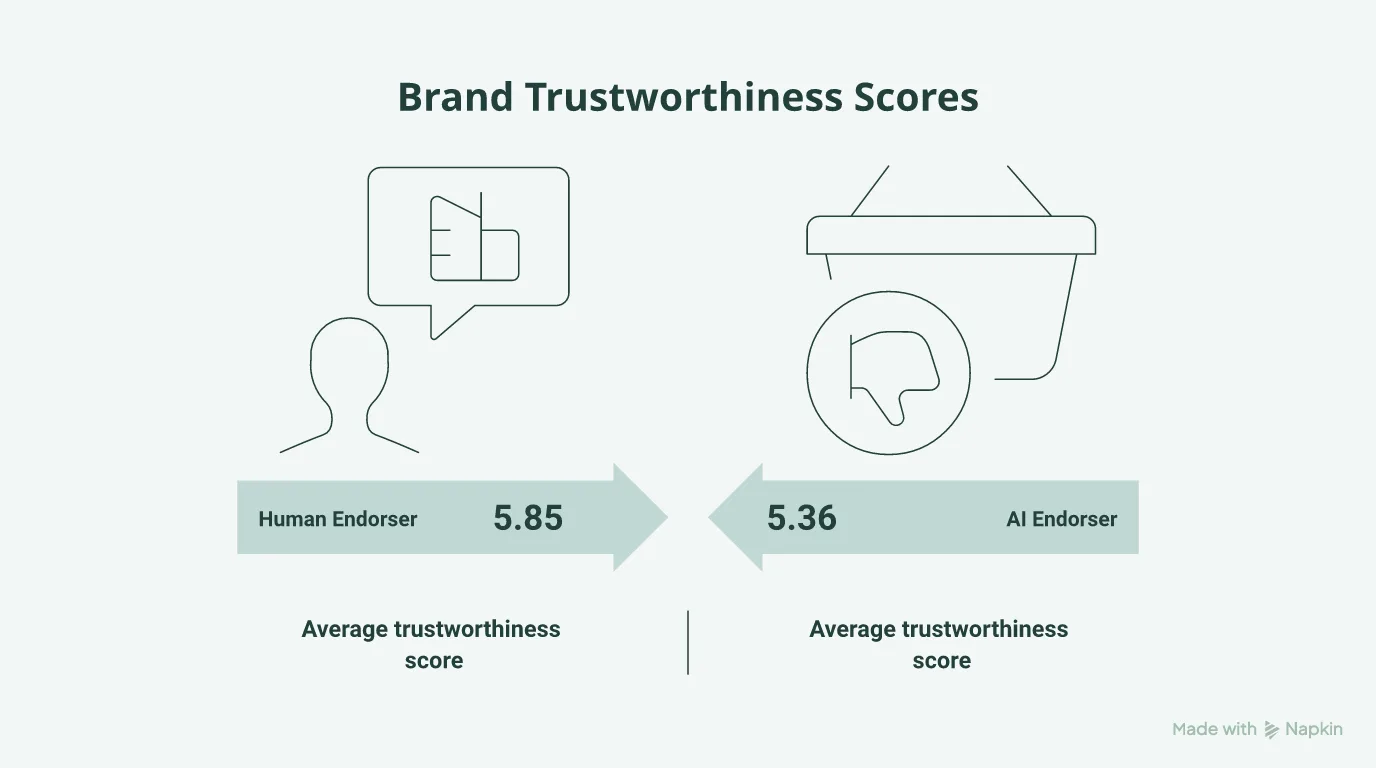
The findings revealed a systemic and measurable penalty across both studies. AI endorsements consistently drove lower perceived brand trustworthiness compared to human endorsements. In the first study, brand trustworthiness scored lower for AI (M=5.36) than for human endorsers (M=5.85). This deficit in trust subsequently led to lower overall purchase intentions for the endorsed products.
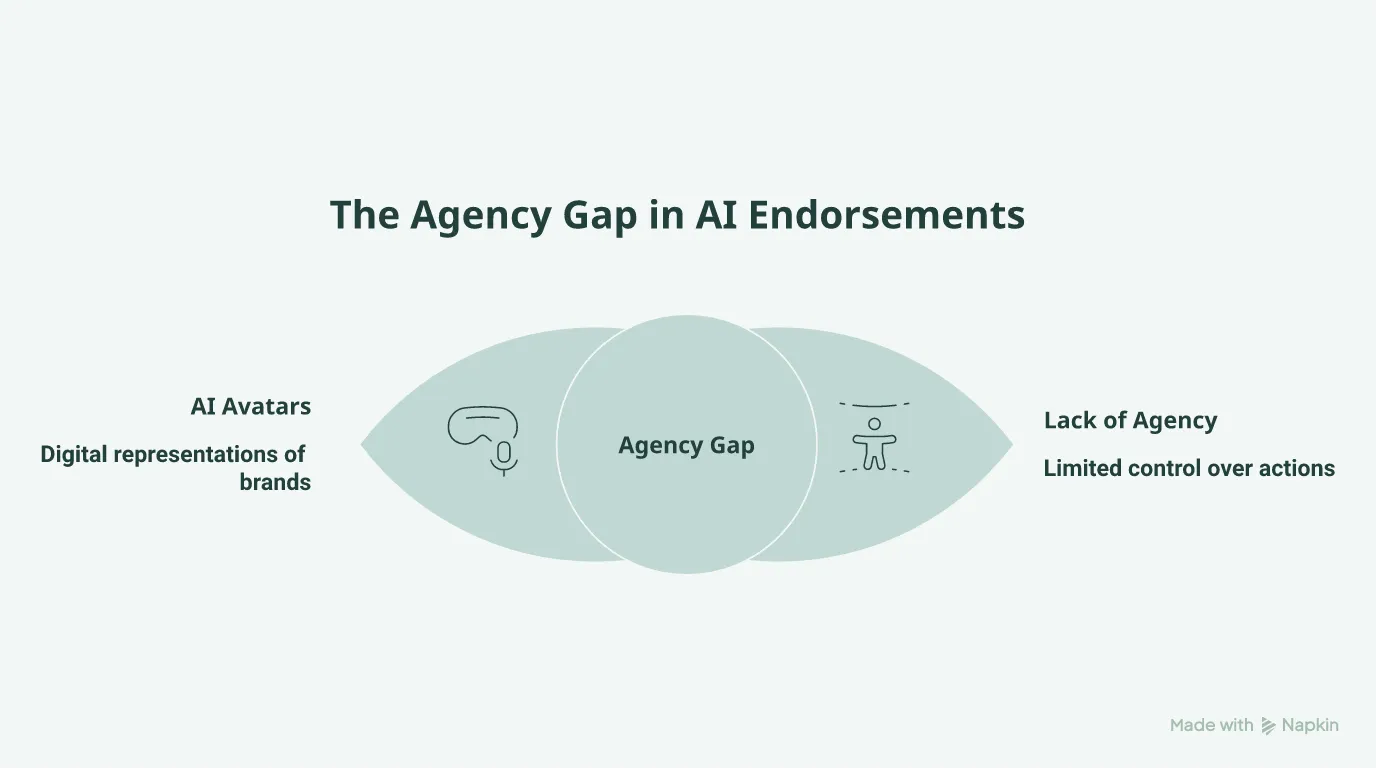
The underlying cause of this drop in trust challenges common assumptions about artificial intelligence and emotion. Consumers do not penalize a brand because a virtual avatar lacks human feelings or cannot physically taste food or feel the fabric of a shirt. The breakdown happens entirely around the psychological concept of agency. The researchers measured two dimensions of mind perception: experience and agency. They found that mind perception of agency strongly mediated the drop in trustworthiness with a significant indirect effect (b = -0.55). Mind perception of experience showed no significant mediation effect (b = 0.10).
Consumers evaluate AI influencers as entities fundamentally lacking the mental capacity to make independent judgments, critically evaluate a product, or take moral responsibility for false advertising. An endorser must possess the capacity to understand the consequences of a recommendation. Without that capacity, the endorsement carries zero weight. Agency encompasses critical traits like communication, morality, self-control, and planning. Because AI influencers are perceived to lack these fundamental traits, they cannot vouch for a product in any meaningful or trustworthy way.
Zhang and He (2025) also tested and ruled out alternative explanations for this trust deficit. They examined whether the negative response was driven by perceived brand expertise, the physical attractiveness of the endorser, or the overall fit between the endorser and the product. None of these factors proved significant in mediating the relationship between the AI influencer and the consumer’s purchase intention. The indirect effects through brand expertise (b = -0.02), endorser attractiveness (b = -0.03), and endorser-product fit (b = -0.03) all failed to reach statistical significance. The core issue remains firmly rooted in the lack of perceived agency and the resulting loss of brand trustworthiness.
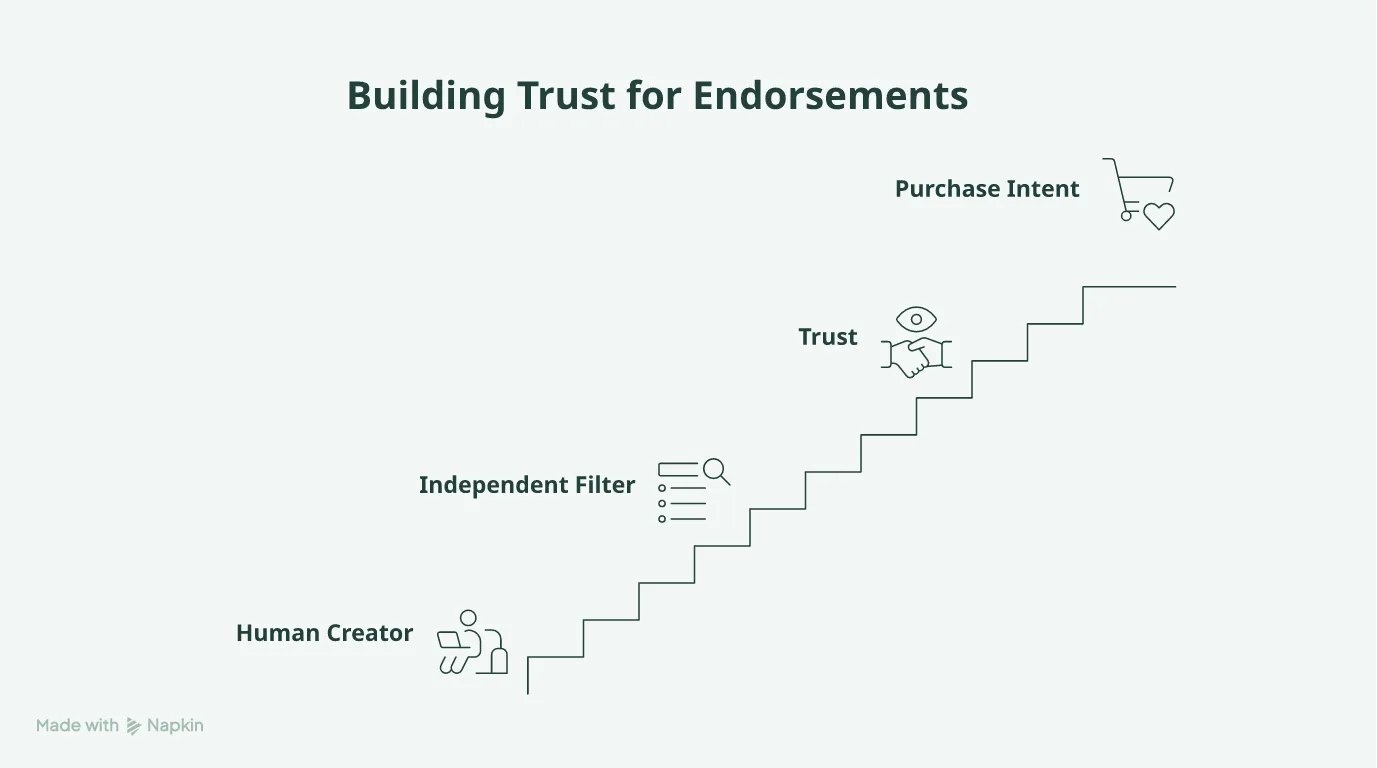
Choosing an endorser without real agency sends a specific and damaging signal to the broader market. Consumers interpret this choice as the brand actively avoiding third-party scrutiny. By selecting an AI influencer, the brand appears to select a perfectly controllable asset designed solely to rubber-stamp its marketing claims. This choice violates the psychological contract of an authentic endorsement, where the endorser is expected to act as an independent filter for quality. This dynamic directly impacts the principles of Designing Trust Into AI Products, where demonstrating independent verification must replace the traditional reliance on human intuition.
When a company uses AI influencers to bypass the reputational risks associated with human celebrities, they trade one vulnerability for another. Human influencers carry the risk of scandal and unpredictable behavior, but their endorsements carry weight precisely because they have reputations to lose. AI influencers carry zero risk of personal scandal, but they also have zero reputation to stake on the product. The psychological contract breaks down because the AI has nothing to lose if the product fails to deliver on its promises.
I would argue this dynamic requires a strict new approach for product teams deploying AI brand voices. The Agency Gap Rule dictates that if a brand deploys an AI avatar for endorsements or customer interactions, the brand must transparently implement independent verification to offset the cognitive resistance caused by the avatar’s lack of agency. You must build a comprehensive trust architecture around the AI to compensate for its inherent inability to bear moral responsibility.
Applying the Agency Gap Rule means acknowledging that you cannot smoothly swap a human for a hyperrealistic avatar and expect the social contract to hold. The brand must over-index on transparency, providing verifiable guarantees and third-party validation for every claim the AI makes. Building The Next Indonesian Wallet Is a Financial OS or expanding a digital footprint requires addressing this cognitive deficit head-on. Relying on an AI to generate authentic connection will backfire unless the product architecture simultaneously solves for the missing accountability. If the digital endorser cannot be held accountable for misleading the consumer, the brand itself carries the entire weight of proof.
References
- Zhang, Y. and He, A.-Z. (2025), ‘The impact of AI influencer endorsements on consumers’ purchase intentions: the serial mediating roles of mind perception and brand trustworthiness’, Journal of Product & Brand Management, Vol. 34 No. 5, pp. 754-765. https://doi.org/10.1108/JPBM-02-2024-4974
Frequently asked questions
Why do AI influencers fail to build brand trust as effectively as humans?
They lack perceived agency. Consumers intuitively know that an AI cannot make independent judgments, evaluate a product critically, or take responsibility for misleading claims, which strips the endorsement of its value.
Do consumers care that AI influencers lack real emotions or experiences?
Surprisingly, no. Research shows the lack of human experience (the inability to feel pleasure or pain) does not significantly drive the drop in trust. The penalty comes entirely from the lack of cognitive agency and accountability.
How should product teams adjust their strategy when using AI brand voices?
Teams must build a trust architecture around the AI. Since the AI cannot verify claims or hold the brand accountable, the brand must over-index on transparency, third-party verification, and clear guarantees to compensate for the missing psychological contract.