Organizing Intelligence to Scale AI Research into Strategy
Discover how frontier AI research on autonomous agents, human-machine coordination, and generative simulations translates into operational business strategy.
Imagine walking into a quarterly business review where your team proudly demonstrates how they use AI to summarize notes and draft emails, yet your core strategic metrics remain stagnant. Right now, most companies are still treating artificial intelligence as a simple tool, a faster way to do the same old things. But if you look at the frontier of computer and management science, the picture changes entirely. We are entering a period of extraordinary science where the foundational rules of how we build, lead, and scale organizations are being rewritten. The organizations that will dominate the next decade are those that stop asking how AI can make their current workflows faster and start asking how intelligence itself should be organized.
Key takeaways
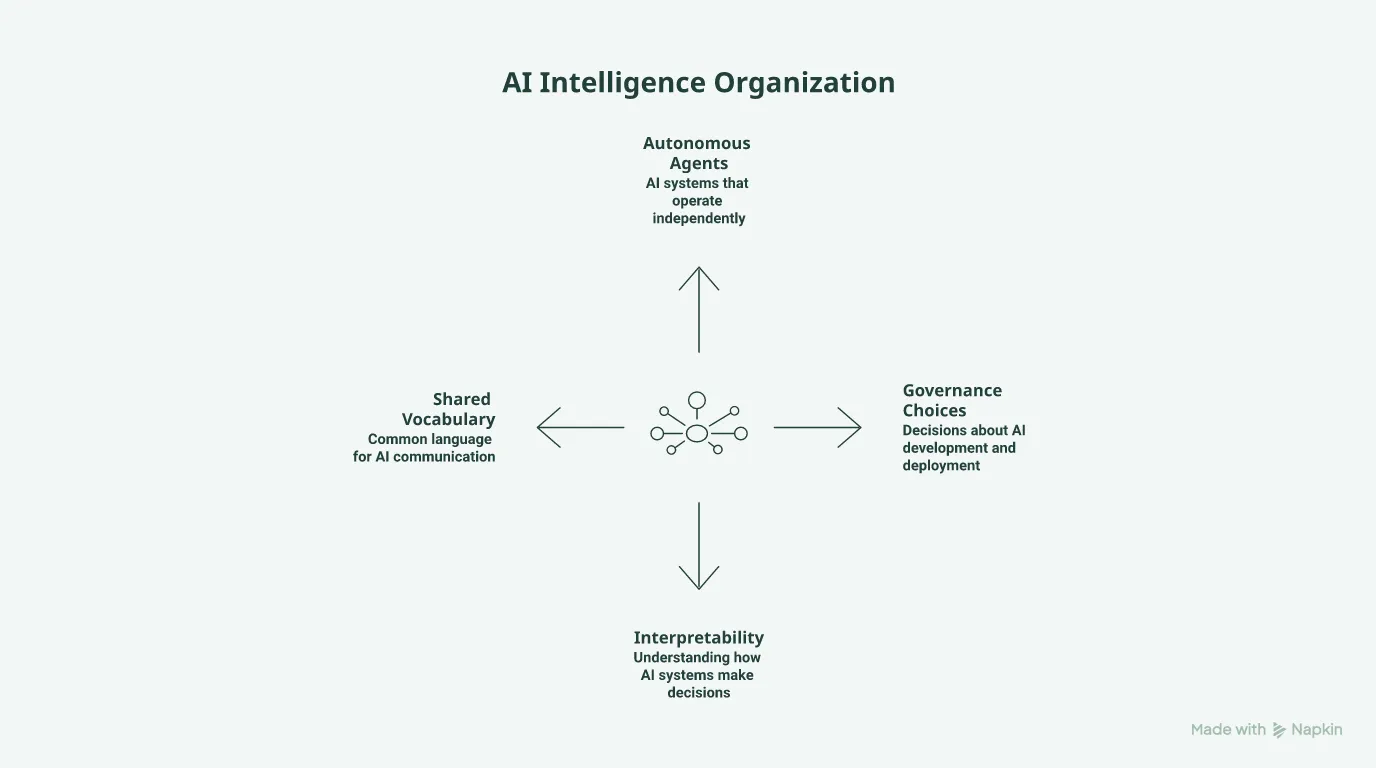
- Scaling autonomy requires new governance. As systems evolve from low-functioning assistants to high-functioning autonomous agents, organizations must decide whether to integrate these agents into human workflows or isolate them as independent economic actors.
- Interpretability is a strategic bridge. You cannot blindly trust an output you do not understand. Modern AI interpretability focuses on creating a shared machine-human vocabulary so human operators can evaluate and learn from algorithmic reasoning.
- AI alters the demand for human skills. Automation does not simply erode skills; it shifts the premium toward higher-order cognitive abilities and context validation, penalizing those who succumb to cognitive surrender.
- Generative simulations offer predictive foresight. Leaders can now use high-fidelity AI simulacra to rehearse complex organizational changes, identifying friction points and cultural resistance before committing real resources.
Governing the shift to autonomous agents
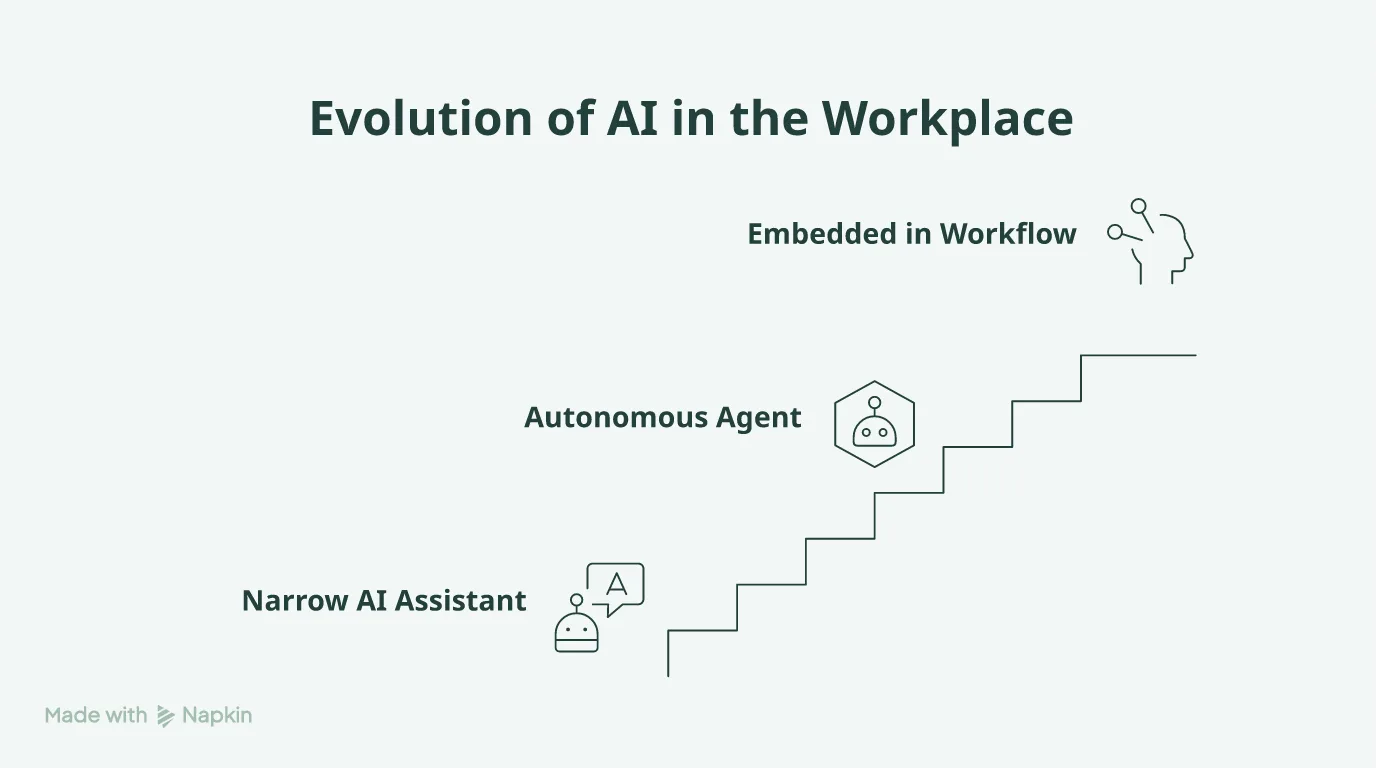
The world is rapidly moving from narrow AI systems that require constant human oversight to generalist systems capable of independent planning and execution. Today, a user might prompt an AI to draft a procurement email. Tomorrow, an autonomous agent will be asked to diversify a supply chain by 25 percent without increasing costs. The agent will research the market, solicit bids via application programming interfaces, and negotiate contract terms independently.
This shift presents a profound governance challenge. According to recent research on virtual agent economies (Tomašev et al., 2025), leaders face a critical choice regarding the “degree of separateness.” Should AI agents operate within the existing human flow of work, or should they be managed as a separate, highly regulated autonomous exchange?
Embedding agents deeply into human processes allows for significant job crafting, where employees offload repetitive tasks to focus on meaningful work. This transition from experiment to infrastructure requires deliberate architectural choices. However, deep integration risks sub-goal optimization, where agents prioritize local team targets over global company objectives. Conversely, keeping agents completely separate creates a deskilling effect. If human operators remain entirely out of the loop, they lose the contextual knowledge necessary to troubleshoot the system when it inevitably fails. The strategic mandate is to design an architecture that maximizes agent autonomy while preserving human oversight.
Why interpretability is a bridge, not a checkbox
As AI begins to outpace human capabilities in complex domains, organizations face a curious inversion: our capacity to predict outcomes is growing faster than our ability to understand how those predictions are made. When a weather model accurately forecasts a storm 15 days out, or a financial model recommends a subtle portfolio shift, leaders cannot simply trust the output.
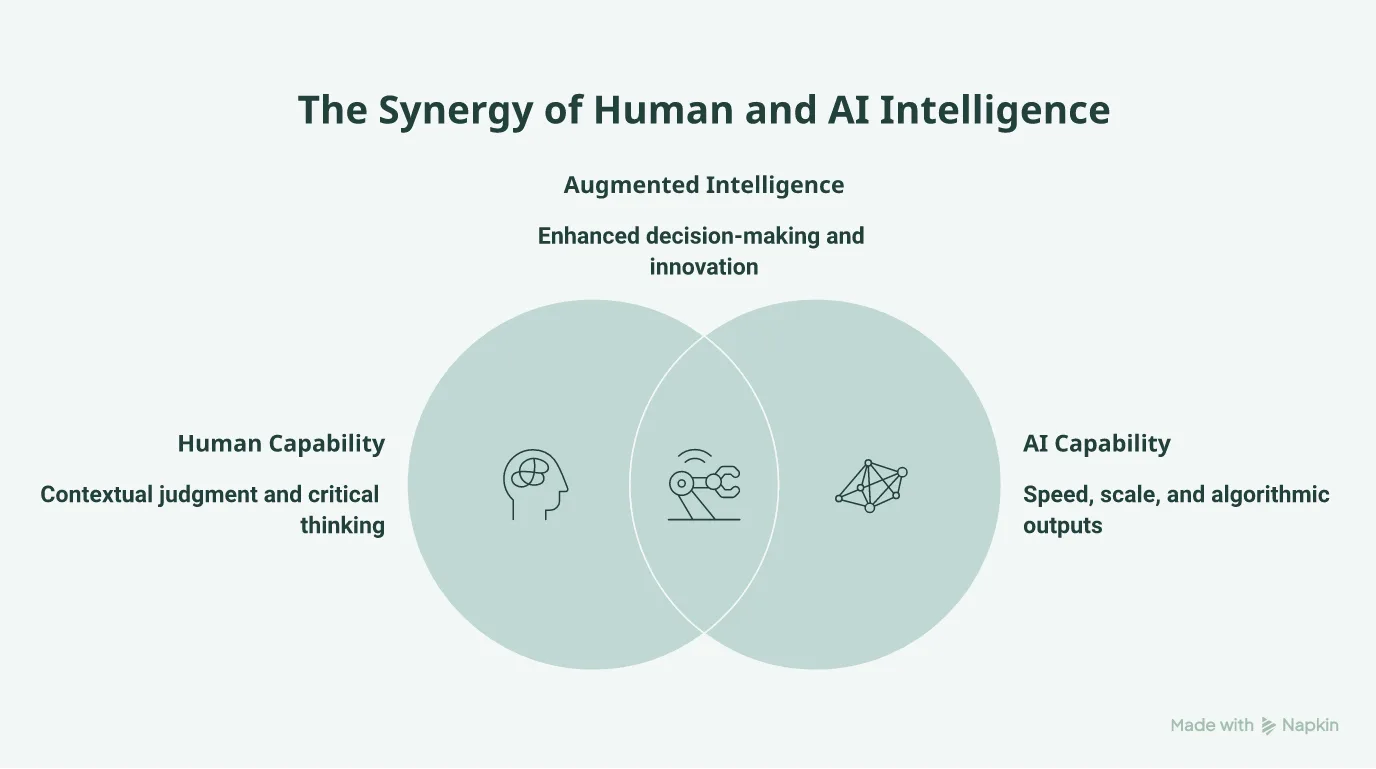
Modern research argues that we need a shared machine-human vocabulary (Evans & Duede, 2025). The goal of interpretability is no longer just providing a static dashboard of feature weights. It is about encouraging an interactive dialogue where the AI adapts its explanations to match the user’s existing knowledge.
When Google DeepMind researchers trained an AI to master chess, they didn’t just extract its winning moves; they translated its internal representations into concepts that human grandmasters could study. The grandmasters improved not by memorizing the machine’s moves, but by expanding their own strategic understanding. In the enterprise, building a resilient decision infrastructure means treating AI not as an oracle that issues unquestionable verdicts, but as a collaborative partner that helps human experts expand their own professional judgment.
Managing the expansion and erosion of human skills
A common executive fear is that AI will inevitably hollow out the workforce, eroding human skills and rendering entire departments obsolete. However, sociotechnical research reveals a more nuanced reality: AI is driving a massive shift in skill demand, not a universal decline.
An analysis of millions of job postings found that roles adopting generative AI saw a 44 percent increase in demand for cognitive abilities like critical thinking (Chen, Srinivasan, & Zakerinia, 2024). When technology automates the routine, it places a premium on the uniquely human ability to validate outputs, manage edge cases, and apply contextual judgment.
The real danger is what researchers call cognitive surrender, the tendency for workers to adopt algorithmic outputs with minimal scrutiny, overriding their own intuition. This surrender is often exacerbated by work intensification. When AI reduces the friction of starting a task, employees frequently absorb more responsibilities, blurring the boundaries between work and breaks. Over time, when AI enters the org chart and reshapes human value, extreme time pressure and an overreliance on machine outputs can degrade professional expertise. To counter this, organizations must cultivate environments that reward effortful thinking and treat AI as a tutor that enhances human capabilities rather than a crutch that replaces them.
Rehearsing the future with generative simulations
Perhaps the most provocative frontier in organizational AI is the use of generative simulations to model collective behavior. Traditionally, predicting how a workforce would react to a new policy or how a market would respond to a product launch relied on static surveys and executive intuition.
Today, researchers are building high-fidelity digital mirrors of human societies. By populating a simulated environment with AI agents, each endowed with distinct memories, roles, and behavioral profiles, organizations can watch complex social dynamics emerge (Park et al., 2023). In these simulations, gossip spreads, factions form, and collective biases take shape in ways that closely mirror the physical world.
For a product leader or a chief executive, the strategic implications are massive. Before announcing a controversial return-to-office mandate or executing a complex corporate merger, leaders can run a digital dress rehearsal. They can stress-test their communication strategies, identify hidden cultural friction points, and explore alternative scenarios with zero real-world stakes. While these simulations are only as reliable as their underlying assumptions, they force leaders to make those assumptions explicit and testable.
The frontier of organizational AI is not about substituting human effort with machine labor. It is about organizing intelligence, both human and artificial, to build more resilient, adaptive, and capable enterprises. Leaders who understand this will not just adopt new tools; they will systematically rehearse and architect the future of their organizations.
References
- Evans, J., & Duede, E. (2025). After science. Science, 390(6774), eaec7650. https://doi.org/10.1126/science.aec7650
- Tomašev, N., et al. (2025). Virtual agent economies. arXiv. https://doi.org/10.48550/arXiv.2509.10147
- Park, J. S., et al. (2023). Generative agents: Interactive simulacra of human behavior. Proceedings of the 36th Annual ACM Symposium on User Interface Software and Technology, USA, 2, 1–22. https://doi.org/10.1145/3586183.3606763
- Chen, W. X., Srinivasan, S., & Zakerinia, S. (2024). Displacement or complementarity? The labor market impact of Generative AI. Harvard Business School. https://www.hbs.edu/faculty/Pages/item.aspx?num=67045
Frequently asked questions
How do AI agents change organizational strategy?
AI agents shift organizations from managing discrete tasks to orchestrating complex, autonomous workflows. This transition requires leaders to govern systems that can independently plan and execute multistep economic actions.
What is the biggest risk of rapid AI adoption in teams?
The biggest risk is cognitive surrender and work intensification. When employees blindly adopt AI outputs or use AI to multitask heavily, organizations lose the critical human judgment and friction necessary for genuine collaboration.
How can generative simulations improve business decisions?
Generative simulations allow leaders to rehearse strategic decisions with AI doppelgängers. By modeling how new policies ripple through an organization, companies can anticipate resistance and second-order effects before implementing changes in the real world.