How AI Redefines Professional Identity in the Automation Era
AI adoption doesn't just change tasks, it destabilizes professional identity. Why change management focused only on skills transfer is failing the workforce.
You monitor the adoption dashboard for a new generative AI tool deployed to your operations team. The training was exhaustive. The interface is clean. The promised efficiency gains were mathematically sound and heavily validated in pilot testing. Yet the usage curve completely flatlines after week two. The common diagnosis from the leadership team is a lack of technical skills or poorly executed change management. They assume the team just needs more time or more training to get comfortable with the new interface. But what if the problem is much deeper than missing competencies?
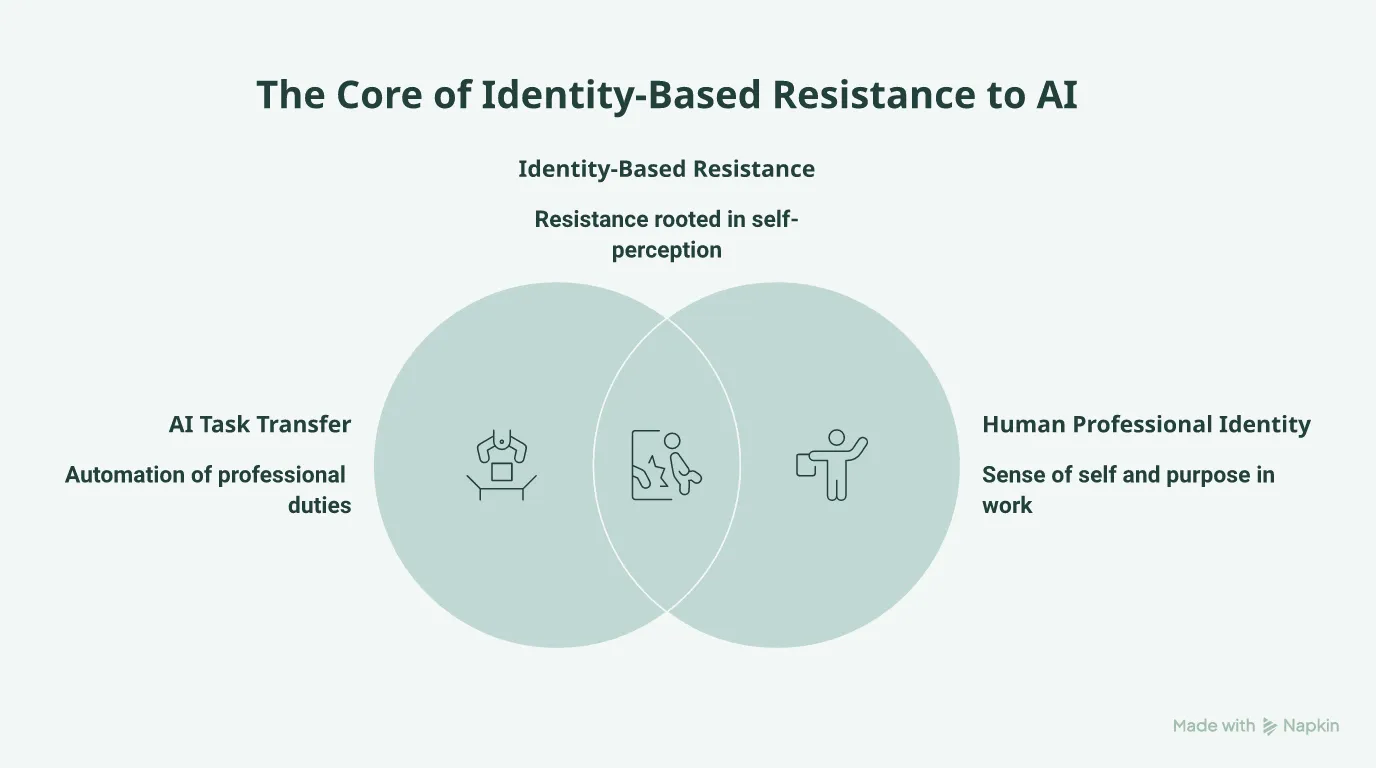
When we treat AI adoption as a simple transfer of tasks from human to machine, we miss the psychological core of work. We aren’t just changing what people do; we are destabilizing who they are. Organizations that design change management purely around task transfer will always struggle with adoption because they ignore the human need for professional significance and status. The crisis is not technological; it is deeply psychological.
Key takeaways
- Identity over tasks: AI adoption often stalls because it directly threatens the specific tasks that define a worker’s professional value and status, not because the new tool is difficult to operate.
- The autonomy gap: While enterprise operating models celebrate human-AI collaboration in theory, the reality on the ground often feels like a profound loss of human agency.
- The three-gate adoption check: A diagnostic framework for product leaders to evaluate whether a new AI deployment will trigger identity-based resistance and how to redesign the rollout to prevent it.
The Invisible Wall of Professional Identity
A 2026 report by QuantumBlack, McKinsey’s AI arm, outlines the rise of the “symbiotic enterprise,” suggesting that nearly 60 percent of work hours are theoretically automatable when cognitive and physical AI capabilities combine. The strategic goal is a flatter, more responsive organization where humans and AI agents contribute based on their respective strengths. On paper, it is a brilliant optimization of resource allocation that promises unprecedented productivity.
However, the execution of this vision often completely ignores how human professionals derive their identity. If you have spent ten years mastering a highly complex operational workflow, that hard-won expertise is your professional currency. It is what makes you indispensable to the organization and respected by your peers. When an agentic skill codifies that exact know-how into a reusable software component that anyone can trigger, it doesn’t just save time. It strips away the very thing that made the professional feel uniquely valuable. This shift directly changes what happens to human value when AI enters the org chart. As an analyst evaluating these massive enterprise deployments, I see this pattern constantly: the integration of AI frequently leaves seasoned operators feeling they have far less autonomy over their own professional growth and daily output. The tool isn’t seen as a helpful co-pilot; it is perceived as a direct threat to their professional pride.
Why Task-Based Change Management Fails
The standard assumption in tech leadership is that AI change management is primarily an exercise in retraining technical skills. We build extensive training modules to teach the team how to write the perfect prompt, how to review the AI’s output for hallucinations, and how to operate the new digital systems. We measure the success of the rollout by how quickly the team completes the certification process and logs into the new platform.
But I’d argue that retraining skills without reorienting identity is a guaranteed recipe for quiet resistance and systemic burnout. When you replace a high-status cognitive task, like drafting a complex strategic analysis, with a low-status supervisory task, like asking a senior analyst to simply review an AI’s drafted report for errors, the professional feels demoted, regardless of whether their title or salary changes. They aren’t rejecting the technology because they lack the intellectual skill to use it; they are rejecting it because they hate the new version of their job. This psychological rejection is exactly why the AI-heavy organization breaks traditional work incentives.
The United Nations Foundation’s 2026 analysis warns that AI diffusion alone can widen structural inequality if transition management isn’t deliberately built in from the start. I’d argue that at the organizational level, this transition management must go beyond economics to address the psychological toll of automation. If organizations only optimize for technological speed and cost reduction without considering how the daily experience of identity shifts, they invite the very displacement and inequality the UN report cautions against. A highly efficient process means absolutely nothing if the talented people required to run it are completely disengaged and planning their exit.
The Three-Gate Adoption Check
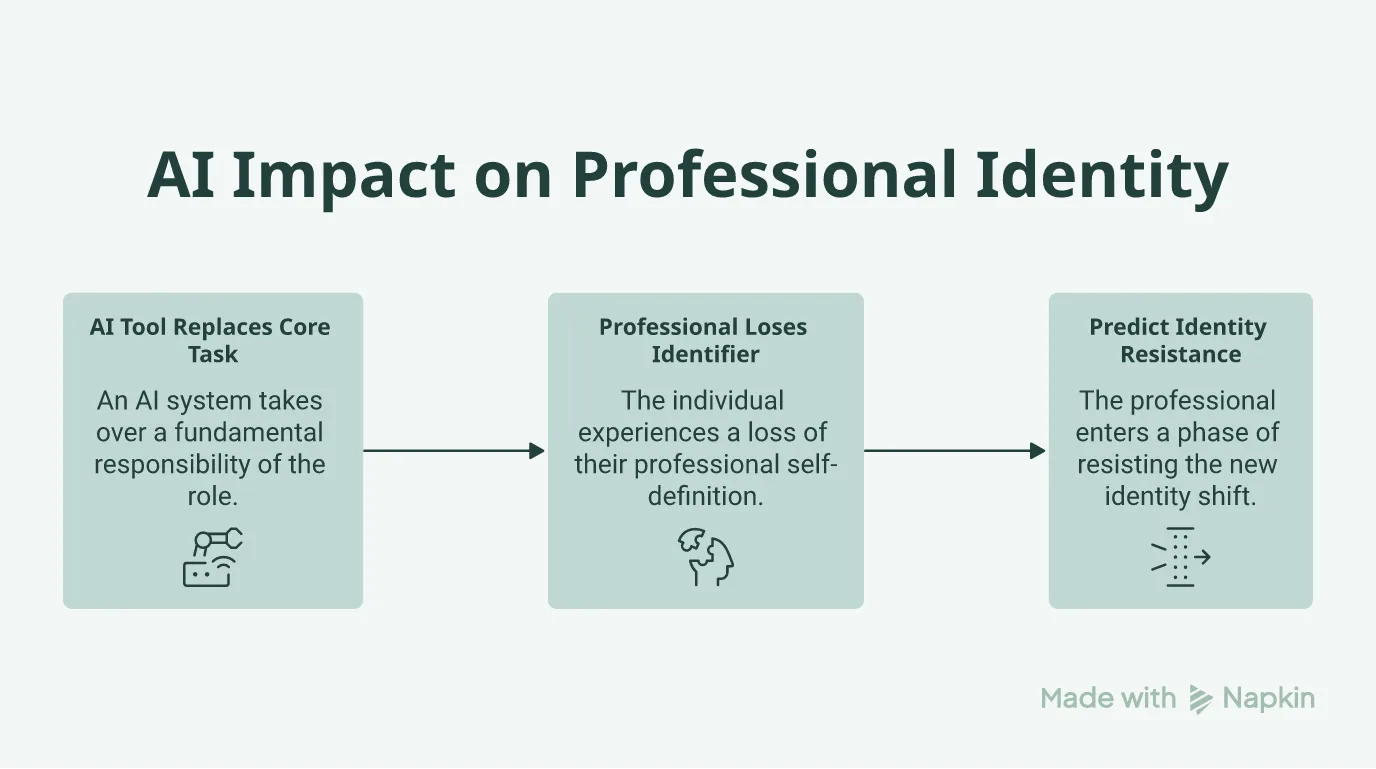
To fix this destructive dynamic, product leaders and executives must evaluate AI deployments through a fundamentally different lens. I use the three-gate adoption check, a framework to predict and manage identity-based resistance before it tanks a multi-million dollar rollout.
- Does this tool replace a core professional identifier? If the AI automates the exact task that defines the team’s pride, status, or unique value proposition, expect massive friction. You must proactively define what their new high-status contribution will be before the tool is ever introduced. If the AI writes the code, the developer’s new status must come from system architecture; if the AI drafts the copy, the writer’s status must come from strategic narrative design.
- Are we measuring success by task completion or expert retention? If the AI completes tasks 50% faster, but your most experienced and knowledgeable operators quit out of frustration, the deployment has failed. Track talent retention, team sentiment, and internal mobility alongside raw productivity metrics to get a true picture of the rollout’s success.
- Where is the new locus of autonomy? As the McKinsey authors note, realizing the symbiotic enterprise requires radically redesigning roles and redeploying talent. If the AI takes over the execution layer, you must give the human new autonomy over strategy, exception handling, or system governance. This requires redesigning people operations for an autonomous workforce.
Redesigning for the Locus of Control
The uncomfortable truth is that organizations that design change management purely around task transfer will inevitably lose their best people. The competitive advantage of the future won’t just be having the most advanced AI models; it will be building a corporate environment where human experts actually want to work alongside them.
If we want the symbiotic enterprise to work in practice rather than just in strategy decks, we have to stop treating professionals like legacy APIs that just need a new instruction manual. We have to intentionally design AI systems, and the workflows around them, that elevate human agency rather than eroding it. This deliberate design ensures that when the nature of the work changes, the intrinsic value of the worker does not. True change management is not about teaching someone how to use a tool; it is about giving them a compelling new professional identity to step into.
References
- Jansen, Christian, Daniele Chiarella, Kim Baroudy, et al. 2026. “The Symbiotic Enterprise: How cognitive and physical AI are reinventing enterprise execution.” McKinsey & Company.
- Melamed, Claire, and Paul Ladd. 2026. “People, Power, and AI: Rethinking Development for the New Era.” United Nations Foundation / United Nations Economic Commission for Europe.
Frequently asked questions
Why does AI adoption often face resistance even after extensive training?
Resistance usually stems from a loss of professional identity, not a lack of technical skills. When an AI system automates the core tasks that give an expert their status and pride, the professional often feels demoted to a supervisory role.
What is the three-gate adoption check?
It is a diagnostic framework for evaluating AI rollouts. It asks whether the tool replaces a core professional identifier, whether success is measured by expert retention alongside productivity, and where the new locus of human autonomy lies.
How should organizations change their approach to AI change management?
Organizations must shift their focus from mere task transfer and skills training to reorienting professional identity. They need to proactively define new high-status contributions for their employees and ensure human agency is elevated rather than eroded.