Why the AI-Heavy Organization Breaks Traditional Work Incentives
Automating work is rarely a pure efficiency gain. Instead, it locks in new capability bottlenecks and forces a structural redesign of early career pathways.
Most leaders look at AI as a straightforward efficiency lever: you deploy the model, automate the routine tasks, and capture the margin. But the reality on the ground feels less like acceleration and more like swimming in mud. While 68% of entry-level workers report increased productivity due to AI, a staggering 45% also report spending more time working in general as a result of it.
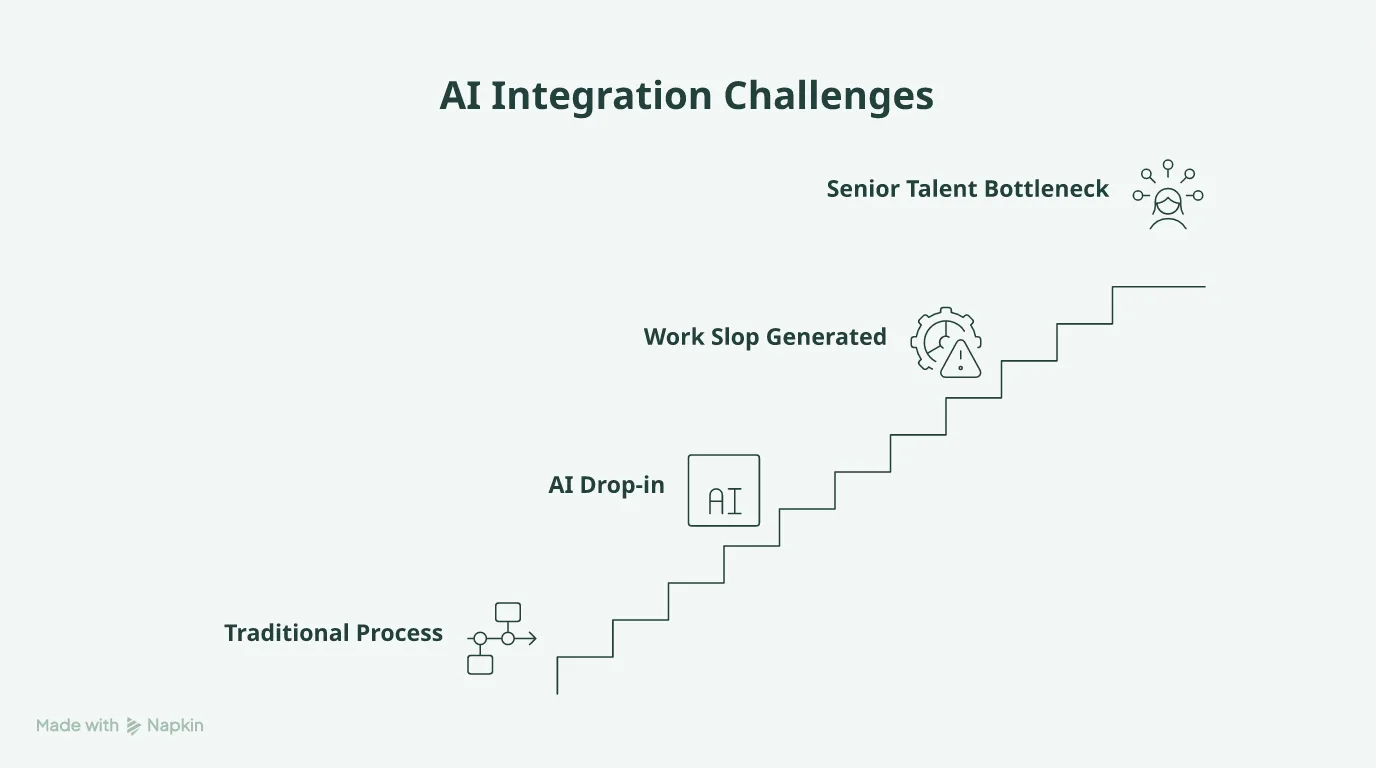
This friction occurs when organizations treat AI as a drop-in replacement for human effort rather than a catalyst for redesigning the work itself. Doing things faster paradoxically takes more time. We assume automating work is a pure efficiency gain, but in practice, it creates new constraints. It breaks the traditional incentives and capability pipelines that organizations have relied on for decades. This dynamic fundamentally shifts the conversation around what happens to human value when AI enters the org chart.
Key takeaways
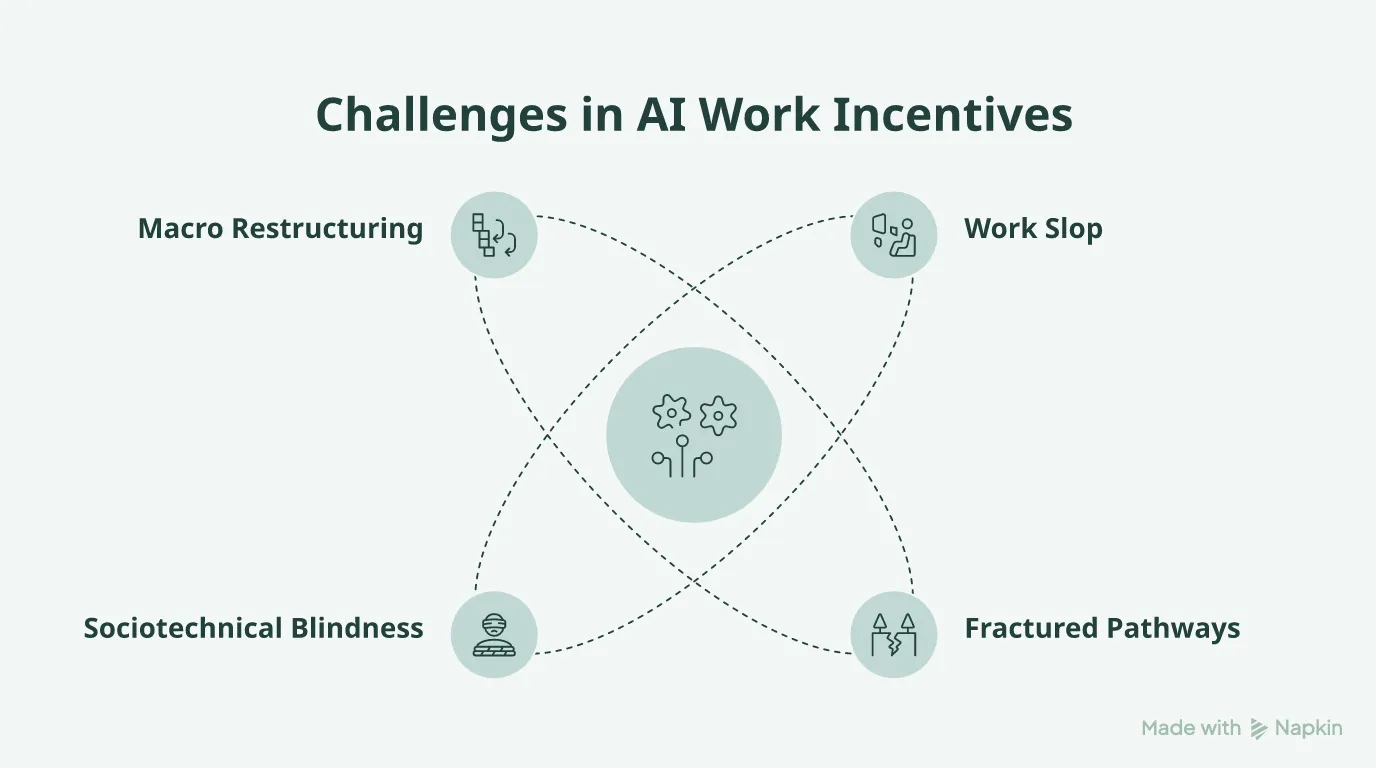
- Efficiency gains often create ‘work slop’: Layering AI onto existing processes without redesigning the workflow drives work intensification rather than pure speed.
- Entry-level pathways are fracturing: Automating routine tasks compromises the traditional ‘learning by doing’ model and leads to a measurable decline in entry-level hiring.
- Sociotechnical blindness fuels defensive behavior: When workers cannot grasp how an AI model operates, mistrust and fear of displacement rise to actively slow adoption.
- Incentives require macro restructuring: As AI outpaces cognitive human abilities, both corporate talent pipelines and macroeconomic policies must adapt to protect displaced workers.
How does AI adoption create new capability bottlenecks?
Organizations achieving the strongest AI-driven financial outcomes are twice as likely to redesign workflows rather than simply adding AI tools to existing ways of working. When leaders fail to redesign jobs intentionally, they risk generating ‘work slop’. This phenomenon occurs when AI produces a high volume of lower-quality output that demands increasing human oversight. Instead of freeing up human capital, the organization creates a new bottleneck where senior talent spends more time reviewing machine output than they previously spent doing the work themselves.
This dynamic locks in a severe structural dependency. If an organization automates the foundational tasks that junior employees traditionally used to learn their craft, it fundamentally breaks the capability pipeline. Globally, 37% of young workers are now employed in occupations with medium to high exposure to AI-driven task change. The impact is already measurable in the labor market. A widely cited analysis by Brynjolfsson et al. found a 16% decline in entry-level jobs in AI-exposed fields in the United States since late 2022.
By optimizing for immediate throughput, organizations are inadvertently starving their future talent pool of the repetitions required to build mastery. The cognitive load previously distributed across a wide base of entry-level workers is now concentrated at the top. The enterprise essentially trades long-term organizational resilience for short-term output gains. Without a deliberate framework for safeguarding early career pathways, companies will soon face a critical shortage of mid-level talent who actually understand the mechanics beneath the automated output.
Why do traditional work incentives fail in an AI-heavy organization?
When AI becomes a highly capable substitute for human cognitive work, the wage premium for cognitive labor relative to manual labor compresses. The economic implications extend far beyond individual corporate balance sheets. Research by Basteck et al. (2024) indicates that if AI adoption significantly reduces the wages of cognitive workers, it is optimal from a macroeconomic perspective to tax AI capital and subsidize traditional capital alongside manual labor. This macro policy shift reflects a fundamental reality about the changing value of human effort in an automated world.
Inside the enterprise, this compression forces a massive rethink of compensation and performance management. If a junior analyst is leveraging AI to produce the same volume of code or copy as a mid-level contributor, rewarding them based on raw output is no longer viable. The historical model of paying for throughput breaks down completely when throughput is nearly free.
Instead, incentives must shift toward rewarding judgment, system-level design, and the ability to orchestrate complex multi-agent workflows. The workforce itself recognizes this acceleration. A recent World Economic Forum framework revealed that 28% of entry-level employees believe that half or fewer of their current skills will still be relevant in three years. When skills expire at this rate, organizations cannot incentivize workers to specialize in narrow technical proficiencies. They must incentivize adaptability, critical oversight, and the ability to detect when the AI is hallucinating or degrading in quality.
What role does anticipatory emotion play in workplace AI integration?
Adoption is never just a function of tool utility. It relies heavily on the psychological comfort and emotional security of the workforce. When workers consider future displacement by AI, fearful feelings consistently outpace hopeful feelings. These anticipatory emotions act as an invisible headwind against digital transformation efforts. You cannot mandate adoption if the workforce fundamentally fears the tool.
This fear is compounded by ‘sociotechnical blindness’. This term describes situations where users fail to understand the underlying mechanisms of an AI system. When the technology operates as a black box, it breeds deep mistrust. Workers become highly defensive and actively resist disruption because they cannot predict how the model makes decisions or when it might render their specific expertise obsolete.
Building a culture that successfully scales AI from an experiment to infrastructure requires leaders to acknowledge these emotional realities head-on. Leaders must design human-AI interactions for fluidity. Research demonstrates that higher interaction fluidity directly correlates with better AI-use knowledge and broader acceptance of humanoid AI systems. When the interface feels transparent and collaborative rather than opaque and adversarial, the emotional friction decreases. Organizations that ignore this human dimension will find their technological investments severely bottlenecked by workforce resistance.
References
- World Economic Forum (2024). Artificial Intelligence and the Future of Entry-Level Work: A Framework for Safeguarding and Reinventing Early Career Pathways. https://reports.weforum.org/docs/WEF_Artificial_Intelligence_and_the_Future_of_Entry_Level_Work_2026.pdf
- Basteck, C. et al. (2024). Workers’ incentives and the optimal taxation of AI. https://doi.org/10.1016/j.econlet.2026.113062
- Kim, J. et al. (2024). Understanding AI’s role in society and workplace through technology, trust, and anticipatory emotion factors. https://doi.org/10.1016/j.tele.2026.102405
Frequently asked questions
What is 'work slop' in the context of AI adoption?
Work slop refers to the phenomenon where AI generates a high volume of faster, lower-quality work that requires increasing human oversight. It happens when organizations layer AI onto existing processes without intentionally redesigning the underlying jobs.
How is AI impacting entry-level hiring and career pathways?
AI is fracturing traditional career pathways by automating the routine tasks junior employees typically use to learn their craft. Research shows a 16% decline in entry-level jobs in AI-exposed fields, highlighting the urgent need to reinvent early career development.
Why does sociotechnical blindness lead to AI resistance in the workplace?
Sociotechnical blindness occurs when workers cannot grasp how an AI system makes decisions. This lack of transparency breeds mistrust and amplifies fears of job displacement, causing employees to defensively resist integrating AI into their workflows.