Investors Stopped Rewarding AI Announcements
Investors now discount AI announcements. To drive valuation, companies must prove AI transforms products and scales revenue under strict ROIC discipline.
In 2024, a product leader could report that their team had rolled out Copilot to engineering or integrated a vendor API, and the executive team would proudly frame it as AI strategy on the next earnings call. The market rewarded the ambition. It was a period of grace where the mere mention of generative AI signaled that leadership was forward-thinking. By 2026, that grace period is definitively over. The market has stopped rewarding AI announcements and started demanding AI evidence.
According to a 2026 McKinsey survey of intrinsic, long-only investors, 77% still rate AI and a clear technology angle as highly important to their investment thesis. In fact, when asked what characterizes a “winner” in 2026, AI adoption was the single most cited theme in open-ended responses. But there is a new, hardened skepticism in the data. Investors now rank “AI bubble risk” and “market concentration” among their top concerns for the overall investment climate. They are intensely aware of the difference between companies that are buying AI tools to subsidize inefficiency and companies that are extracting structural value from them to build moats.
Announcing an AI strategy is no longer a value signal to the market. What matters now is how deeply the technology changes the operating economics of the firm. When a product team transitions from reporting “we bought an AI tool for the marketing department” to “we shipped a probabilistic model that lowers customer acquisition costs by 15% and structurally changes our unit economics,” they start speaking the new language of the market. Investors are no longer listening for the word ‘AI’; they are listening for the impact of AI on the fundamental drivers of the business.
Key takeaways
- The market has stopped rewarding AI ambition and now demands evidence of integration that scales revenue or structurally changes operating economics.
- Private equity valuations reveal a massive gap between companies using AI for internal productivity (14x multiple) and those transforming their core products (20x multiple).
- Investors expect AI investments to face the same rigorous Return on Invested Capital (ROIC) discipline as M&A or organic reinvestment.
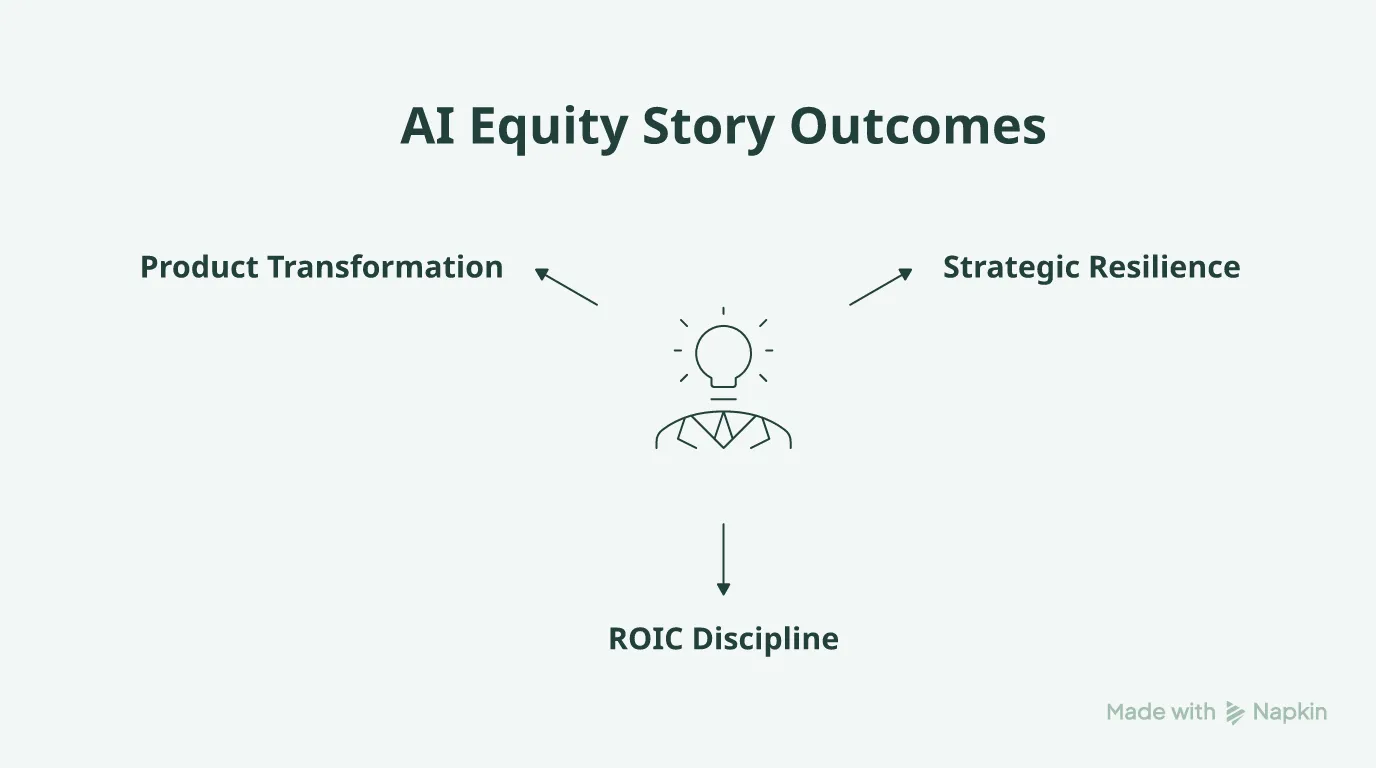
- Building a coherent AI equity story requires product leaders to demonstrate strategic resilience, traceable operating economics, and strict capital discipline.
The McKinsey analysis makes the shape of this valuation gap undeniably clear.
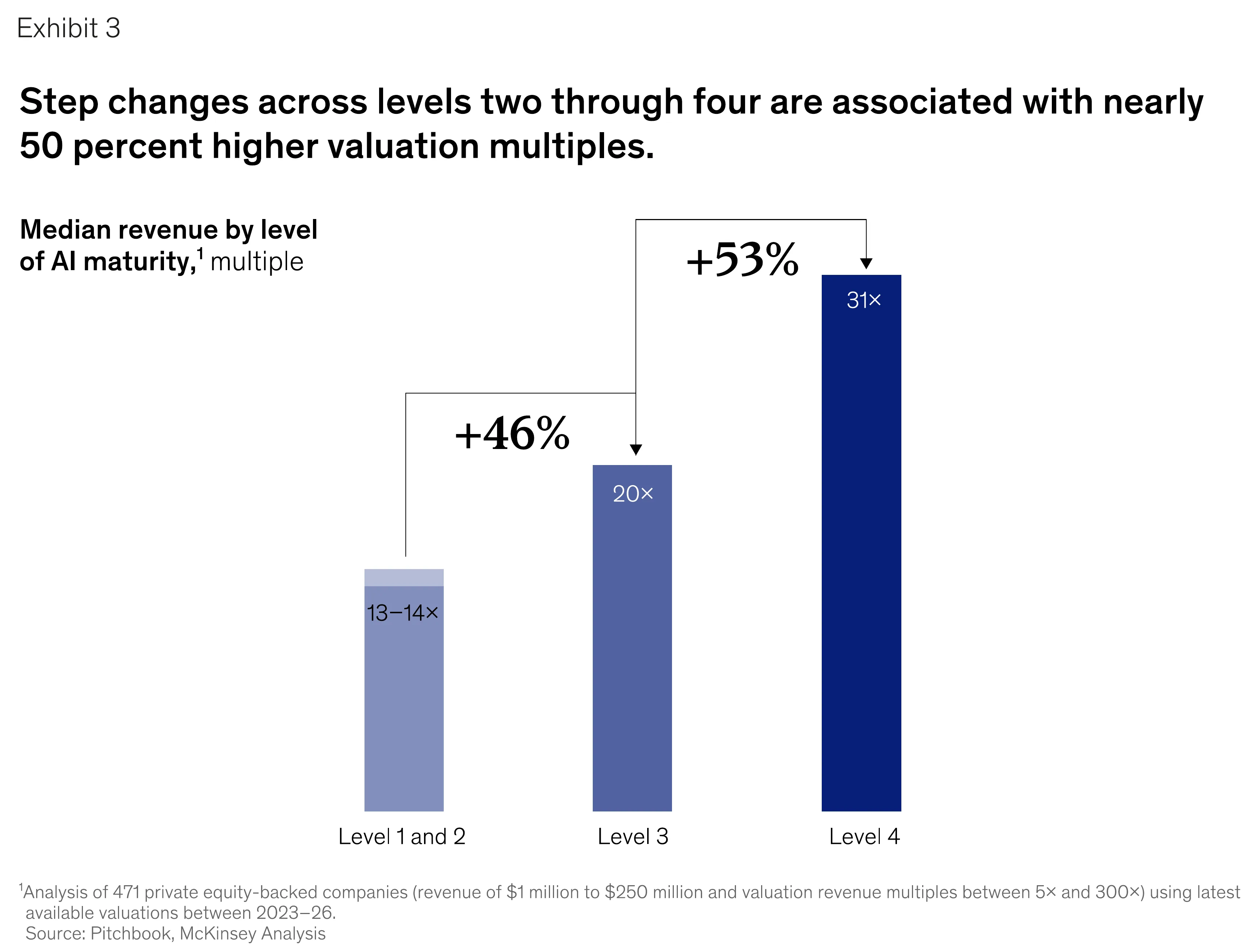
Exhibit 1. Median revenue multiples rise sharply as companies move from superficial AI adoption to core product transformation. Source: McKinsey & Company, 2026, Beyond productivity: How AI creates value in private equity, McKinsey & Company, p. 7.
The valuation gap in AI maturity
The market’s demand for hard evidence is most visible in private equity, where the mandate to drive rapid, measurable value creation forces a ruthless look at AI return on investment. In public markets, AI narratives can sometimes drift on sentiment, but private equity requires a clear path to cash flow. A 2026 analysis of 471 private equity-backed companies across 31 industries reveals that the market heavily discounts superficial AI adoption and dramatically rewards structural integration.
The research classifies companies into four distinct tiers of AI maturity, with clear valuation impacts for each:
- Opportunistic adoption (Level 1): These companies run ad-hoc experiments and rely on basic productivity tools, often without centralized governance or a clear link to strategy (median revenue multiple: 13x).
- Operating-model enhancement (Level 2): These firms are embedding AI to streamline internal workflows and scale output without proportional headcount growth. They use AI to make existing processes faster (median revenue multiple: 14x).
- Product transformation (Level 3): Companies at this level are embedding AI into the actual products and services sold to customers, changing the value proposition (median revenue multiple: 20x).
- Business building (Level 4): These organizations are launching entirely new AI-driven business lines, platforms, and data monetization streams (median revenue multiple: 31x).
The most striking finding from this data is the negligible difference between Level 1 and Level 2. The market does not materially reward companies that use AI merely to make their existing internal operations slightly more efficient. An extra point on a revenue multiple is barely a rounding error compared to the capital expenditure required to deploy enterprise AI. Valuations only break out when AI changes what the company sells, moving into product transformation, which drives a massive 43% leap in the revenue multiple.
When companies reach Level 4 and build entirely new businesses on top of AI capabilities, the financial profile of the firm fundamentally shifts. At the highest level, companies also see their median revenue per employee jump by 52% to $180,000. This proves that revenue streams anchored in AI are fundamentally more scalable than human-led services alone. Investors are willing to pay a premium for that scalability, but they will not pay a premium for a slightly faster marketing team.
Survey data confirms that investors are falling back on their most reliable defense mechanism.
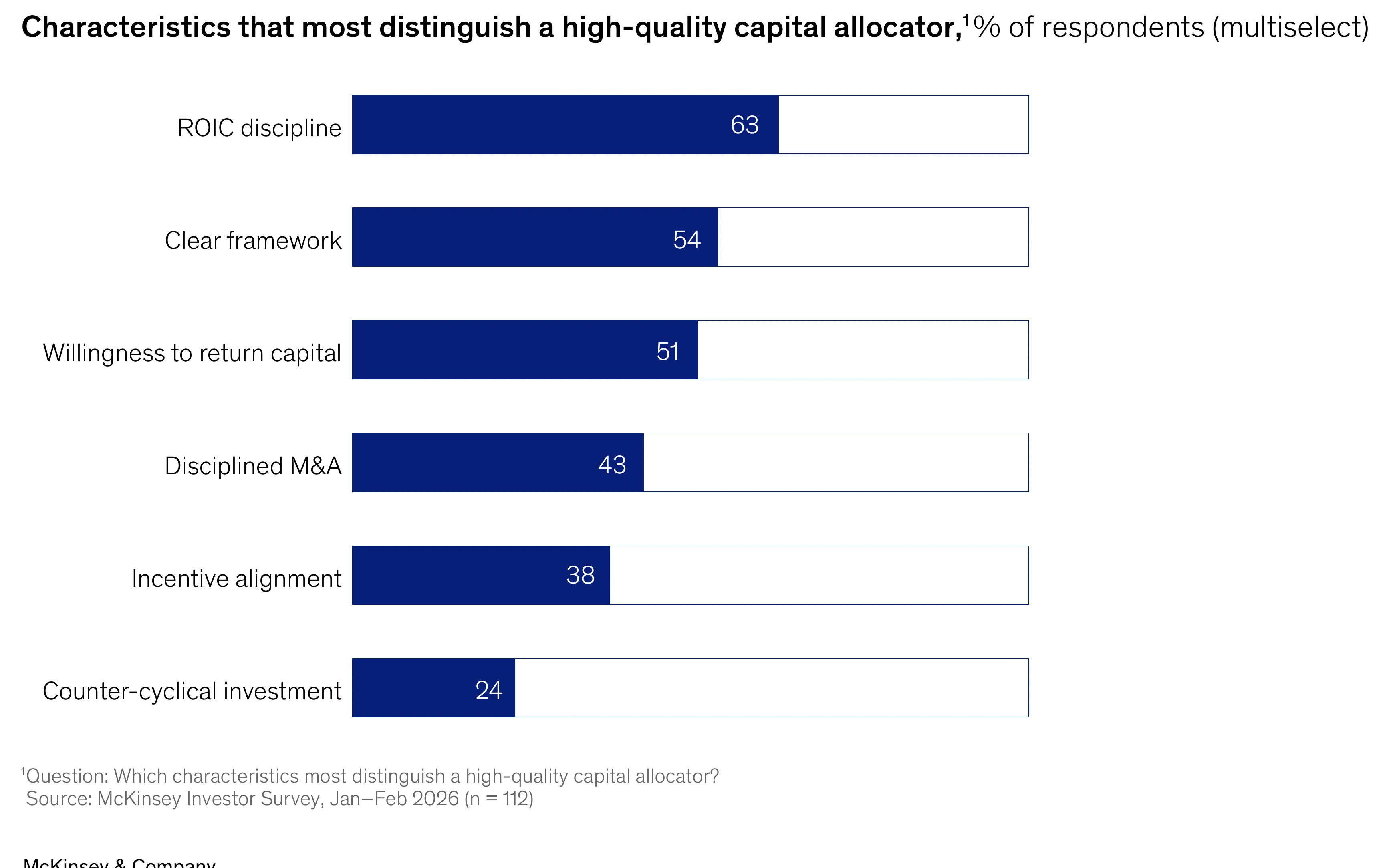
Exhibit 2. ROIC discipline is the most frequently cited characteristic of a high-quality capital allocator among surveyed investors. Source: McKinsey & Company, 2026, What matters most to investors in 2026 and what it means for companies, McKinsey & Company, p. 11.
ROIC discipline as the ultimate filter
As the fear of an AI bubble grows, investors are applying their most reliable historical defense mechanism: capital allocation discipline. In past hype cycles, from the dot-com era to the early days of cloud computing, the companies that survived and delivered outsized returns were those that maintained a rigorous focus on capital efficiency. For 63% of investors surveyed in 2026, Return on Invested Capital (ROIC) discipline is the hallmark of a high-quality capital allocator.
Investors want to see that a company’s AI initiatives are not exempt from the rules that govern the rest of the business. A strong AI narrative is only credible when it is tightly tethered to margin improvement, productivity gains that translate to the bottom line, improved customer acquisition economics, or a defensible technical moat. The strongest signal a management team can send today is that AI investment is governed by the exact same strict ROIC framework as M&A, dividends, or organic reinvestment. They need to prove that this framework holds up even under macroeconomic stress. If an AI project cannot clear the hurdle rate, it should not be funded, no matter how technologically impressive it might be.
Building for the 2026 market
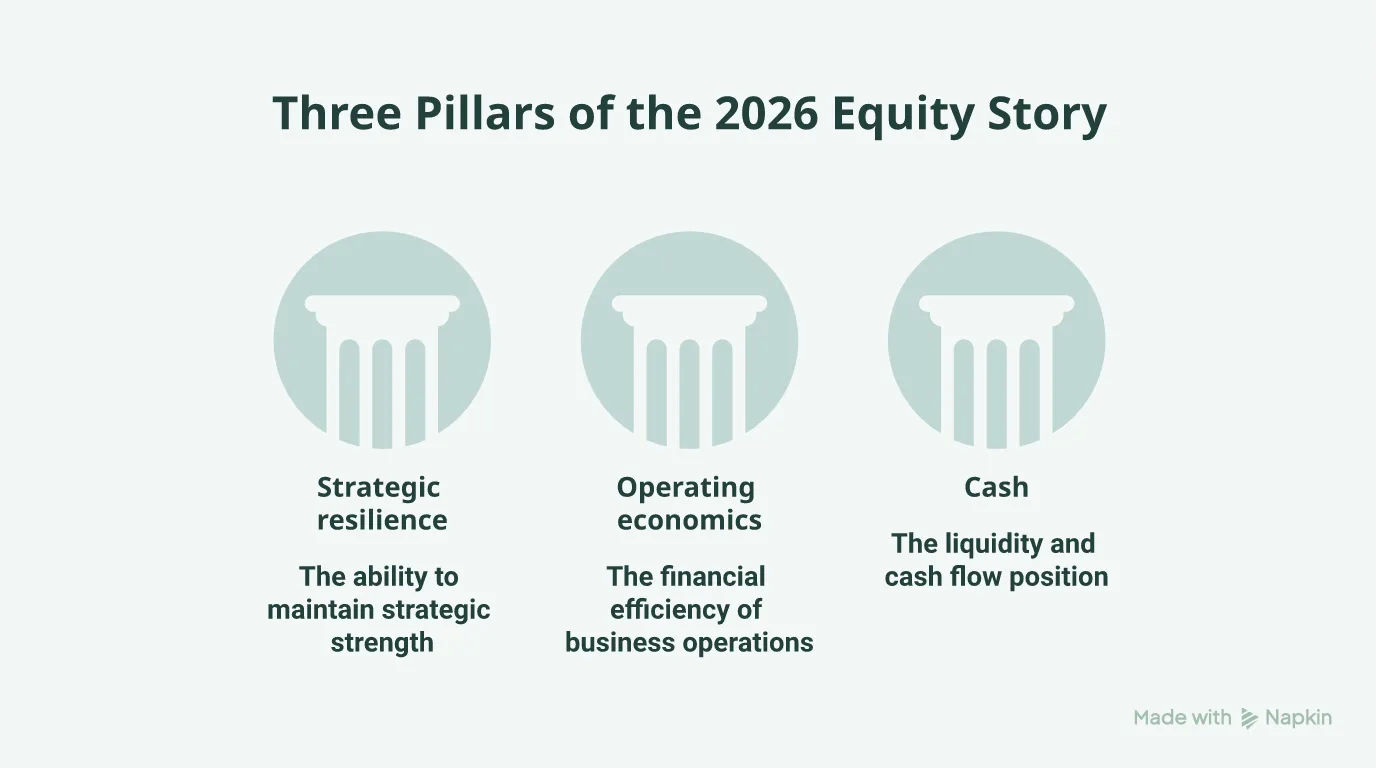
To capture long-duration investor commitment, product and engineering leaders need to move past tactical AI integrations and build a coherent equity story. This requires a shift in how product roadmaps are designed and communicated. The new equity story must be built on three unshakeable pillars:
- Strategic resilience: The ability to make bold, calculated bets amid geopolitical and economic uncertainty, rather than just reacting defensively. Geopolitics is overwhelmingly the top macro concern for investors in 2026, with 69% placing it among their top three influences on investment decisions. Investors expect companies to navigate this volatility without losing focus on long-term value creation. An AI strategy that relies on fragile supply chains for compute or data will be heavily discounted.
- Operating economics: A clear, traceable line from AI investments directly to the profit-and-loss statement. Engineering leaders must be able to draw a straight line from their architectural choices to the company’s gross margins. If a new language model increases compute costs, the product must simultaneously increase customer retention or command a higher price point to justify the expense.
- Cash and capital discipline: The rigorous allocation of capital toward AI initiatives that structurally transform products and build new businesses, rather than merely subsidizing internal productivity. Every dollar spent on AI infrastructure is a dollar that could have been returned to shareholders. The burden of proof is on product teams to show that the internal reinvestment generates a higher yield.
Companies still writing announcement-shaped disclosures are optimizing for a market that no longer exists. The grace period for AI tourism is over. The winners in 2026 are those that treat AI not as a messaging strategy, but as the core engine of their business strategy. They understand that the technology is only as valuable as the economic reality it creates.
References
- McKinsey & Company (2026). What matters most to investors in 2026 and what it means for companies.
- McKinsey & Company (2026). Beyond productivity: How AI creates value in private equity.
Frequently asked questions
Does announcing new AI initiatives still boost a company's valuation?
No. By 2026, investors have stopped rewarding AI ambition and instead demand evidence of AI integration. The market requires a traceable link between AI investments and improved operating economics or new scalable revenue streams.
How does AI maturity affect revenue multiples in private equity?
There is a massive valuation gap between companies using AI for internal productivity (14x median revenue multiple) and those using it for product transformation (20x) or entirely new business building (31x). The market heavily rewards AI when it changes what a company sells, not just how it operates.
What is the most important metric investors look for when evaluating a company's AI strategy?
Return on Invested Capital (ROIC). Investors expect AI investments to be governed by the same strict capital allocation discipline as M&A or traditional reinvestment, proving that the technology is driving measurable financial returns rather than feeding a bubble.