Redesigning People Operations for an Autonomous Workforce
When AI becomes a workforce rather than just a tool, incremental HR adaptations fail. CHROs must redesign hiring and progression for the symbiotic enterprise.
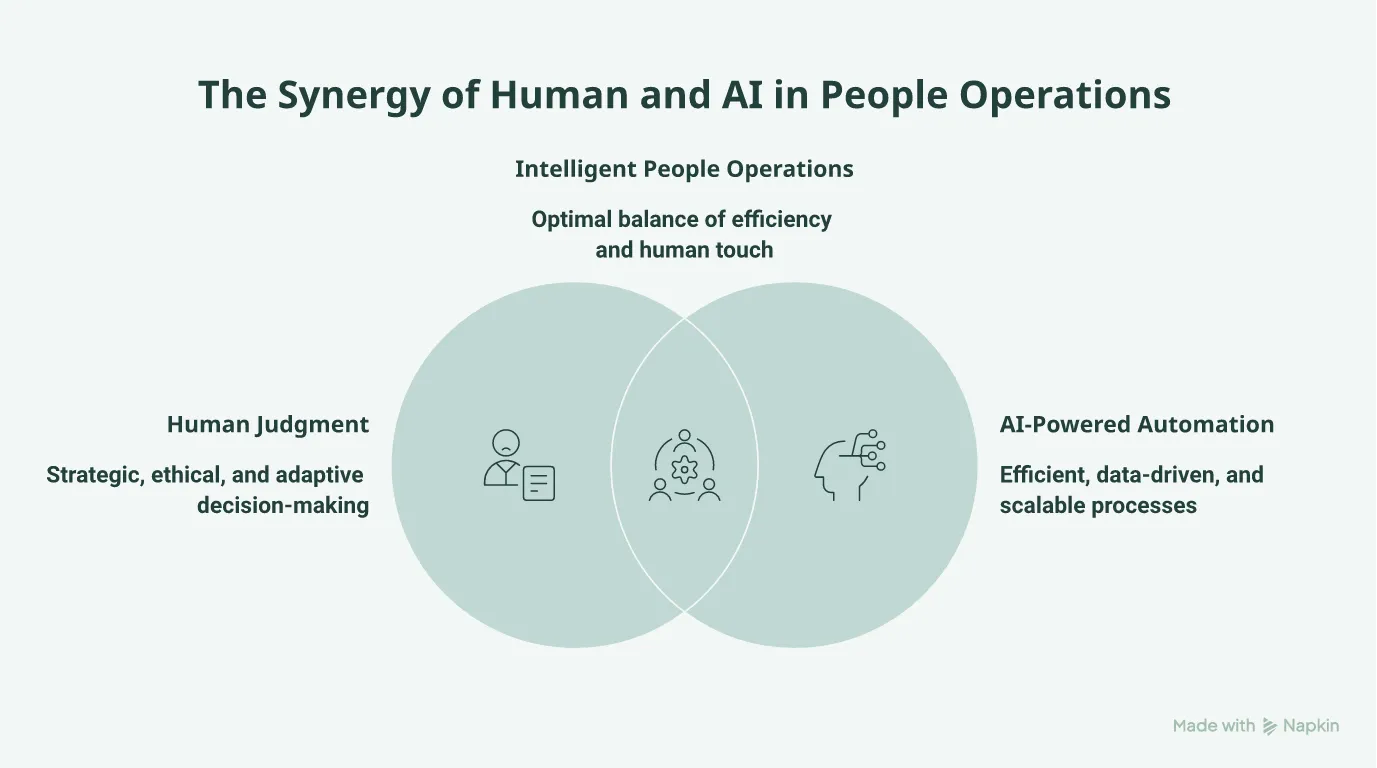
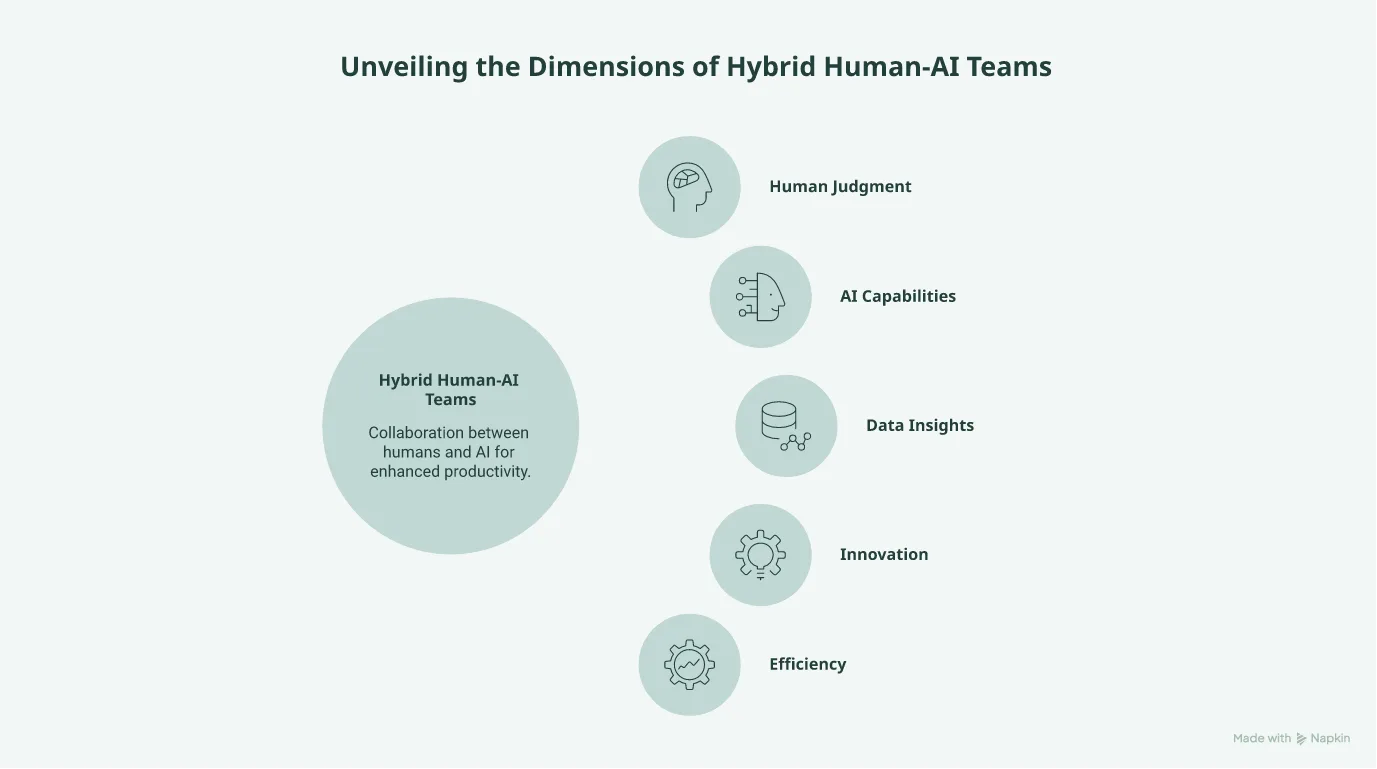
Artificial intelligence adoption is largely driven by product and engineering teams focused on execution speed. But the structural consequences of those decisions land squarely on the desk of the Chief Human Resources Officer. When AI advances from a supportive tool to a professional-grade execution layer, the enterprise becomes what McKinsey terms a “symbiotic enterprise”, an organization where humans, AI agents, and intelligent robots contribute side-by-side. The foundational unit of execution is no longer the individual employee. It is the hybrid human-AI team.
Human resources frameworks built entirely for human workforces fail in this environment. Adapting them incrementally is a severe undercorrection. The organization needs a completely new decision architecture to manage job access, role design, and talent pipelines.
The Collapse of the Entry-Level Apprenticeship
The most immediate structural crisis is the hollowing out of early career pathways. A 2026 World Economic Forum report highlights that 37% of young workers globally are employed in occupations with medium to high exposure to AI-driven task change. In knowledge-intensive sectors like financial and professional services, entry-level hiring slowdowns are already evident. Cognitive AI handles the routine information processing tasks that typically serve as the entry point for new talent.
When organizations eliminate these junior roles to capture short-term efficiency gains, they sever their future capability pipeline. The traditional “learning by doing” apprenticeship model breaks down. Without these foundational roles, the organization loses the training ground required to develop the strategic judgment and domain expertise demanded of senior leaders. Furthermore, the WEF report notes that 28% of entry-level workers believe that half or fewer of their current skills will still be relevant in three years, and while 68% report productivity increases due to AI, 45% actually report spending more time working. This indicates that AI is intensifying work and accelerating skill decay rather than simply replacing tasks.
Safeguarding these pathways requires intentionally redesigning entry-level work. Organizations must shift the focus of these roles from direct task execution to AI orchestration, exception handling, and critical evaluation.
The Automation Succession Rule
To prevent the erosion of future talent pipelines, CHROs should implement a firm decision boundary: The Automation Succession Rule.
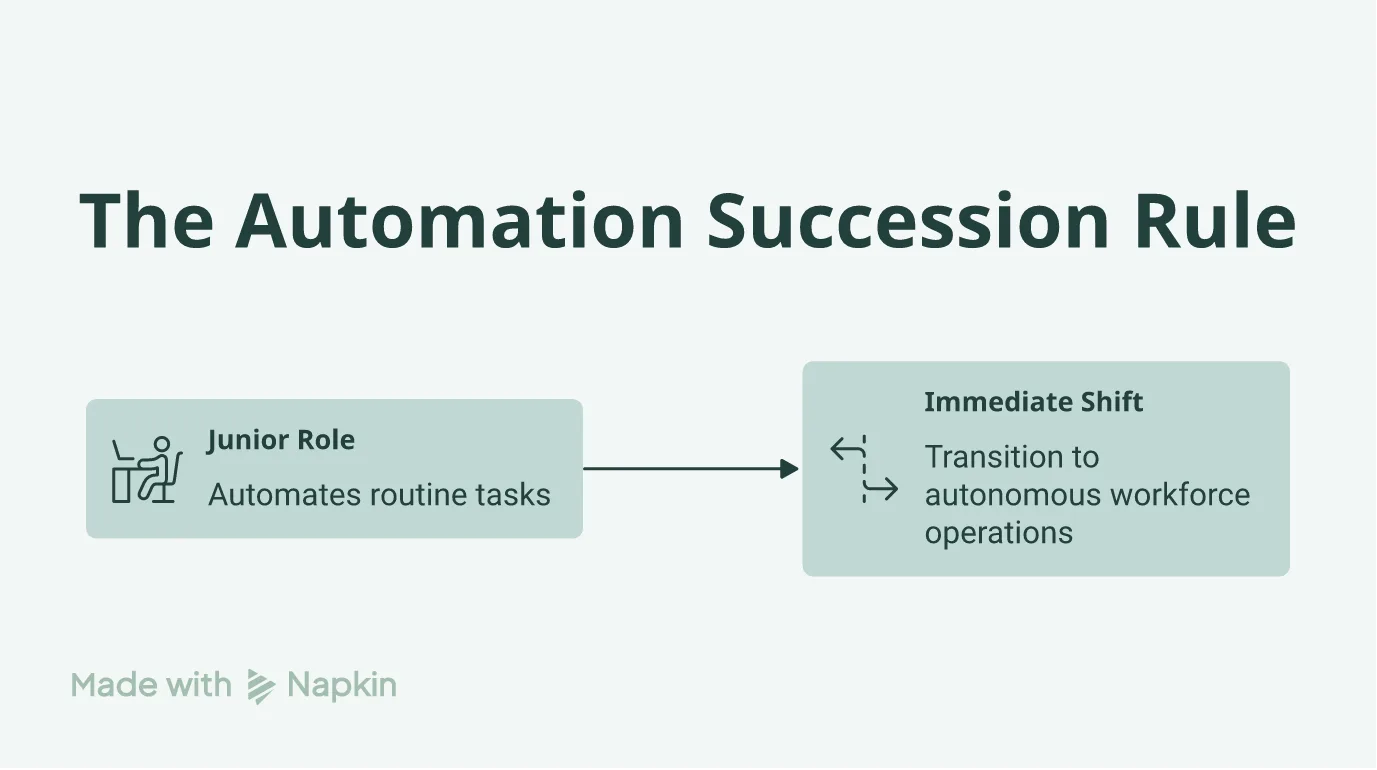
The rule dictates: Never automate an entry-level cognitive task unless the role is simultaneously redesigned to govern the output of that task.
If an AI agent takes over drafting code, the junior developer role must immediately shift to reviewing, testing, and directing the agent’s output. If a claims processing system is automated, the junior analyst role must evolve to handle exceptions and monitor the AI’s decision boundaries. The organization must intentionally preserve the learning loop. If a role cannot be redesigned to govern the automated work, the automation should be flagged as a strategic risk to future capability. This rule ensures that efficiency gains do not come at the expense of organizational learning.
Shifting Incentives and the Flattening Pyramid
As AI substitutes for human cognitive work, the fundamental economics of the workforce shift. Research by Growiec et al. (2026) constructs a dynamic taxation model revealing a critical threshold. Once AI becomes sufficiently capable of substituting humans across cognitive tasks, cognitive workers lose their labor-market advantage relative to manual workers. The model indicates that it becomes socially optimal to tax AI capital while subsidizing traditional capital and manual labor. This theoretical reversal highlights the extreme disruption coming to white-collar incentive structures. The assumption that cognitive labor will always command a premium over manual labor is fundamentally challenged.
This macro-economic shift mirrors the internal dynamic of the enterprise: the value of routine cognitive execution plummets, while the premium on judgment, cross-functional orchestration, and physical adaptability rises.
When agentic systems can autonomously coordinate workflows across boundaries, the need for extensive middle-management coordination layers evaporates. The pyramid structure is replaced by a flatter network of outcome-oriented teams. McKinsey points out that up to 60% of work hours are theoretically automatable, giving rise to operating models like the “two-shift factory” in software development: human developers take the day shift to define specifications and set guardrails, while specialized AI agents take the night shift to execute coding and testing. For the CHRO, this means traditional, step-by-step career progression models are obsolete. Organizational capability must be built through non-linear movement and diverse project exposure rather than hierarchical sequence.
Rebuilding the Decision Architecture
To manage a workforce augmented and partially replaced by AI, CHROs must reconstruct the organization’s people operations. This involves three critical pivots:
- Redefining Performance: Performance expectations must shift from human output to AI orchestration. Employees should be assessed on how effectively they direct AI tools to accelerate delivery, rather than how fast they type or research. The metric is leverage, not sheer effort.
- Skills-Based Progression: As the traditional hierarchy flattens, progression becomes harder to interpret. Organizations need a skills-based architecture that codifies AI capability and makes progression visible outside of management tracks. This ensures that the AI-heavy organization does not break traditional work incentives.
- Cross-Generational Capability Transfer: AI adoption is not purely a technical challenge. Pairing digital fluency with institutional knowledge, such as through multi-generational mentoring tandems, ensures that the judgment required to supervise AI systems transfers successfully to the next generation.
The CHRO’s mandate is no longer limited to managing human capital. It is architecting the relationship between human judgment and machine execution.
References
- World Economic Forum in collaboration with PwC. (2026, June). Artificial Intelligence and the Future of Entry-Level Work: A Framework for Safeguarding and Reinventing Early Career Pathways. https://www.weforum.org/publications/artificial-intelligence-and-the-future-of-entry-level-work/
- Jansen, C., Chiarella, D., Baroudy, K., Hämäläinen, L., Van der Veken, L., Schaubroeck, R., Lacroix, S., Bout, S., & Dagorret, G. (2026, June). The symbiotic enterprise: How cognitive and physical AI are reinventing enterprise execution. QuantumBlack, AI by McKinsey. https://www.mckinsey.com/capabilities/quantumblack/our-insights/the-symbiotic-enterprise-how-cognitive-and-physical-ai-are-reinventing-enterprise-execution
- Growiec, J., Prettner, K., & Szkróbka, M. (2026). Workers’ incentives and the optimal taxation of AI. Economics Letters, 266, 113062. https://doi.org/10.1016/j.econlet.2026.113062
Frequently asked questions
How does AI integration impact entry-level hiring and talent development?
AI automates the routine tasks traditionally used to train junior employees, causing entry-level hiring slowdowns. To preserve the talent pipeline, organizations must redesign early-career roles to focus on AI orchestration and critical evaluation rather than basic task execution.
Why do traditional hierarchical organizational structures fail in an AI-augmented environment?
Autonomous AI agents can coordinate workflows and manage dependencies across functional silos, reducing the need for middle-management coordination layers. This flattens the organizational pyramid, requiring progression models based on skills and non-linear movement rather than step-by-step promotion.
What is the symbiotic enterprise and how does it change performance management?
The symbiotic enterprise is an operating model where humans, AI agents, and robots work in integrated teams based on their respective strengths. Performance management must shift from measuring individual human output to assessing how effectively employees orchestrate and govern AI systems.