Why Explainability Is the Ultimate Growth Lever for Probabilistic Credit Models
As banks shift from deterministic scorecards to probabilistic AI, the barrier to adoption is the emotional and regulatory anxiety that opaque decisions create.
The transition from traditional credit scorecards to advanced artificial intelligence models is stalled by a fundamental friction point. Risk teams and regulators face a dilemma when replacing the comfort of a deterministic, fully transparent scorecard with the predictive power of a complex algorithm. The resulting hesitation stems directly from the anxiety of relying on a system whose decisions cannot be easily audited or explained to a denied applicant.
Key takeaways
- Accuracy does not equal trust: High-performing models like neural networks and gradient boosting machines often fail in production because their opacity triggers user anxiety and fails regulatory transparency tests.
- Explainability reduces emotional friction: Evidence from high-stakes environments shows that transparency and accountability reduce system-related anxiety, which serves as the primary driver of technology adoption.
- Probabilistic models require new XAI standards: Tools like SHAP are becoming standard, but their sensitivity to the underlying data portfolio requires explainability to be designed as a continuous product feature.
Why complex credit models face adoption barriers
Banks have spent decades relying on logistic regression and the 5C framework (character, capacity, collateral, capital, and conditions) because these methods are inherently interpretable. A 2026 systematic review of credit risk assessment in banking found that advanced machine learning models, specifically tree-based ensembles like XGBoost and Random Forest, consistently outperform traditional methods in predicting default. However, these complex models introduce severe interpretability challenges.
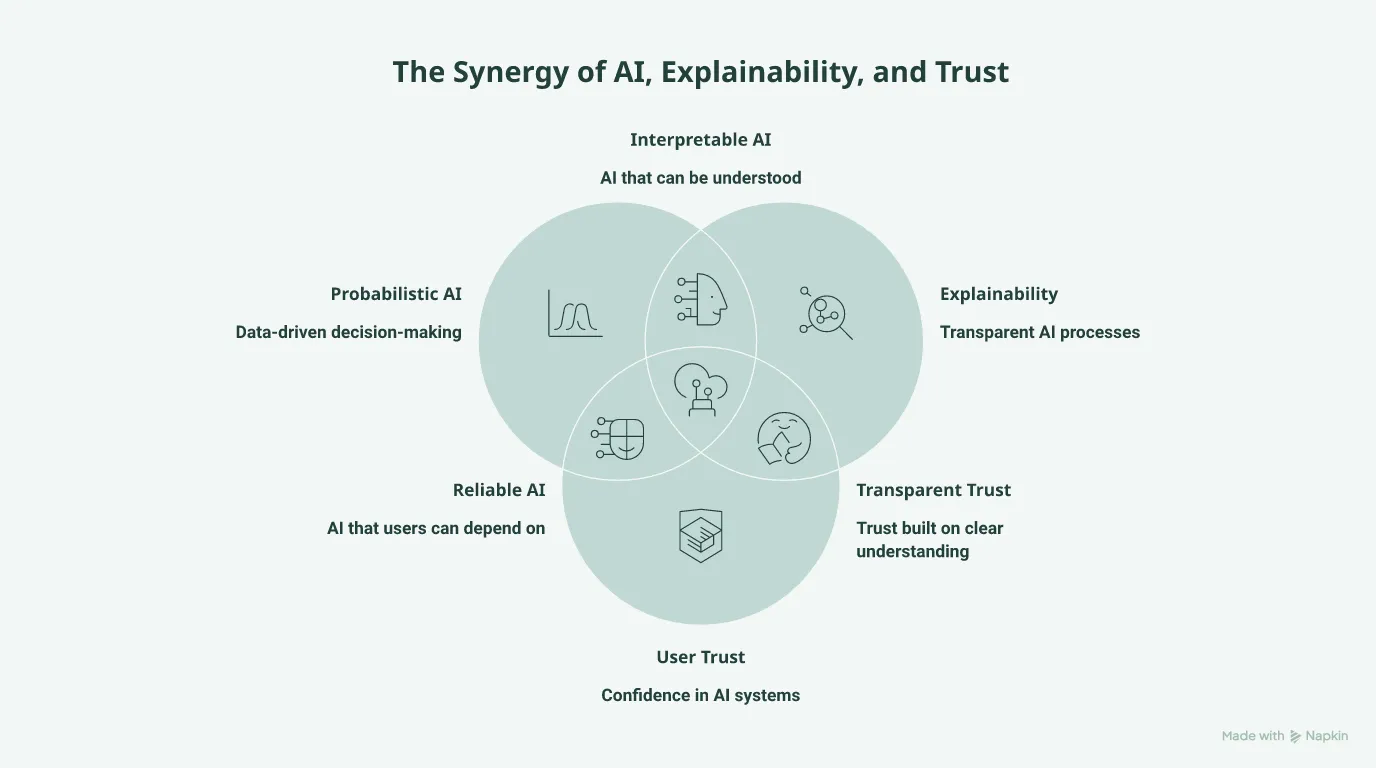
The barrier to scaling these systems lies entirely in their opacity. When a neural network or an ensemble model denies a small business loan, it cannot naturally explain the specific feature interactions that drove the rejection. This opacity conflicts directly with regulatory frameworks like Basel III and IFRS 9, which demand justifiable and transparent credit decisions. The 2026 review noted that out of 289 model usages across 77 studies, probabilistic AI models accounted for only 6 percent.
Probabilistic AI explicitly encodes uncertainty through probability distributions rather than single-point predictions. This allows models to capture epistemic uncertainty, which arises from limited data or model limitations, and aleatoric uncertainty, which stems from inherent data variability. For example, uncertainty-aware credit scoring can adjust decision thresholds based on predictive variance, while stress testing can incorporate simulated loss distributions rather than single-point estimates. While understanding the confidence associated with predictions is critical for decision-making under uncertainty, the underutilization of these models highlights a broader reluctance to adopt complex methods without clear explanatory mechanisms. Institutions that fail to provide these mechanisms will find their advanced models rejected by the very risk officers meant to deploy them.
The role of explainability in technology adoption
We often assume that a highly accurate model will naturally command trust. However, research into AI adoption in other high-stakes fields proves otherwise. A 2026 study on explainable AI in healthcare examined the influence of explainability on the intention to adopt AI systems among 389 healthcare professionals. Grounded in the Technology Acceptance Model 3 and Trust Calibration Theory, the research found that explainability, specifically transparency and accountability, functions primarily by reducing AI-related anxiety rather than merely building cognitive trust.
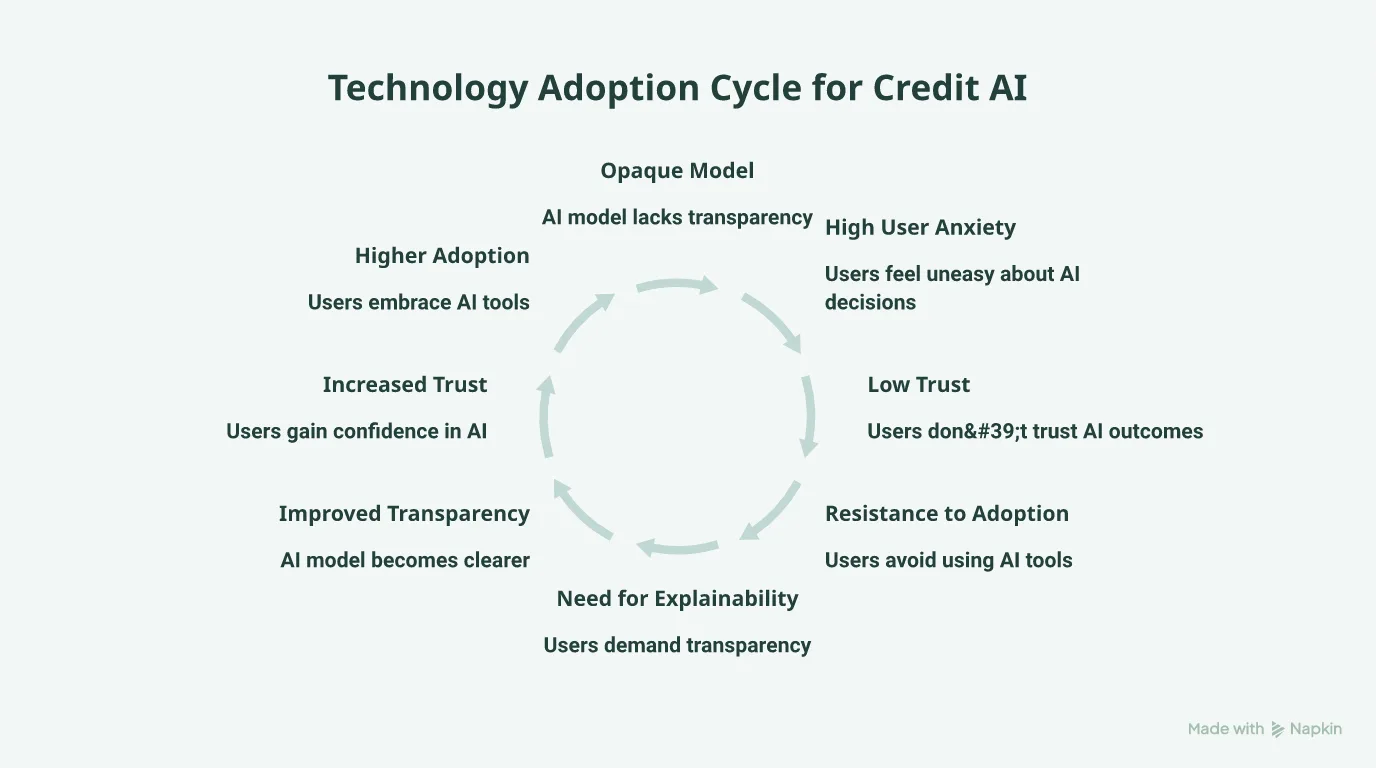
Trust calibration refers to the relationship between an individual’s level of trust in a system and the system’s actual capabilities. The healthcare study revealed that cognitive trust alone does not have a significant direct impact on the intention to adopt AI. Instead, reduced AI anxiety strongly mediates the relationship between explainability and adoption intention. When professionals are presented with transparent systems that clarify the rationale behind a diagnosis, their anxiety regarding unpredictable outcomes decreases. This means that users reject opaque systems out of emotional anxiety and a perceived loss of control, not just a lack of rational trust.
This dynamic translates directly to the financial sector. When loan officers and risk managers are forced to rely on credit scoring systems they do not understand, their anxiety increases, and adoption stalls. By integrating Explainable AI (XAI) techniques, organizations can lower this emotional barrier. Explainability acts as a bridge, making the shift to advanced modeling psychologically and operationally safe for the human operator. This dynamic is a crucial component of How Credit Risk Modeling Is Moving Past the Scorecard, highlighting that the transition to new models relies heavily on user comfort.
The limits of current XAI tools in banking
To solve the transparency problem, the financial industry has increasingly turned to post-hoc explainability tools like SHAP (SHapley Additive exPlanations) and LIME (Local Interpretable Model-Agnostic Explanations). These approaches aim to transform complex models into transparent systems, allowing stakeholders to understand the reasoning behind predictions. While these tools help approximate algorithmic behavior, they carry significant structural vulnerabilities.
The 2026 credit risk review highlighted a critical limitation: SHAP values are not portfolio-invariant in banking applications. The study demonstrated that the choice between interventional and path-dependent Tree SHAP variants produces materially different feature attributions. More importantly, the resulting explanations are highly sensitive to the composition of the background reference portfolio. For a bank, this means that an explanation for a loan denial might change depending on the specific dataset the model is benchmarked against.
If explainability is unstable or dependent on the reference distribution, it cannot satisfy strict regulatory audits. Regulators require consistent, auditable, and portfolio-independent explanations. The widespread adoption of SHAP without standardized guidance may give an incomplete or misleading picture of model behavior when applied across different portfolio compositions.
Approaching explainability as decision infrastructure
Explainability must operate as a core product requirement from the earliest stages of development. When designing systems that utilize probabilistic AI, teams must recognize that they are optimizing for user adoption and regulatory defense alongside predictive accuracy. This aligns perfectly with the necessity of Decision Infrastructure That Makes the Right AI Call the Default.
Organizations building advanced credit models must integrate XAI into the foundational architecture. You must verify whether the explanations generated are consistent and auditable across different portfolios. Reducing the anxiety of the humans responsible for the final decision is just as critical as minimizing the expected loss of the portfolio. By addressing both the cognitive and emotional requirements of the end user, banks can successfully navigate the transition to probabilistic risk modeling.
References
- Engan, A., Hjelkrem, L. O., & Risstad, M. (2026). A review of credit risk assessment in banking, From deterministic models to probabilistic AI. Finance Research Open, 2, 100125. https://doi.org/10.1016/j.finr.2026.100125
- Saoud, L. S., & Qureshi, O. A. (2026). Demystifying the black box: How explainable AI builds trust and reduces anxiety in healthcare adoption. Strategic Business Research, 2, 100157. https://doi.org/10.1016/j.sbr.2026.100157
Frequently asked questions
Why is explainability important for AI credit models?
Explainability is essential for regulatory compliance and user trust. Without clear transparency, risk managers and regulators cannot audit decisions, leading to anxiety and resistance against adopting advanced AI models.
Do tools like SHAP completely solve the "black box" problem?
No. While SHAP and LIME provide valuable insights into model behavior, research shows that in banking, SHAP values are highly sensitive to the reference portfolio, making them potentially unstable for strict regulatory audits.
How does explainable AI impact the adoption of new technologies?
Explainability directly reduces the psychological anxiety associated with relying on automated systems. Studies indicate that lowering this anxiety is a stronger driver of adoption than simply proving a model's statistical accuracy.