How Credit Risk Modeling Is Moving Past the Scorecard
A look at why banking relies on deterministic AI for credit decisions, and how probabilistic models that quantify uncertainty offer a better path forward.
When you build a credit product, the hardest question isn’t whether a borrower will default. The hardest question is how confident your model is in its own prediction. We treat credit scoring as a binary classification problem: accept or reject. But financial risk isn’t binary; it’s a spectrum of uncertainty. Yet, the tools most banks use to measure that risk pretend the uncertainty doesn’t exist. If you ask a standard model for a probability, it gives you a point estimate. It does not tell you if that estimate is backed by a thousand identical repayment histories or if it is guessing based on a sparse dataset from a new market segment. As the data shows, the industry is stuck relying on tools that prioritize a clean answer over an honest assessment of doubt.
Key takeaways
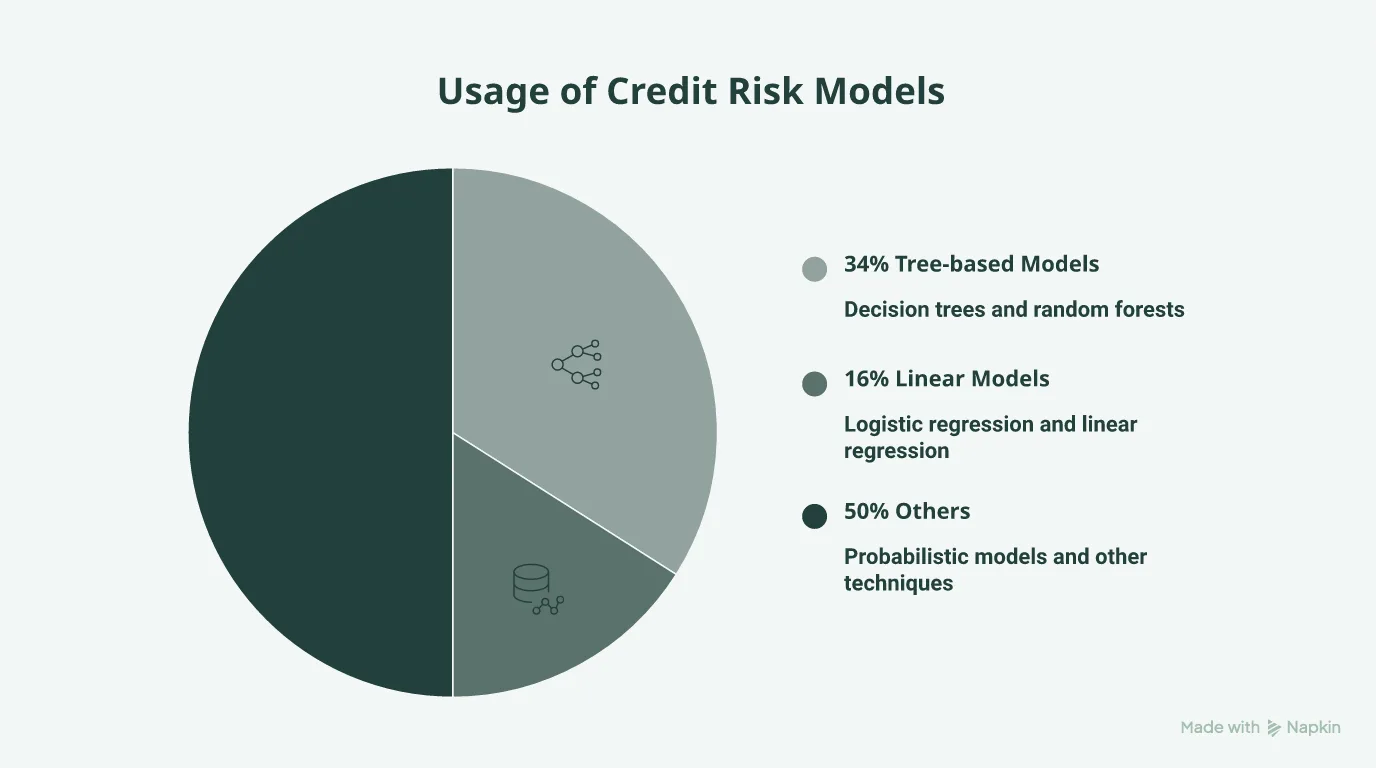
- Deterministic models dominate. A 2026 review of 77 credit risk studies found that 34% of model usages rely on tree-based methods (like Random Forest and XGBoost), while traditional linear models still account for 47 usages.
- Probabilistic AI is under-utilized. Only 6% of model applications in the literature use probabilistic AI, leaving a massive gap in how banks quantify prediction uncertainty.
- Generative AI is a missed opportunity. The rarity of loan defaults makes class imbalance the most cited technical challenge, affecting 23% of reported modeling issues. Generative models like GANs and VAEs offer an underused solution for creating synthetic borrower data.
- XAI remains rare. Despite regulatory pressure, explainable AI techniques like SHAP appear in only 15 of the 77 studies.
Why deterministic models still rule the credit committee
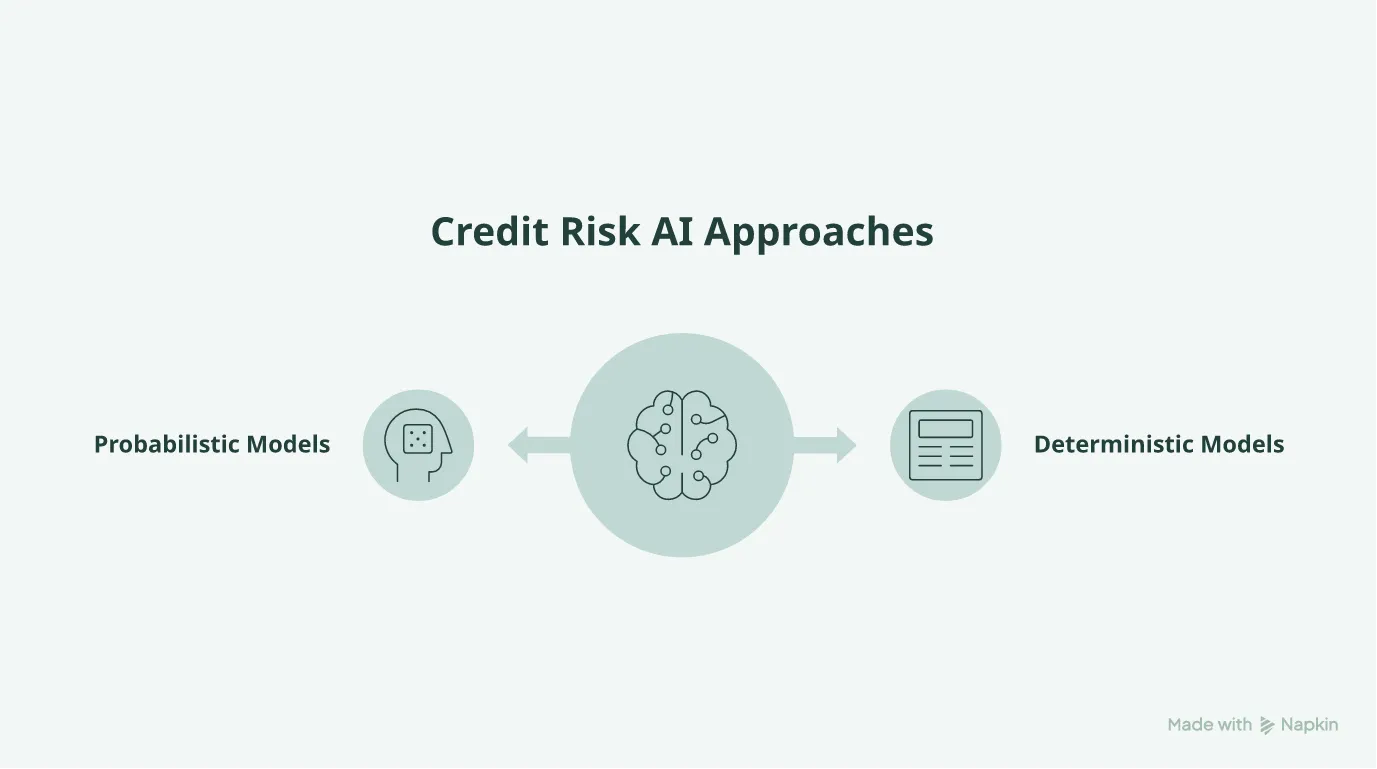
Tree-based algorithms and linear models remain the default choice because they are easy to explain and scale. A 2026 systematic review published in Finance Research Open analyzed 77 recent studies on credit risk assessment in banking. The data shows that tree-based models make up 34% of all model applications (97 total uses), with Random Forest leading at 29 uses. Linear models follow closely, with Logistic Regression applied 41 times.
I’d argue this isn’t just about legacy preferences. When you sit down to build a decision infrastructure for a lending product, you need models that pass regulatory scrutiny. Logistic regression gives you coefficients you can hand to a compliance officer. Random forests and gradient boosting machines handle large, non-linear datasets efficiently. But these are deterministic models. They output a single point estimate, a probability score, but they do not tell you how much epistemic uncertainty surrounds that score. They give you an answer, but they cannot tell you when they are guessing. For a product leader, optimizing for an easily explained point estimate often means trading away the deeper context needed for complex credit decisions.
The cost of ignoring uncertainty
You cannot price risk accurately if you do not know the variance of your predictions. The same 2026 review found that probabilistic AI, models explicitly grounded in probability theory that represent uncertainty through distributions, accounts for just 6% of model usages (17 out of 289 instances).
When you use deterministic AI, a probability output of 0.8 from a sigmoid function looks identical whether the model has seen ten thousand similar borrower profiles or only two. In contrast, probabilistic methods like Bayesian Neural Networks (BNNs) and Gaussian Process Regression (GPR) treat parameters and predictions as random variables. This distinction is critical because it allows you to separate epistemic uncertainty from aleatoric uncertainty. Epistemic uncertainty arises from a lack of knowledge, for example, a thin credit file or a new loan product with no historical data. You can reduce this by gathering more data. Aleatoric uncertainty, on the other hand, stems from the inherent variability of the market. You cannot reduce it, but you must price it into your lending margins.
The 2026 data shows that 13 of the 17 probabilistic studies focused specifically on capturing epistemic uncertainty. When a Bayesian Network flags a high-variance prediction, it signals to your underwriting team that the model lacks the data to make a confident call. In a credit environment marked by volatile market conditions, knowing the confidence interval of a default prediction allows you to adjust decision thresholds dynamically. Yet, the industry largely leaves this capability on the table, opting for brittle certainty over mathematically sound caution.
Generative AI and the class imbalance problem
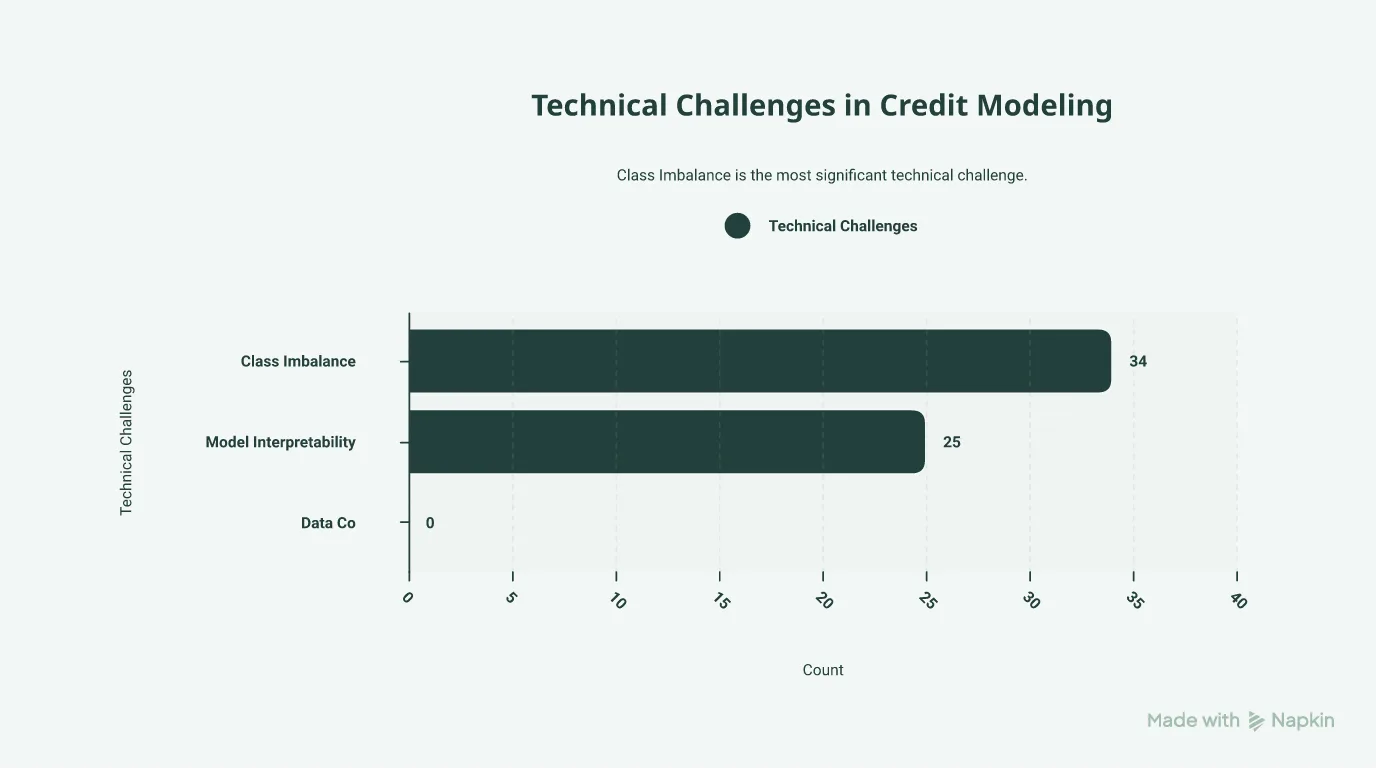
The biggest technical hurdle in credit modeling isn’t algorithm selection; it is the fact that defaults are rare. Class imbalance was cited 34 times in the reviewed literature, representing 23% of all reported challenges. When you train a model on a dataset where 95% of the loans are repaid, the model quickly learns that it can achieve high accuracy simply by predicting that no one will ever default.
This bias fundamentally undermines the reliability of the credit engine. Researchers typically attempt to solve this using basic resampling techniques like SMOTE (Synthetic Minority Over-sampling Technique) or stratified sampling. But these legacy approaches often just duplicate existing rare cases, which can lead to severe overfitting.
The review identifies generative AI as a highly promising but severely under-researched alternative. Models like Generative Adversarial Networks (GANs) and Variational Autoencoders (VAEs) do not just duplicate data; they synthesize entirely new, realistic borrower profiles and economic stress scenarios. For a product org, this means you can generate controlled, synthetic environments to stress-test your credit algorithms against market shocks that haven’t happened yet. Furthermore, probabilistic models offer another mechanism to counter missing data: they allow you to encode prior knowledge, such as historical portfolio default rates, directly into the model parameters using a Bayesian framework. This ensures the output remains grounded in economic reality, even when the specific training dataset lacks enough default examples to form a clean pattern.
The explainability gap in banking AI
You cannot deploy a model you cannot audit. Model interpretability is the second most common challenge in the literature, cited 25 times. Despite this, Explainable AI (XAI) techniques are surprisingly scarce. Only 15 of the 77 reviewed studies actually implemented XAI tools like SHAP (SHapley Additive exPlanations) or LIME.
The data suggests a disconnect between what regulators demand and what modelers build. When an AI denies a loan, you have to tell the customer why. If you rely on complex, opaque models like deep neural networks without an XAI layer, you run into immediate compliance walls. Furthermore, the researchers found that explanations derived from SHAP can change depending on the background reference data, meaning the “why” isn’t always stable across different portfolio compositions. This implies that building trust into AI products requires more than just bolting an explainer onto a black box. It requires a deliberate strategy to select models that are designed for auditability from day one, rather than attempting to reverse-engineer transparency after the fact, which is exactly why explainability is the ultimate growth lever for probabilistic credit models.
Moving beyond the point estimate
If you are leading a product team in fintech or banking, the shift from deterministic scorecards to probabilistic modeling is the next structural advantage. The gap in the academic literature maps directly to a gap in the commercial market. While competitors rely on single-point estimates that fail silently on edge cases, building systems that quantify their own uncertainty allows you to manage risk with far greater precision.
The math exists, and the computing power exists to run Bayesian Neural Networks and Gaussian Process Regression at scale. The next step is treating uncertainty not as a defect to be minimized, but as a core feature of your decision infrastructure.
References
- Engan, A., Hjelkrem, L. O., & Risstad, M. (2026). A review of credit risk assessment in banking, From deterministic models to probabilistic AI. Finance Research Open, 2, 100125. https://doi.org/10.1016/j.finr.2026.100125
Frequently asked questions
Why are deterministic models still so common in credit scoring?
Banks favor deterministic models like logistic regression and random forests because they are easier to explain to regulators and require less computational power than probabilistic models.
What is the primary advantage of probabilistic AI in credit risk?
Probabilistic AI captures epistemic uncertainty, allowing models to communicate their confidence intervals so lenders know when predictions are based on limited or volatile data.
How does class imbalance affect default prediction models?
Because defaults are rare, standard models often over-predict repayment to maximize overall accuracy. This fundamentally undermines the model's ability to catch the actual risky loans.
Why is explainable AI (XAI) adoption slow in banking research?
While necessary for compliance, XAI methods like SHAP can produce unstable explanations depending on the reference data used, making them difficult to implement reliably at scale.