There Is No Global AI Race. There Are Nine Different Bets.
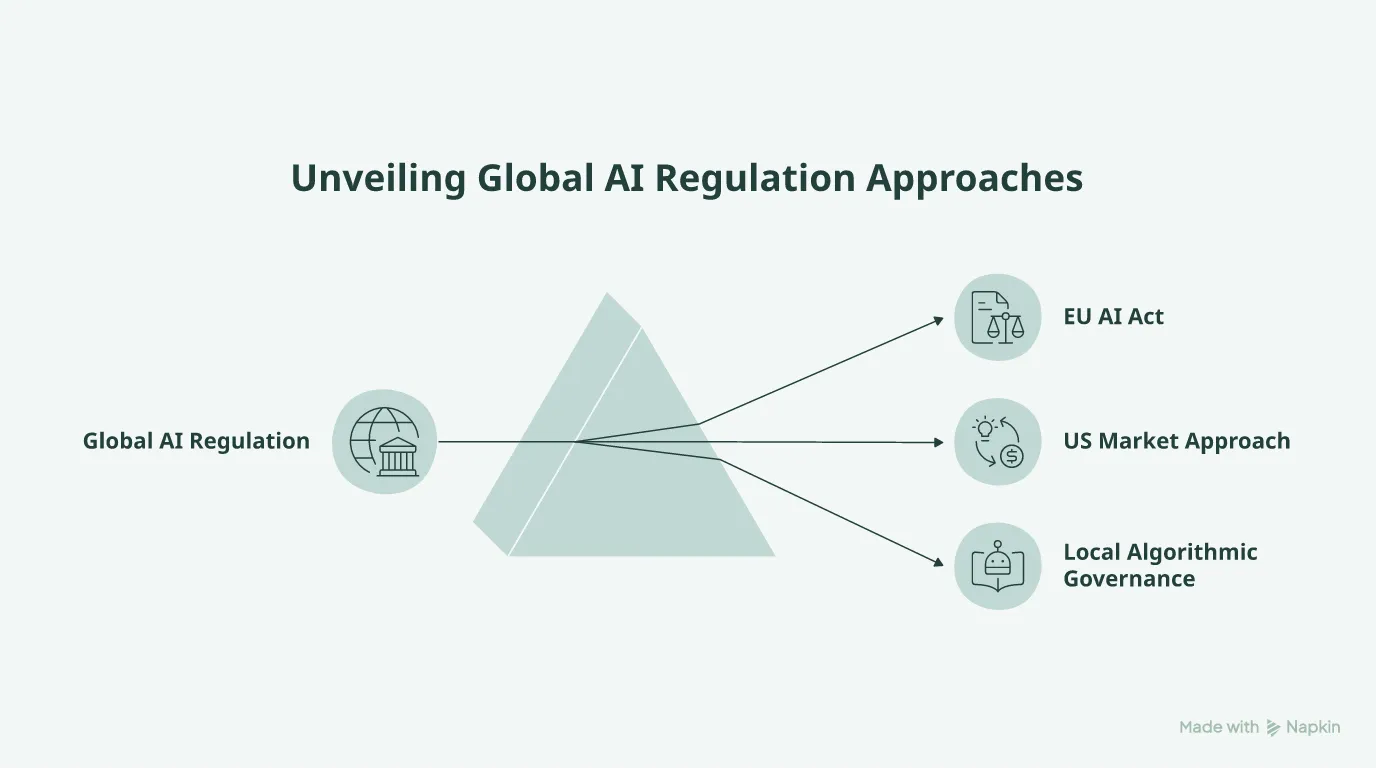
Global AI regulation isn't a race between the EU and US; it's a mix of nine distinct approaches. Architect for modular compliance to ship cross-border.
When you try to deploy an AI-driven credit scoring model across five different markets, you immediately hit a wall. One jurisdiction demands a full algorithmic impact assessment before launch. Another just wants to verify your compliance with existing consumer protection laws. A third is offering tax incentives if you deploy it inside their regulatory sandbox first. The standard narrative claims that AI regulation is a two-horse race between the prescriptive compliance of the EU AI Act and the market-driven landscape of the United States. But for anyone actually building and shipping products across borders, that binary is a dangerous oversimplification.
There is no single global AI race. Instead, lawmakers worldwide have converged on nine distinct regulatory bets.
Key takeaways
- The narrative of a binary EU vs. US regulatory race ignores the nine distinct governance models countries actually use, forcing builders to navigate a much broader spectrum of compliance rules.
- Regulating AI under uncertainty requires adaptive instruments immediately, because waiting hands the default rules of engagement to the first tech companies that ship.
- Competitive advantage in the AI era relies on social coherence rather than just technology, making a country’s regulatory choices the deciding factor in how well it manages disruption.
- Cross-border AI products must be architected for modular compliance from day one, allowing teams to selectively satisfy varying transparency and explainability mandates without forking the codebase.
The Nine Approaches to AI Governance
A recent UNESCO analysis of global legislative trends reveals that countries are not just picking sides; they are combining approaches across a spectrum from light-touch enablement to stringent liability. The nine emerging approaches are:
- Principles-Based: Establishing high-level propositions (ethical, human-centric) to guide development without hard enforcement.
- Standards-Based: Leveraging technical standards from bodies like ISO to provide operational precision and regulatory safe harbors.
- Agile and Experimentalist: Creating regulatory sandboxes that allow organizations to test new models under flexible conditions with oversight.
- Facilitating and Enabling: Building environments that proactively encourage and subsidize responsible AI development.
- Access to Information and Transparency Mandates: Requiring public disclosure about how AI systems work and what data they use.
- Adapting Existing Laws: Patching sector-specific rules (like finance, health, or labor) to cover AI-driven scenarios.
- Risk-Based: Establishing obligations tiered to the assessed risk of the AI tool, famously championed by the EU.
- Mandatory Rights-Based: Enshrining new individual rights specifically designed to protect citizens from algorithmic harm.
- Liability: Assigning strict legal responsibility and sanctions for the adverse impacts of AI systems.
Most jurisdictions blend these. You might face a risk-based framework in one market that relies on a standards-based approach for compliance, while a neighboring market leans entirely on adapting existing labor and copyright laws. Navigating this fragmented map requires recognizing that the legal threshold for deployment will shift fundamentally every time your product crosses a border. A feature that is celebrated as an innovation in a facilitating environment may trigger strict liability sanctions in a mandatory rights-based jurisdiction. This fragmentation shatters the illusion of a single global launch strategy; instead, entering a new region is a bespoke integration effort that must balance local legal constraints against the operational overhead of maintaining multiple variations of the same product.
Regulating What You Cannot Yet Measure
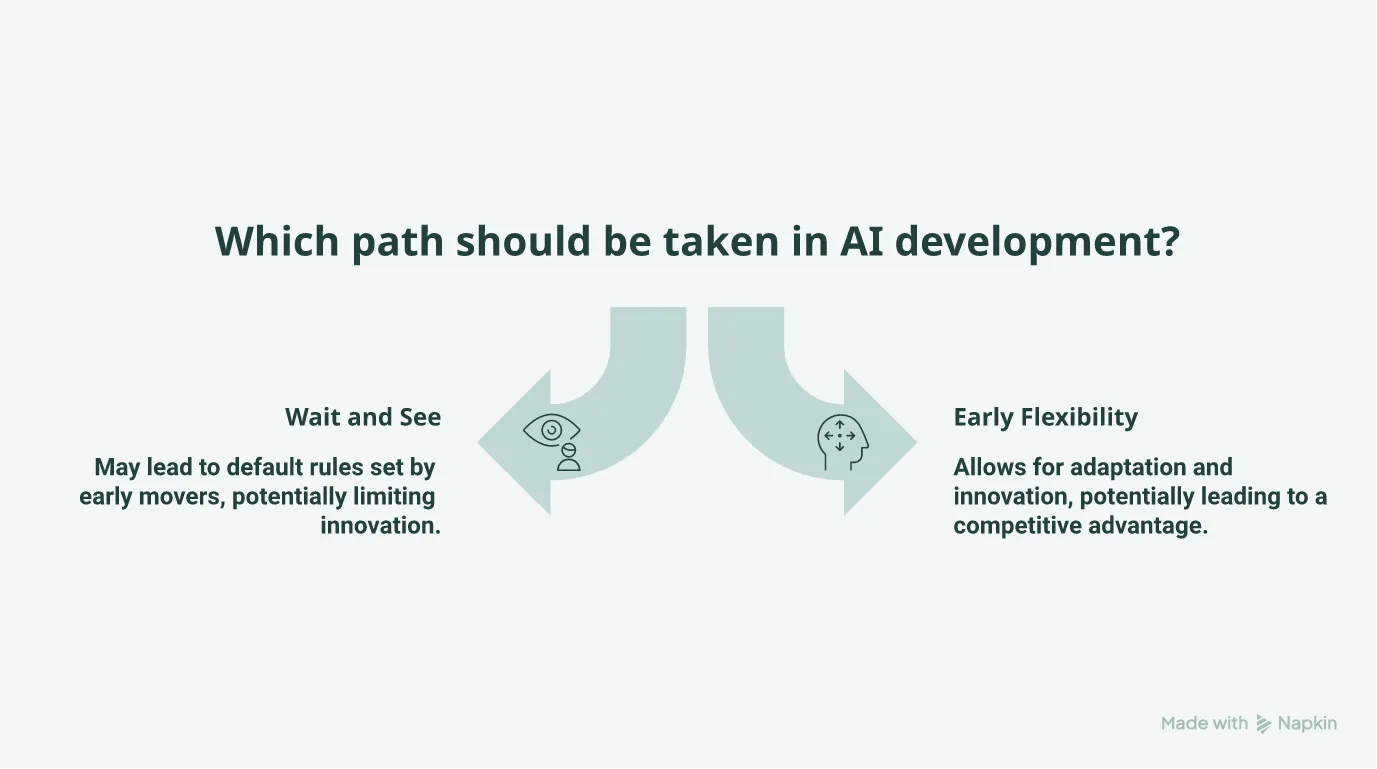
The most common objection to early AI legislation is that the technology is moving too fast, that we cannot regulate what we do not yet understand. However, governance literature argues the exact opposite.
Regulating under uncertainty is not a reason to wait; it is an argument for adaptive instruments right now. Waiting for the technology to settle means handing the default rules of engagement to whichever company ships first. In the absence of policy, the architecture of the product becomes the de facto law of the land. Early, flexible regulation, like experimental sandboxes and transparency mandates, allows governments to shape the trajectory of development before it becomes entrenched. Lawmakers have recognized that if they fail to define the boundaries of algorithmic decision-making early, the sunk costs of re-architecting live systems later will make meaningful enforcement nearly impossible.
As we have explored in our analysis of how AI governance is a product discipline, compliance can no longer be bolted on at the end. It must be architected into the system from day one. When we were integrating a localized language model into a regional application, the technical challenge was not just prompt engineering; it was ensuring the system could selectively expose its training lineage to satisfy transparency mandates in one market without violating data privacy laws in another. This level of architectural agility is not a legal nice-to-have; it is the core capability that allows an AI product to scale across multiple regulatory regimes without requiring a hard fork of the codebase.
The Societal Foundations of Advantage
Why does this fragmented regulatory landscape matter so much? Because the competitive advantage in the AI era is not purely technological; it is fundamentally social.
Nations that lead this era will not merely be the ones with the most advanced data centers or the largest parameter models. As RAND research suggests, they will be the societies that provide fertile soil for the diffusion of these technologies while maintaining social coherence. AI will crash into existing economic and political instabilities. The rules a country sets today determine whether AI mitigates those dangers or exacerbates them. A principles-based approach might accelerate initial adoption, but a rights-based framework might prevent the societal backlash that derails long-term technological integration.
For product leaders, this means understanding that what LLM providers actually promise about your data is only the first layer of the problem. If you are shipping internationally, your product must be modular enough to turn on explainability traces for a risk-based market, prove adherence to technical standards in another, and offer full transparency in a third. It forces engineering teams to decouple the core intelligence of the model from the compliance modules that interface with the user. You cannot hardcode a single threshold for confidence scores or data retention when those thresholds vary wildly by jurisdiction. By isolating these compliance rules into interchangeable modules, you build a system that can adapt to new regulations as quickly as lawmakers draft them.
The race is not about which superpower writes the definitive rulebook. It is about whether your product architecture is resilient enough to comply with all nine bets at once. The companies that win will not be the ones that lobby hardest for deregulation, but the ones whose software can elegantly absorb the friction of a fragmented world.
References
- UNESCO. (2026). Governing AI: Nine Emerging Approaches for Lawmakers Worldwide.
- G’sell, F. (2024). Regulating Under Uncertainty: Governance Options for Generative AI.
- RAND Corporation. (2026). A New Age of Nations: Power and Advantage in the AI Era.
Frequently asked questions
Why is the EU vs. US AI regulation narrative incomplete?
Framing AI regulation as a binary choice ignores the reality that countries worldwide are adopting a mix of nine distinct approaches, ranging from agile sandboxes to strict liability frameworks. Builders must navigate this entire spectrum, not just two extremes.
Should governments wait to regulate AI until the technology stabilizes?
No. Regulating under uncertainty requires adaptive instruments now. Waiting hands the default rules to tech companies, making product architecture the de facto law instead of democratically chosen policies.
How does AI regulation impact national competitiveness?
Competitive advantage in the AI era is a social challenge, not just a technological one. The regulations a country chooses dictate how well its society adapts to AI's disruptions, directly impacting its long-term stability and economic dynamism.
What does this mean for cross-border AI product development?
Products must be architected for modular compliance from day one. You need the ability to toggle explainability, transparency, and data privacy features to satisfy the specific blend of regulatory bets in each market you enter.