Auditing What LLM Providers Actually Promise About Your Data
Enterprise product teams must actively audit frontier LLM privacy policies to avoid accepting undisclosed privacy risk on behalf of their users.
When enterprise product teams integrate large language models (LLMs) into their software, they often assume that enterprise-grade API agreements automatically protect their users’ privacy. But a close reading of frontier LLM developers’ privacy policies reveals a systematic gap between what users expect and what developers actually contractually commit to.
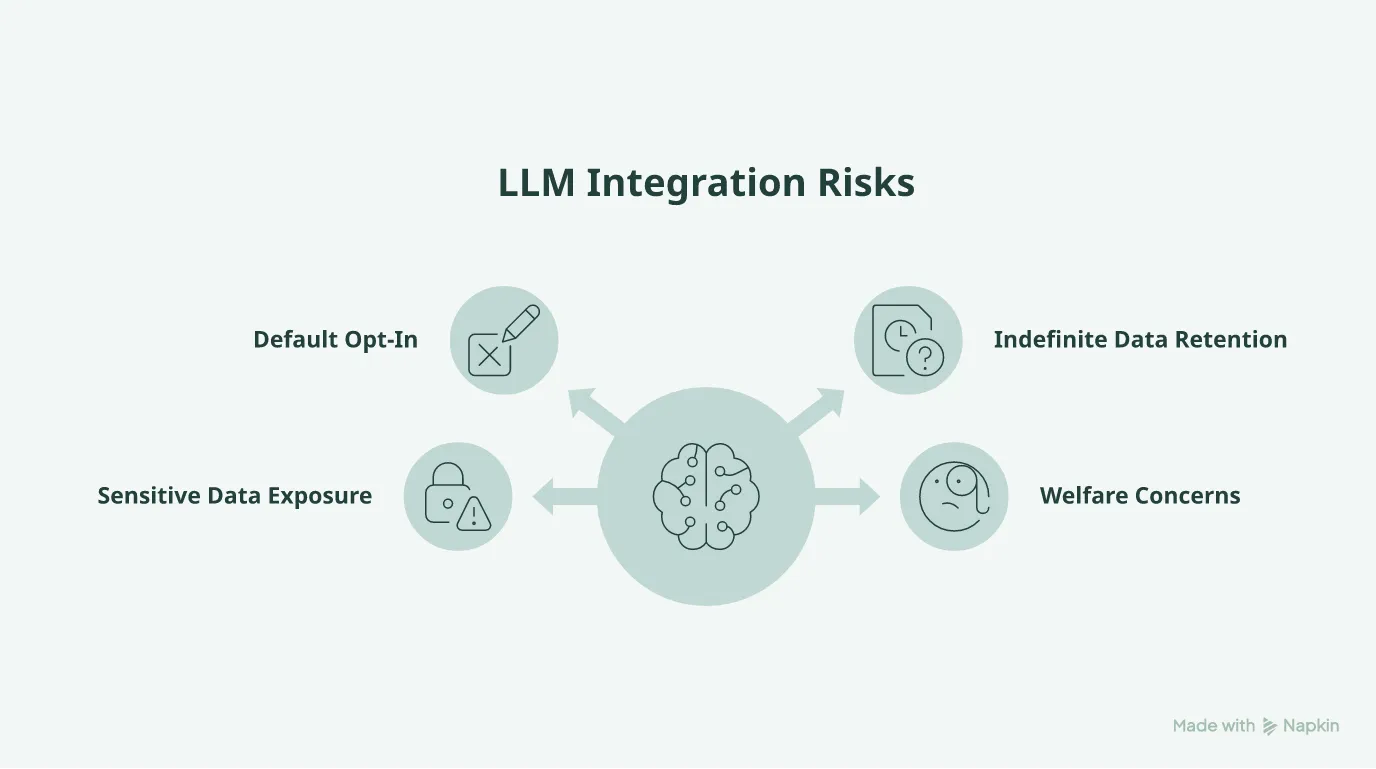
Recent analysis of six U.S. frontier AI developers reveals a sobering reality: all six developers appear to employ user chat data to train and improve their models by default, and some retain this data indefinitely. This includes sensitive personal information disclosed in prompts and files uploaded by users.
This isn’t merely a compliance issue; it represents a structural transfer of risk. When you build an application on top of an LLM without explicitly auditing and configuring the provider’s data retention policies, you are accepting undisclosed privacy risk on behalf of your users. Recognizing that AI Governance Is a Product Discipline, Not a Compliance Checkbox, product teams must actively design data flows that protect users rather than defaulting to the permissive data collection regimes of frontier models. The assumption that the LLM layer is a neutral, stateless utility is one of the most dangerous misconceptions in modern AI product development.
The Illusion of Default Privacy
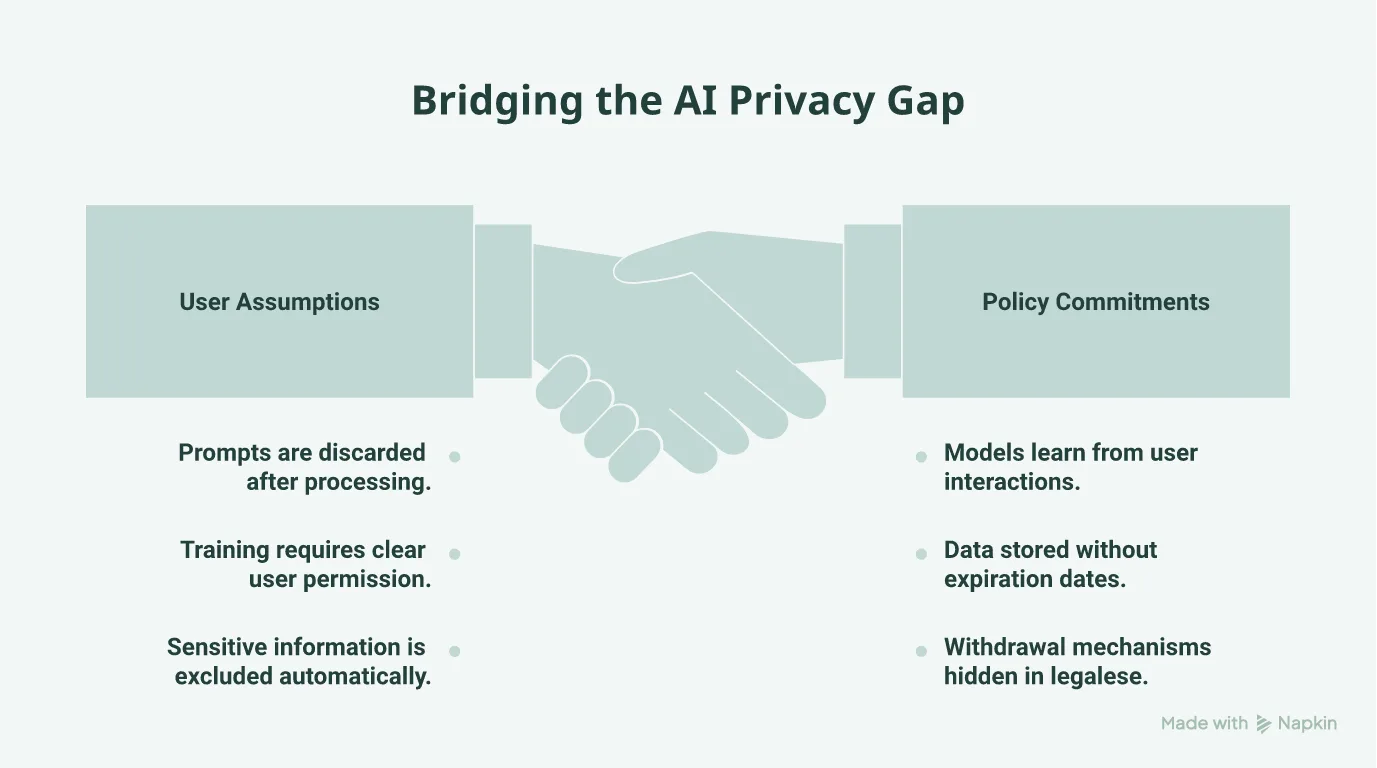
The assumption that user interactions are ephemerally processed and discarded is false. Most frontier models require users who wish to avoid having their data used for model training to affirmatively opt out. Even then, the mechanisms for opting out are often buried in dense, difficult-to-read privacy policies that lack standardization. These policies are typically too long, poorly presented as dense blocks of text, and written in legalese that requires a graduate degree to comprehend. They are not designed to be easily navigable by the end user, or even by the product teams evaluating them.
Furthermore, the retention of this data poses significant downstream risks. Developers may collect and train on personal information, including biometric and health data, disclosed in chats. When this data is retained indefinitely, it becomes a permanent liability. Every prompt your user submits that contains sensitive information becomes a permanent part of a third-party training set unless explicit actions are taken. This creates an unmanaged data honeypot that your organization has no visibility into or control over. If your product relies on these models, your Decision Infrastructure That Makes the Right AI Call the Default must include explicit architectural boundaries that strip sensitive data before it reaches a third-party LLM. When product teams neglect to audit these policies, they implicitly shift the burden of privacy protection onto the end user. This is an abdication of responsibility. In a healthy decision infrastructure, the system must protect the user by default, treating their data with the highest level of care rather than serving it up to external models as training fodder. Leaving data retention policies unchecked turns your enterprise application into an involuntary data collection agent for foundational model providers.
The Governance Frontier and the Privacy Budget
The tension between model utility and privacy is not just a qualitative concern; it is mathematically quantifiable. The “Governance Frontier” establishes that there are joint limits on a model’s accuracy, fairness, privacy, and explainability. Regulatory expectations for machine learning increasingly demand all four properties at once, but the mathematical reality is that they trade off against each other. Every demand for greater accuracy or personalization costs a specific amount of privacy, what researchers term the “welfare-optimal privacy budget.”
This budget is derived from a first-order condition equating the marginal accuracy gain of a looser budget against its marginal disclosure harm. In this framework, harder, higher-dimensional problems rationally demand spending more of this privacy budget, while environments with more data or stronger signals can spend less. The critical insight for product leaders is that the optimal privacy budget falls as society’s (and your users’) weighting of privacy increases. Specifically, the optimal budget falls with society’s privacy weight at a −1/3 elasticity. You cannot simply maximize accuracy without explicitly trading off against the privacy budget. Every time your product team decides to pass richer context to an LLM to improve the completion, you are spending down that privacy budget.
The trade has a shape, and the shape is a U: accuracy collapses at one end, and the harm from disclosed data outruns its own benefit at the other.
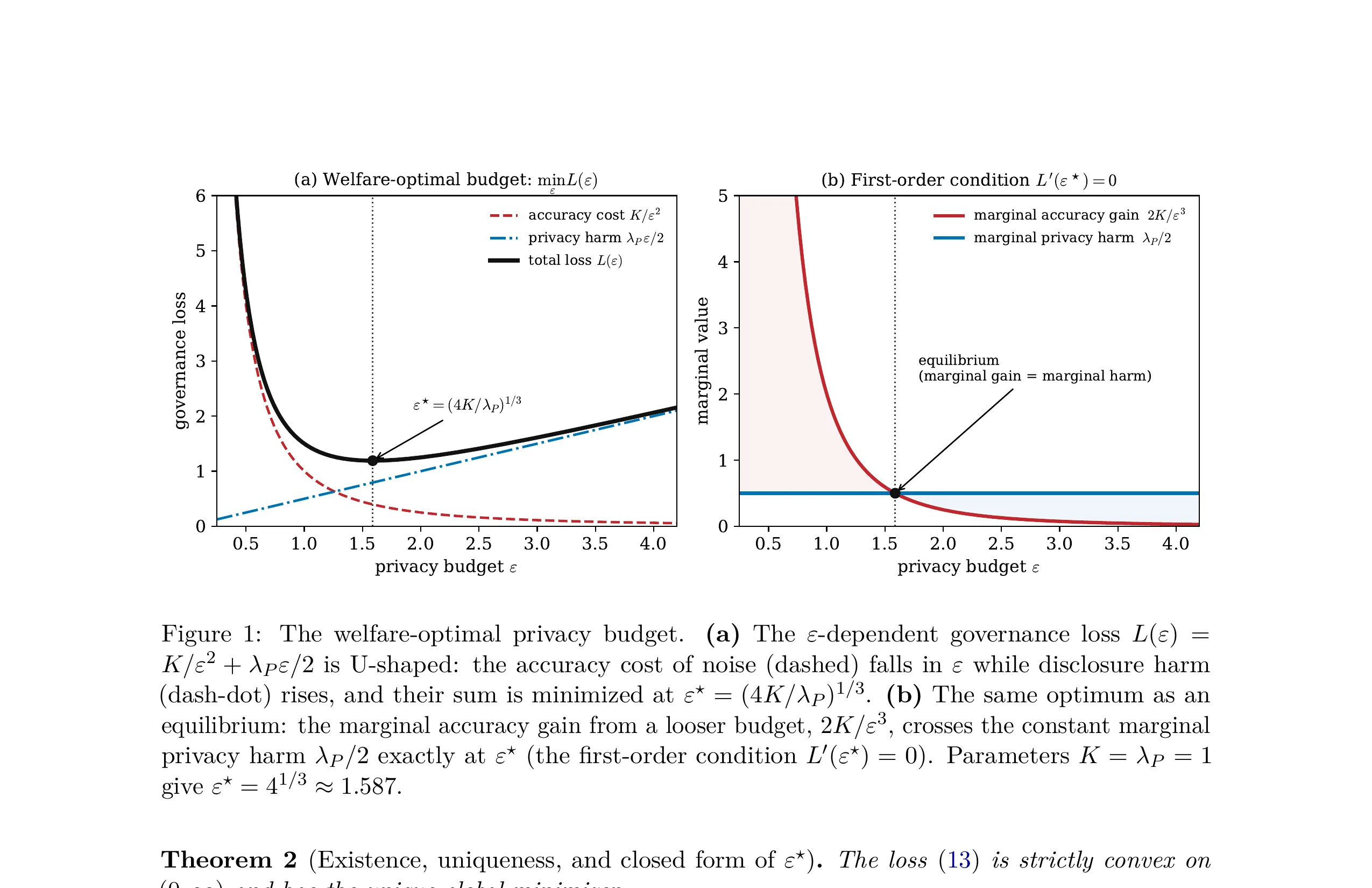
Exhibit 1. Governance loss across a range of privacy budgets, with the minimum marked at the welfare-optimal budget, and the same optimum shown as the point where marginal accuracy gain meets marginal privacy harm. Source: Kenney, N. M., 2026, The Governance Frontier: Joint Limits of Accuracy, Fairness, Privacy, and Explainability, and the Welfare-Optimal Privacy Budget, preprint, p. 9.
Designing for the Reality of LLM Policies
Enterprise teams cannot rely on LLM providers to self-regulate their data appetites. The race for ever-more capable models requires vast amounts of high-quality human interaction data, creating a direct conflict of interest between the provider’s need for training data and your users’ right to privacy. As long as the primary competitive vector for frontier models is their reasoning capability, developers will prioritize data collection over default privacy.
To build responsibly, product leaders must take matters into their own hands:
- Assume Default Opt-In: Treat every third-party LLM integration as if it is actively logging and training on your users’ inputs unless explicitly contracted otherwise. You must negotiate zero-data retention enterprise agreements, and verify that your API tier actually enforces them. Do not assume the “enterprise” label means zero retention.
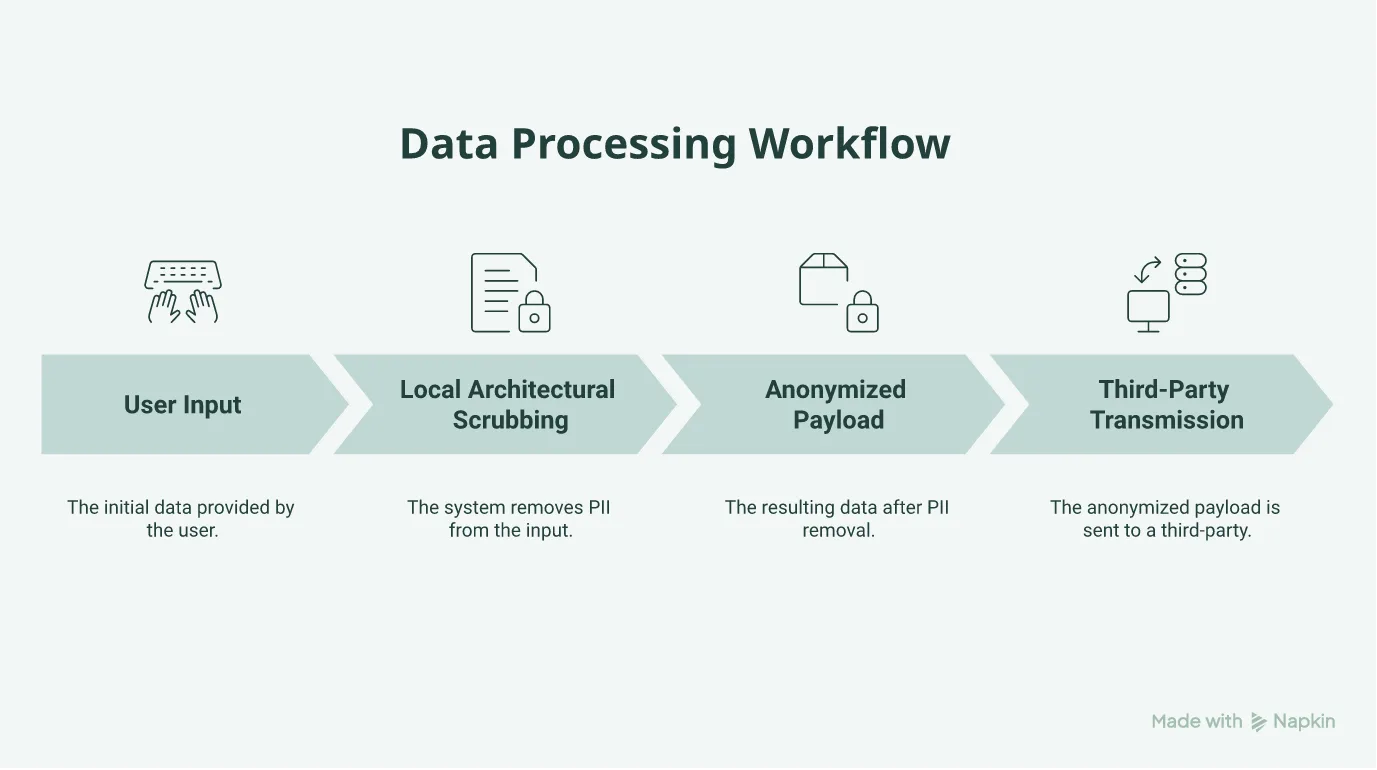
- Implement Architectural Scrubbing: Do not rely on policy alone. Implement local data scrubbing to remove Personally Identifiable Information (PII) before the payload ever leaves your servers. Your architecture should default to masking, meaning the LLM receives anonymized tokens rather than raw user data.
- Calculate Your Privacy Budget: Acknowledge the Governance Frontier. Decide explicitly how much privacy you are willing to trade for model accuracy, and communicate that trade-off transparently to your users. When designing a feature, ask whether the marginal gain in accuracy is worth the marginal disclosure harm.
- Monitor Policy Changes: AI developer policies change rapidly and often quietly. Establish a recurring process to audit the privacy policies of the foundation models powering your application, ensuring that an upstream policy update does not suddenly put your users’ data at risk.
The path forward requires a fundamental shift in how we view third-party integrations. Rather than viewing an LLM API as a simple utility, treat it as a complex dependency with profound privacy implications. By establishing clear architectural boundaries and rigorously calculating your privacy budget, you can harness the power of frontier models without compromising the trust your users have placed in you. Protecting user privacy must be treated as a core product feature, not an afterthought delegated to a third-party API.
References
- King, J., Klyman, K., Capstick, E., Saade, T., & Hsieh, V. (2025). User Privacy and Large Language Models: An Analysis of Frontier Developers’ Privacy Policies. Stanford University.
- Kenney, N. M. (2026). The Governance Frontier: Joint Limits of Accuracy, Fairness, Privacy, and Explainability, and the Welfare-Optimal Privacy Budget.
Frequently asked questions
Do LLM providers use our chat data to train their models?
Yes, by default, major U.S. frontier AI developers use consumer chat data to train and improve their models. Enterprise customers must explicitly negotiate zero-data retention agreements or use specific enterprise API tiers to prevent this.
How long do LLM providers keep user data?
Data retention policies vary, but some developers retain user chat logs indefinitely unless the user affirmatively opts out or deletes their account. This includes any sensitive personal or corporate data included in the prompts.
What is a privacy budget in AI governance?
The privacy budget is a mathematical concept defining how much privacy must be sacrificed to achieve a certain level of model accuracy. It proves that accuracy, fairness, and privacy are a zero-sum trade-off at the frontier of model performance.