Why the Same Price Feels Unfair Across Different Channels
Consumers apply different fairness standards to identical prices depending on the channel and product category. Pricing teams often ignore this dynamic.
Multichannel retailers are caught in a structural bind. Online pure-players force prices down through high transparency, while offline brick-and-mortar stores carry punishing operating costs. The temptation to charge a premium offline to recover those costs is obvious, but retailers hesitate. The prevailing logic is that consumers demand absolute price parity across channels, that a different price tag on the same shelf inevitably triggers a sense of betrayal.
The assumption that price consistency guarantees perceived fairness is a massive undercorrection. We assume that if the number on the tag is identical, the buyer’s reaction will be identical. But the context of the purchase completely alters the baseline standard of fairness. The product category, the urgency, and the interface itself dictate how a price difference is judged. When pricing teams apply uniform margin targets across channels, they ignore the cognitive shortcuts their buyers actually use.
The Margin Illusion vs. Buyer Reality
Most pricing engines optimize for a theoretical rational buyer, one who evaluates shipping costs, shelf-space overhead, and margin parity objectively. In reality, buyers evaluate fairness relative to frequency.
A 2026 study of 898 multichannel consumers (Kiczmachowska, De Pourbaix, & Mazurek) isolates this dynamic. When testing cross-channel price differentiation across product categories with varying purchase frequencies (toys, cosmetics, food and beverages), the data shows a clear divergence. If a retailer offers a low cross-channel discount, say, 10% lower online, the consumer perceives this as equally fair to absolute price parity, provided delivery costs are assumed. The buyer calculates that the 10% margin roughly covers the shipping cost, balancing the equation.
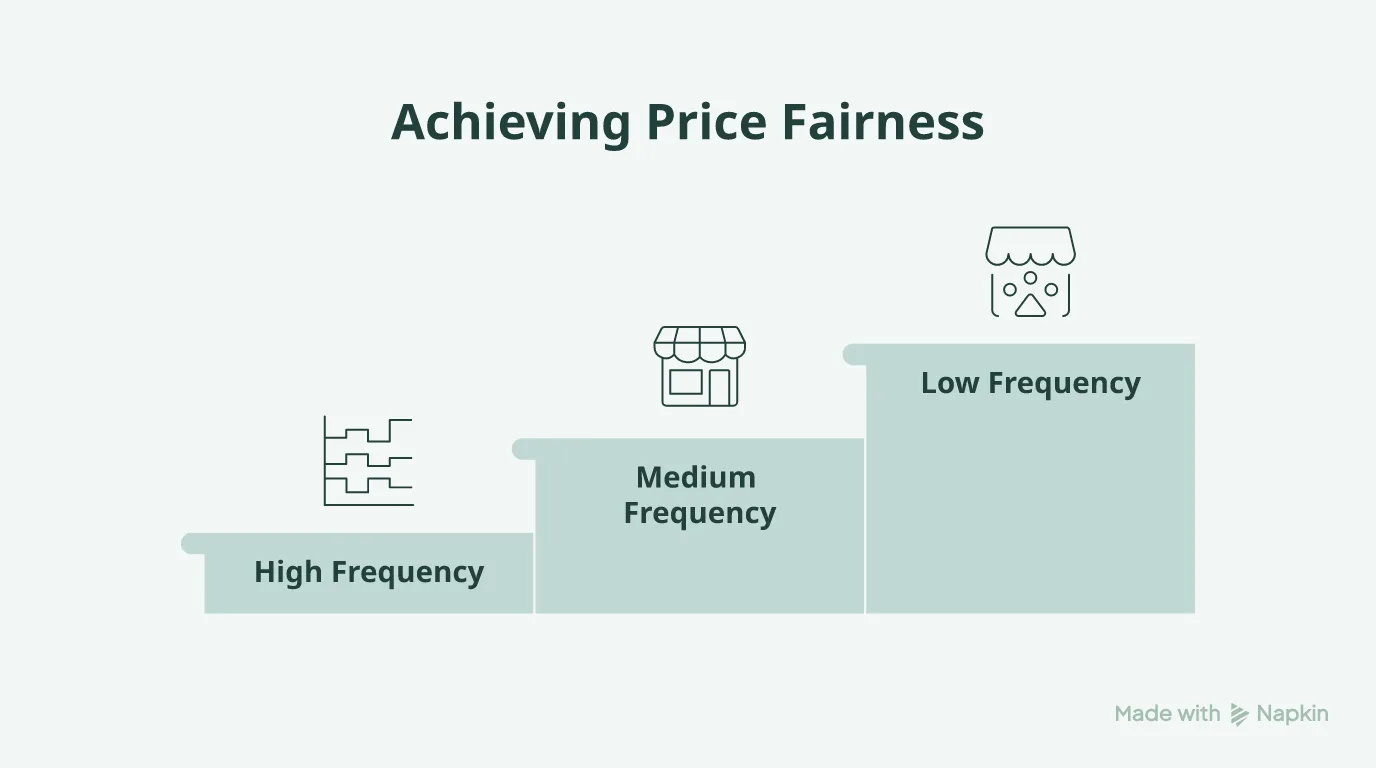
But push that discount to 40% online, and the perceived fairness plummets. The buyer no longer sees shipping offset; they see arbitrary punishment for walking into the physical store. More crucially, this perception is inextricably linked to the product category. Customers are intensely resistant to offline premiums on frequently purchased items. A markup on daily necessities, food, beverages, routine cosmetics, feels like a penalty for existing. A premium on an infrequent purchase, like a toy, feels far more acceptable.
The Frequency-Discount Threshold
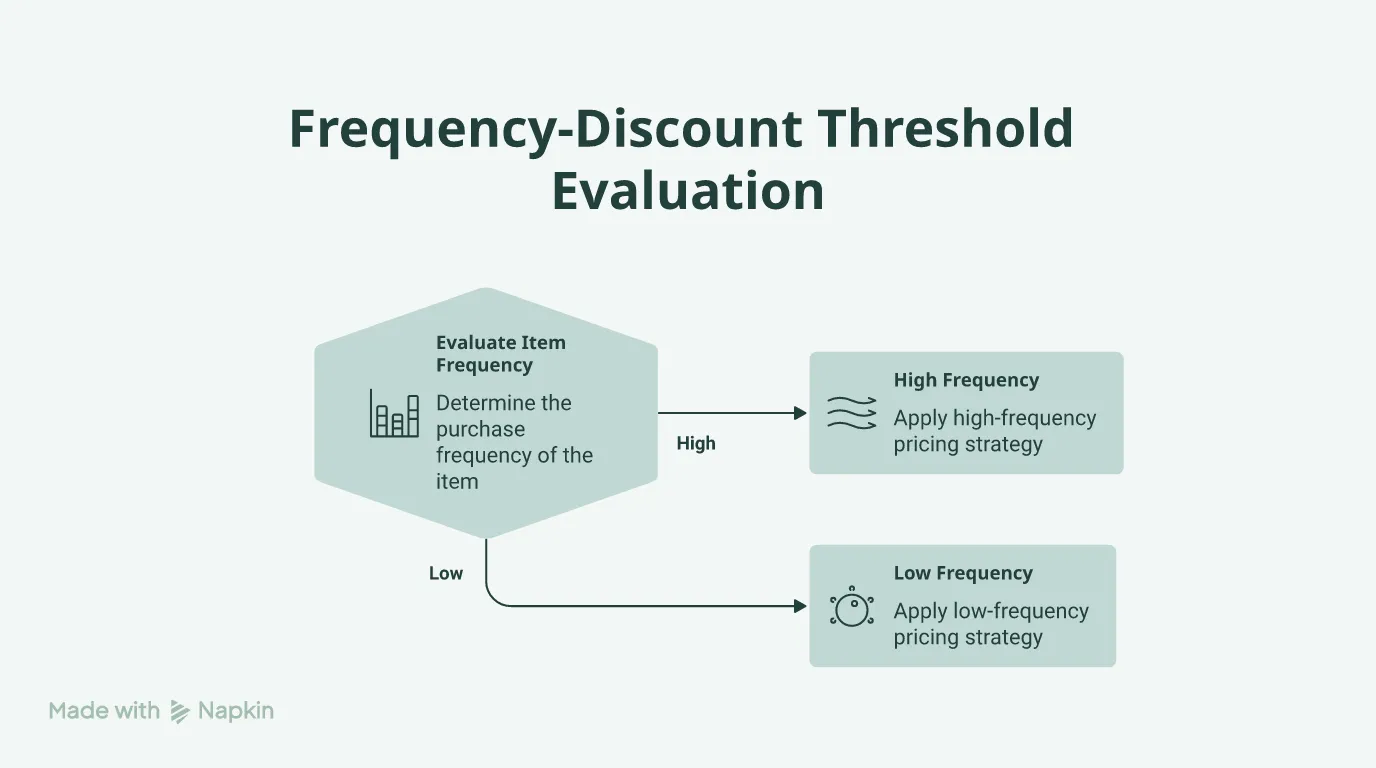
The error I see in pricing models is treating all SKUs uniformly across channels. To operationalize these findings, pricing teams need what I call the Frequency-Discount Threshold. This decision rule dictates when a retailer can safely differentiate prices across channels, and when they must hold the line.
1. High-Frequency / Routine Purchases: If the item is bought weekly or monthly (groceries, daily cosmetics), enforce strict price parity. The buyer is highly sensitive to any offline premium. The threshold for perceived unfairness is near zero. If you must differentiate, cap the online discount at 10% and explicitly anchor it to shipping offsets. 2. Low-Frequency / Occasional Purchases: If the item is an occasional or look-and-feel purchase (toys, electronics), the threshold expands. You can safely sustain an offline premium. The buyer is paying for the immediacy and the physical evaluation.
This threshold redefines the pricing model. Instead of asking “What margin do we need to clear?”, the product team must ask, “How often does the user buy this, and where are they standing when they do?”
Reframing Value Through the Interface
This context-dependency isn’t limited to physical retail. It extends aggressively into digital financial products, where the “price” is often disguised as interest or fees.
Consider the rapid expansion of Buy-Now, Pay-Later (BNPL) services. The fundamental transaction, delaying payment for a fee, carries inherent psychological friction. Yet adoption is exploding. A 2026 structural equation modeling study of 280 BNPL users (Yamuna & Sahila) demonstrates that adoption isn’t driven solely by the utility of delayed payment. It is driven by the intersection of perceived value and gamification.
When a BNPL platform introduces gamified elements, progress tracking, reward streaks, badge unlocks, they fundamentally alter the perceived value of the transaction. The study indicates that gamification significantly impacts both perceived value (β = 0.577) and user attitude (β = 0.241). The interface reframes the consumer’s emotional involvement. The cost of the financial commitment is mitigated by the experiential reward of the interaction.
If you just look at the raw numbers, the BNPL fee might seem unfair compared to paying upfront. But the interface changes the context. The gamified experience creates a sense of achievement that offsets the financial penalty. Just as the physical store provides an experiential offset for the toy premium, the gamified interface provides an experiential offset for the BNPL fee.
Context as a Core Pricing Input
The lesson for product and strategy leaders is that pricing cannot be divorced from experience and frequency. You cannot model a pricing strategy based purely on margin recovery or competitive benchmarking. You must build the context into the engine.
Whether you are optimizing an e-commerce platform, adjusting offline margins, or building a financial OS, the identical price can feel “wrong” in a different context. The organizations that win are the ones that stop trying to enforce artificial consistency, and start pricing for the context the buyer is actually in.
References
- Kiczmachowska, E. E., De Pourbaix, P., & Mazurek, G. (2026). The product category role in the perceived price fairness of multichannel price differentiation strategies. Central European Management Journal. https://doi.org/10.1108/CEMJ-11-2025-0347
- Yamuna, S., & Sahila, C. (2026). Role of Gamification and Perceived Value on Consumers’ Behavioural Intention to Use Buy-Now, Pay-Later (BNPL) Services through the Extended Tam Model. International Review of Management and Marketing, 16(3), 662-674. https://econjournals.com/index.php/irmm/article/view/15783
Frequently asked questions
Does price parity across channels guarantee that customers will perceive the pricing as fair?
No. Customers apply different fairness standards depending on the channel and the product category. A deeper discount online might be perceived as unfair if it is a frequently purchased good, whereas it might be acceptable for an infrequent purchase.
How does product category affect the acceptance of multichannel price differentiation?
Consumers are far less tolerant of price differentiation for frequently purchased items like groceries and cosmetics. They are more accepting of offline premiums for look-and-feel products or infrequent purchases like toys, where the physical store adds immediate value.
How do experiential factors like gamification alter perceived value in digital transactions?
Gamification introduces interactive, reward-based elements that elevate the perceived value and utility of a service. In digital finance products like BNPL, these elements mitigate perceived risk and enhance engagement, making the overall transaction feel more justified to the user.