Why Adoption Isn't Access for the Next 140 Million Wallet Users
Access is no longer the problem. True financial inclusion means converting episodic wallet users into resilient participants in the digital economy.
By mid-2026, Indonesia counted 212 million active internet users and 125% mobile penetration. The access problem is solved. But access is a low bar. A downloaded application does not equate to financial participation. and a mobile connection penetration rate of 125%. The QR code has become ubiquitous. If the goal was simply to give people a mechanism to move money, the job is mostly done.
But access is a low bar. The harder reality is that a downloaded application does not equate to financial participation. The real frontier for product leaders in emerging markets is moving beyond the structural distribution of wallets to the behavioral conversion of the unbanked. The challenge is turning transient, episodic users, those who treat a wallet as a temporary pass-through for cash, into active, retained participants who trust the ecosystem enough to store value, borrow, and build financial resilience.
Key takeaways
- Access does not equal inclusion: Ubiquitous payment rails and high download numbers mask the behavioral gap; true inclusion requires digital financial literacy and resilience.
- Resilience drives retention: Users who develop the capacity to manage financial shocks through digital platforms are the ones who stay and convert to higher-margin services.
- The physical bridge remains critical: Offline-to-online (O2O) agent networks, like traditional kiosks, are mandatory infrastructure for ingesting the cash economy into the digital ledger.
- Ecosystems beat standalone features: Wallets survive by embedding themselves into daily utility, replacing the friction of traditional banking with high-frequency transaction data.
The illusion of the downloaded wallet
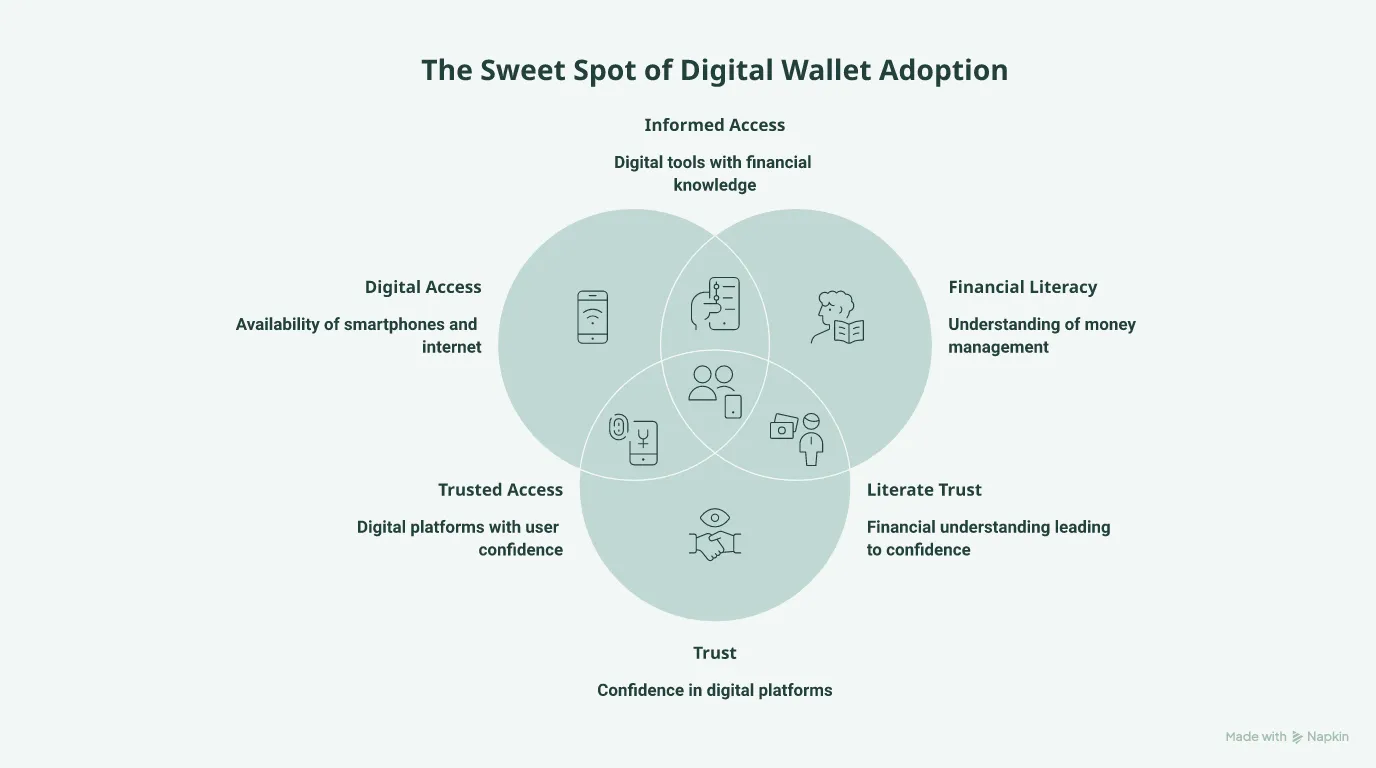
When an application is heavily subsidized through cashback and promotions, user acquisition spikes. However, these numbers frequently reflect multi-homing, where consumers maintain several wallets purely to harvest incentives. A 2026 comparative study of FinTech empowerment indicates that merely having access to digital financial tools yields limited benefits unless the user possesses the digital financial literacy to operate them safely.
The structural evolution of the Indonesian market demonstrates the end of the subsidized growth era. Bank Indonesia’s regulatory framework, notably the BSPI 2030 blueprint, pushed the industry toward consolidation by enforcing risk-based access. Standalone electronic wallets operating as loss-leaders are no longer economically viable. The competitive frontier has shifted from basic payment facilitation, which is now commoditized via universal QR standards, to embedded finance. The objective is capturing consumer liquidity through high-yield deposits and algorithmic credit underwriting.
Product teams must stop optimizing purely for top-of-funnel acquisition. The focus needs to shift toward designing interfaces that build competence. A user who understands how an algorithmic credit score works, or how to identify a secure transaction, is far less likely to abandon the platform when the promotional subsidies run dry.
Financial resilience as the conversion engine
We often assume that financial knowledge directly translates into usage. The data suggests otherwise. Cognitive capability must be converted into adaptive habits. A recent structural model of FinTech empowerment found that financial resilience, the capacity to withstand shocks, maintain liquidity, and continue financial participation, acts as the central mechanism linking digital literacy to sustained platform engagement.
In less formalized economies, digital wallets frequently function as a substitute mechanism for liquidity smoothing. Gig-economy workers and micro-merchants use mobile payments and micro-savings tools not just for convenience, but to manage the volatility of their daily cash flows.
When a product team designs for resilience rather than mere transaction volume, the feature set changes. It moves away from aggressive push notifications for discretionary spending and toward automated micro-savings, liquidity alerts, and transparent, manageable credit facilities like “Buy Now, Pay Later” (BNPL). By embedding behavioral scaffolding into the platform, operators can help users convert their raw access into durable financial stability.
The physical reality of digital money
While product strategies often obsess over the digital user experience, the hardest physical limit to market expansion is the vast proportion of the economy that still operates in physical fiat. You cannot digitally bank the unbanked if they have no way to digitize their cash in the first place.
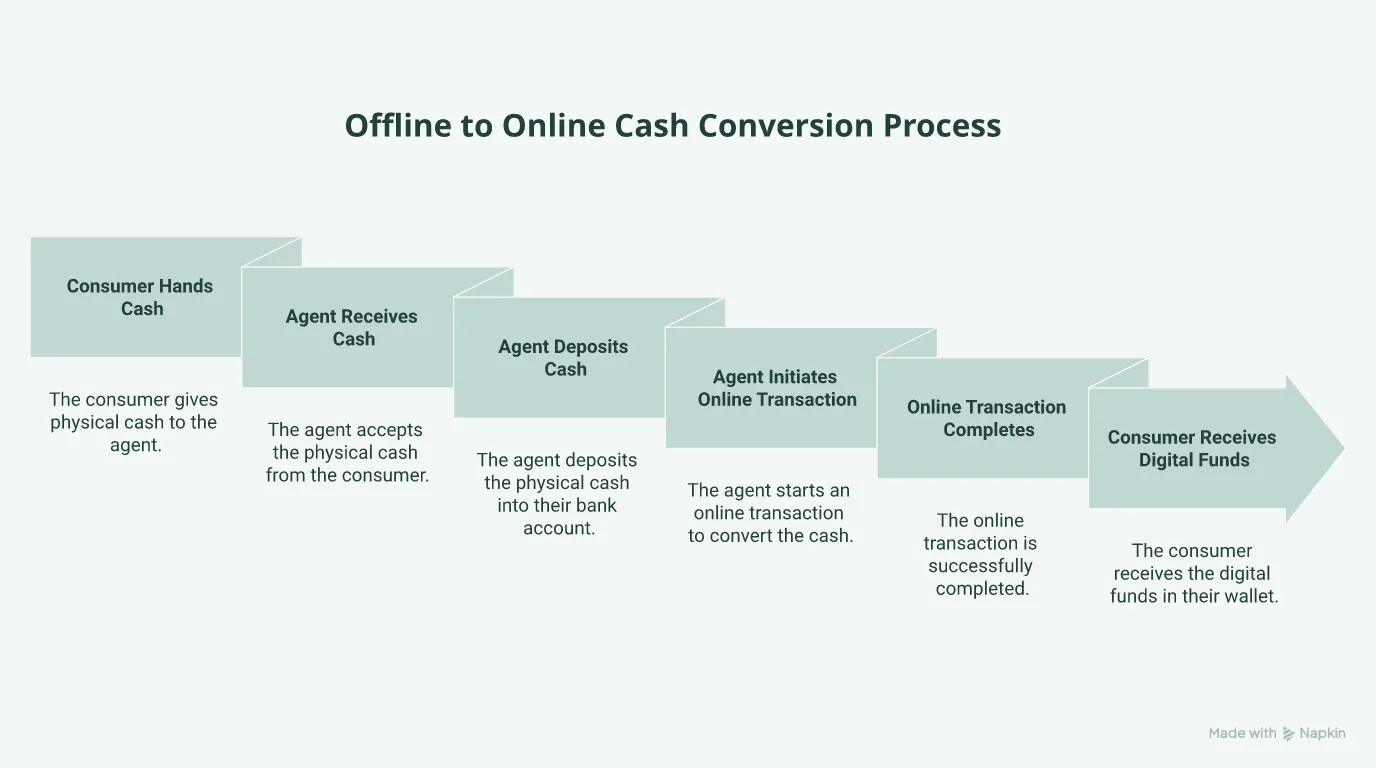
This friction point necessitates an offline-to-online (O2O) architecture. Platforms have effectively weaponized ubiquitous neighborhood kiosks, known as warungs in Indonesia, transforming them from simple convenience stores into distributed nodes of a decentralized digital bank. In this model, an unbanked consumer hands physical cash to a local agent, who then initiates a digital transfer from their pre-funded merchant wallet.
This human-led, physical transaction network requires its own specialized product logic. It introduces complex supply chain problems regarding agent liquidity management and vulnerability to fraud. Securing these micro-transactions requires deploying advanced, real-time machine learning engines to detect synthetic identities and account collusion before the digital ledger updates. The product strategy here is entirely distinct from urban e-commerce; it is an exercise in building trust and security across millions of decentralized, physical touchpoints, similar to the requirements for designing trust into AI products.
The shift to the closed-loop ecosystem
The behavioral conversion of the underbanked ultimately relies on utility collateral. When a digital wallet operates as a standalone application, the switching costs are effectively zero. When it is embedded within a broader superapp ecosystem with proper decision infrastructure, powering food delivery, transportation, and daily municipal services, abandoning the wallet means losing access to modern urban infrastructure.
This deep integration allows platform operators to act as massive, decentralized escrow systems. By continuously capturing peer-to-peer transactions and digitizing cash through agent networks, the platform builds a self-sustaining financial supply chain. The resulting proprietary data moat enables the deployment of alternative credit scoring models. Instead of evaluating traditional bank account histories, algorithms analyze geospatial stability, transaction frequency, and device metadata to securely extend credit to demographics previously deemed too opaque by legacy banks.
Converting the next wave of users requires accepting that adoption is a capability-building exercise. Market expansion in these environments is not a distribution problem; it is a design problem centered on trust, resilience, and the patient integration of digital services into the informal economy, proving exactly why the wallet is the wedge that superapps use to turn basic payments into expansive financial ecosystems.
References
- Sabri, M.F., Trinugroho, I., Magli, A.S., Law, S.H., Wahyono, B., Ridhwang, M.M., & Septianto, F. (2026). Bridging digital capabilities and financial resilience: A comparative study of FinTech, AI literacy, and financial inclusion among households in Malaysia and Indonesia. Journal of Open Innovation: Technology, Market, and Complexity, 12, 100759. https://doi.org/10.1016/j.joitmc.2026.100759
- GlobeNewswire. (2026). Indonesia Prepaid Card and Digital Wallet Intelligence Report 2026.
Frequently asked questions
What is the difference between digital access and financial inclusion?
Digital access indicates that a user has a smartphone and a downloaded wallet application. Financial inclusion means the user possesses the digital financial literacy and systemic trust required to actively save, borrow, and build economic resilience within that digital ecosystem.
How do offline-to-online (O2O) networks drive wallet adoption?
O2O networks utilize traditional neighborhood kiosks as decentralized bank tellers. They allow consumers operating entirely in the physical cash economy to convert fiat currency into digital ledger entries, bridging the gap between informal cash and digital finance.
Why is financial resilience critical for digital wallet retention?
Financial resilience, the ability to manage economic shocks and maintain liquidity, acts as the behavioral mechanism that converts raw digital access into sustained usage. Users who leverage platforms to smooth out their cash flow volatility become the most loyal and active participants.