Why the Wallet Is the Wedge for Superapp Financial Ecosystems
A digital wallet isn't a payments feature, it's an acquisition wedge. How Southeast Asian superapps digitize cash, build behavioral data, and unlock lending.
The paradox of financial inclusion in Southeast Asia is that millions of people own smartphones but remain entirely cut off from formal banking. Traditional commercial banks struggle to penetrate rural and lower-income demographics because they rely on structured data: formal credit histories, W-2 equivalents, and centralized identity systems. When a population operates almost entirely in physical cash, the banking model breaks down.
Digital platform operators recognized that the solution was building a better data pipeline. By transitioning from utility providers, like ride-hailing and food delivery, into comprehensive financial ecosystems, platforms like Grab turned the digital wallet into an acquisition wedge. They systematically capture peer-to-peer transactions, digitize physical cash through neighborhood agent networks, and use the resulting behavioral data for algorithmic credit scoring.
Key takeaways
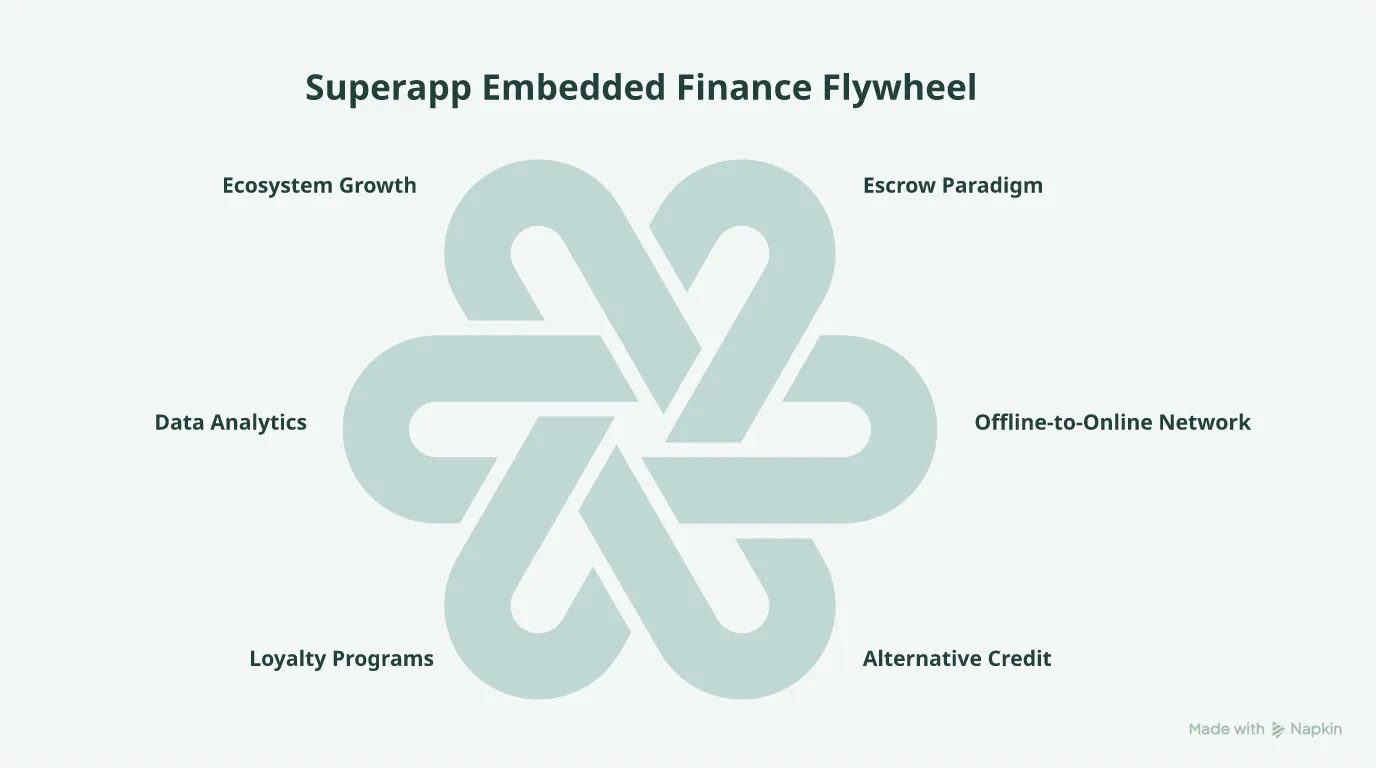
- The escrow paradigm: Superapps function as massive decentralized escrow platforms, utilizing the temporal gap between payment and settlement to build a highly liquid float.
- Cash-in infrastructure: True market penetration requires digitizing physical fiat currency through offline-to-online (O2O) agent networks, essentially turning local convenience stalls into distributed bank tellers.
- Alternative credit scoring: Machine learning models evaluating geospatial stability, utility velocity, and device metadata can achieve non-performing loan (NPL) rates as low as 1.7%, significantly outperforming the industry average.
- Zero-CAC banking: Consolidating a licensed digital bank into a superapp eradicates traditional customer acquisition costs (CAC) by embedding savings and lending directly into daily-use interfaces.
The escrow paradigm and temporal liquidity
To understand the financial mechanics of a superapp, you have to look past the logistics and transport layers. At its core, a platform like Grab functions as a vast transactional infrastructure engineered for financial intermediation.
When a consumer deposits funds into their digital wallet to pay for a ride or a meal, the platform assumes total custodianship of those funds. Because digital platform transactions utilize deferred multilateral net settlement rather than real-time gross settlement, a structural temporal gap exists between the moment a consumer pays for a service and the moment the merchant or driver withdraws those funds to an external bank account.
This delay generates an “escrow window.” During this window, the platform holds an aggregated pool of floating capital. By maximizing Gross Transaction Value (GTV) and actively incentivizing users to maintain balances through loyalty rewards and cross-subsidies, the platform continuously replenishes this float. This capital pool, representing billions of dollars in transit, provides the systemic liquidity necessary to extend micro-lending and insurance to a demographic previously deemed too risky by legacy commercial banks.
Weaponizing the offline network for cash ingestion
While digital wallets and QR codes resolve the friction of digital-native transactions, they encounter a hard physical limit: the massive proportion of the Indonesian economy that still operates entirely in physical fiat currency. Expanding the digital escrow float requires a reliable ingestion mechanism capable of converting physical cash in the hands of the unbanked into digital ledger entries.
Grab achieved this through an offline-to-online (O2O) architecture, anchored by the strategic acquisition of Kudo, which evolved into the GrabKios network. This architecture weaponizes the ubiquitous network of traditional Indonesian neighborhood kiosks, known as warungs, transforming them from simple convenience stores into distributed nodes of a decentralized digital bank.
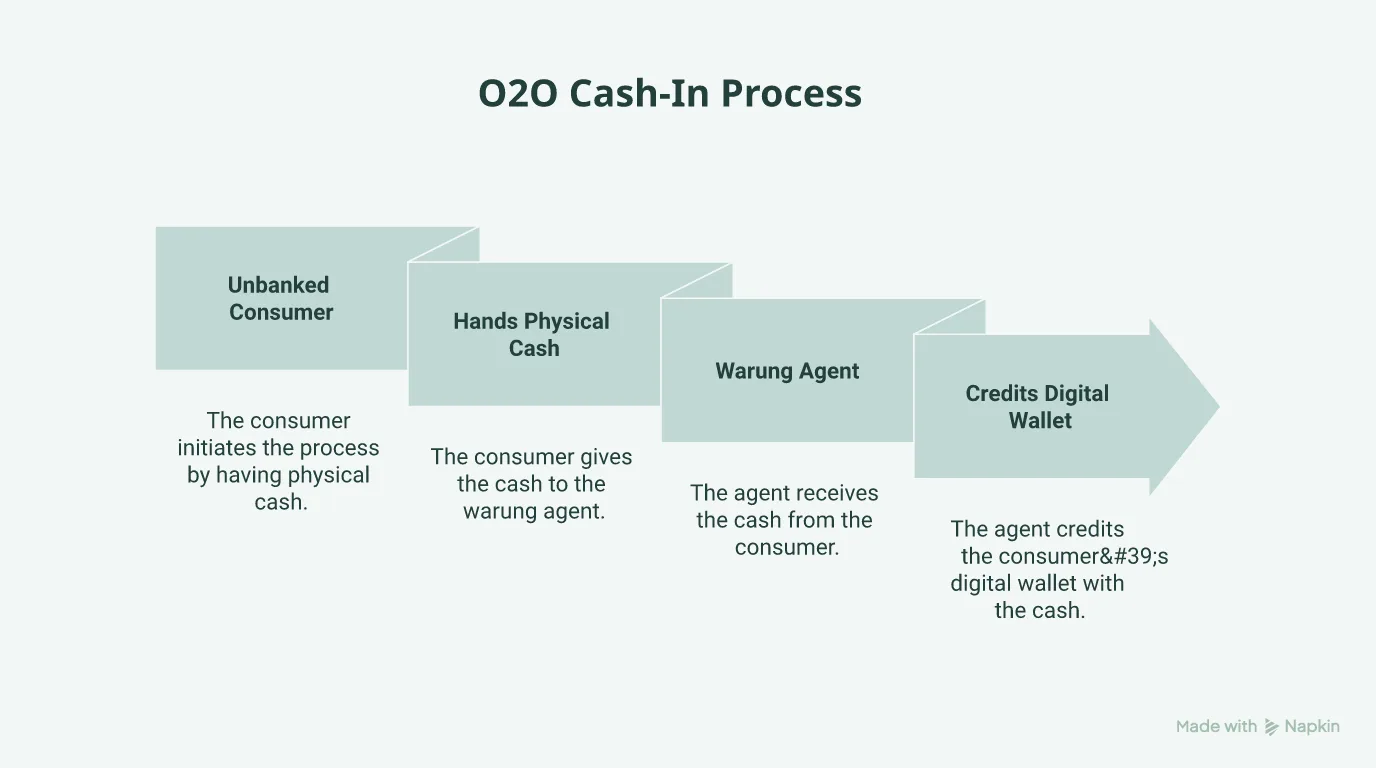
When an unbanked consumer approaches a local warung with physical cash to top up their digital wallet or pay a utility bill, the agent uses their pre-funded balance to process the transaction instantaneously. The platform deducts the digital balance from the agent, credits the consumer, logs the transaction, and instantly rewards the agent with a micro-commission. Internal data suggests that integrating these O2O services can increase a warung’s overall revenue by 30% to 40% while driving secondary foot traffic for their physical retail goods.
Algorithmic underwriting and the PayLater supply chain
The provision of unsecured consumer credit to the unbanked requires a complete circumvention of traditional credit bureau infrastructure. Buy-Now-Pay-Later (BNPL) services, specifically the Grab PayLater facility, solve this systemic challenge by analyzing proprietary alternative data generated continuously within the platform’s ecosystem.
To extend credit securely, the platform relies on Alternative Credit Scoring (ACS) models. Instead of analyzing traditional bank account cash flows, the system evaluates the user’s digital ecosystem footprint. The underlying risk evaluation engines utilize advanced computational models to classify user behavior and assign dynamic risk scores. These models analyze highly predictive data points:
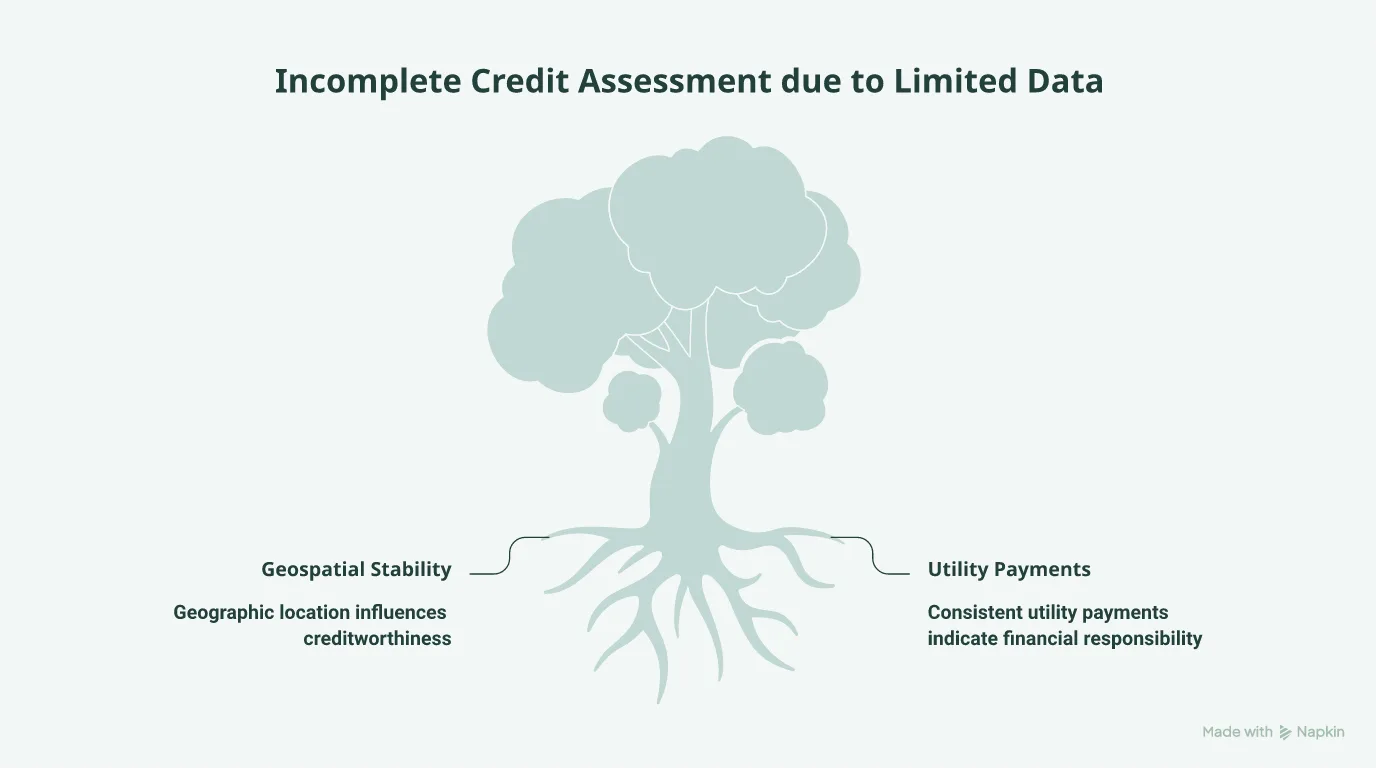
- Geospatial stability: The consistency of a user’s ride-hailing pickup and drop-off locations serves as a highly accurate proxy for residential permanence and employment stability.
- Utility velocity: The regularity with which a user orders food delivery or pays municipal utility bills indicates baseline cash flow.
- Device fingerprinting: The age of the mobile device, operating system version, and digital footprint help algorithms rule out synthetic identities or organized fraud rings.
By synthesizing these real-time signals, the platform’s embedded lending partners can assign a personalized, dynamic credit limit. This deployment of alternative data allows financial institutions to achieve Non-Performing Loan (NPL) rates as low as 1.7%, significantly outperforming the 3-5% industry average in emerging markets.
The transition to full-stack digital banking
While a digital wallet facilitates payment routing and float retention, the ultimate evolution of the superapp ecosystem requires a licensed banking institution to legally hold deposits, issue formal credit, and execute complex treasury functions. This requirement drove Grab’s strategic consolidation of Superbank in Indonesia.
The integration of a licensed bank directly into the superapp yields profound operational advantages, primarily the eradication of Customer Acquisition Costs (CAC). By embedding digital savings products directly into the interfaces used daily by millions of Indonesians, the bank bypasses the massive marketing expenditures traditionally required to attract deposits.
The financial outcomes of this ecosystem-based growth strategy are stark. As detailed in corporate disclosures, Superbank’s integration yielded exponential growth metrics by April 2026, including a 1,528.8% year-over-year growth in Profit Before Tax, reaching IDR 142 billion, and a 98.4% growth in Third-Party Funds (deposits) to IDR 15.1 trillion.
Securing the physical-digital bridge against fraud
The integration of millions of physical, human-led cash nodes with a centralized digital ledger introduces profound attack vectors. In an O2O network, fraud bleeds into the physical world, involving physical collusion between agents, synthetic manipulation of location data, and the aggressive exploitation of asynchronous clearing gaps.
To secure this financial supply chain, Grab developed an enterprise-grade suite of anti-fraud technologies. When syndicates attempt to artificially meet performance quotas through fake orders, often facilitated by ghost applications designed to spoof GPS coordinates, machine learning algorithms cross-reference reported GPS data with physical sensor data, such as accelerometer movement and Wi-Fi triangulation.
Furthermore, entity intelligence models evaluate the complex social graph and historical relationship between transacting accounts. High-velocity transactions between the same two nodes, or transactions executed without corresponding physical movement, trigger immediate real-time blocks. By securing the physical-digital bridge, the platform ensures that the data driving its financial ecosystem remains untainted, allowing the wallet to function as the ultimate wedge for market expansion. Ultimately, this proves that adoption isn’t access without deliberate capability-building, and maintaining this momentum requires product teams to constantly navigate a dual-regulator, fraud-heavy reality to keep the financial supply chain intact.
References
- Grab Holdings Limited. (2026). Operational Architecture of Embedded Finance and Offline-to-Online Networks in Emerging Markets: A Teardown of the Grab Indonesia Ecosystem.
- Grab Holdings Limited. (2026). Strategic and Technical Architecture of the Grab-Superbank Integration: Navigating the 2026 Indonesian Digital Banking Landscape.
- Hasselwander, M. (2026). Super apps, super wallets, and everything apps. Strategic Business Research, 2, 100130.
Frequently asked questions
What is the escrow paradigm in digital platforms?
The escrow paradigm refers to how superapps hold onto user funds between the time a payment is made and when it is settled with the merchant or driver. This temporal gap creates a massive pool of floating capital that the platform can use to provide systemic liquidity for other financial services.
How do superapps solve the physical cash problem in emerging markets?
Superapps use offline-to-online (O2O) networks by equipping neighborhood kiosks and stalls with digital agent applications. This allows unbanked consumers to hand physical cash to an agent, who then instantly credits the consumer's digital wallet, effectively converting physical fiat into digital float.
How does alternative credit scoring work without a credit bureau?
Alternative credit scoring analyzes a user's behavioral footprint within a digital ecosystem. Algorithms evaluate data points like geospatial stability (ride-hailing drop-offs), transaction frequency, and device metadata to assess risk, often achieving lower default rates than traditional banking methods.
Why do superapps acquire or consolidate with licensed digital banks?
Consolidating with a licensed bank allows the superapp to legally hold deposits, issue credit, and perform treasury functions. It also eliminates customer acquisition costs for the bank, as financial products can be embedded directly into an app already used daily by millions.