Financial Inclusion Is a Product Problem Not a Charity
Algorithmic lending and digital wallets do not automatically democratize access. The data shows that financial inclusion requires deliberate product design.
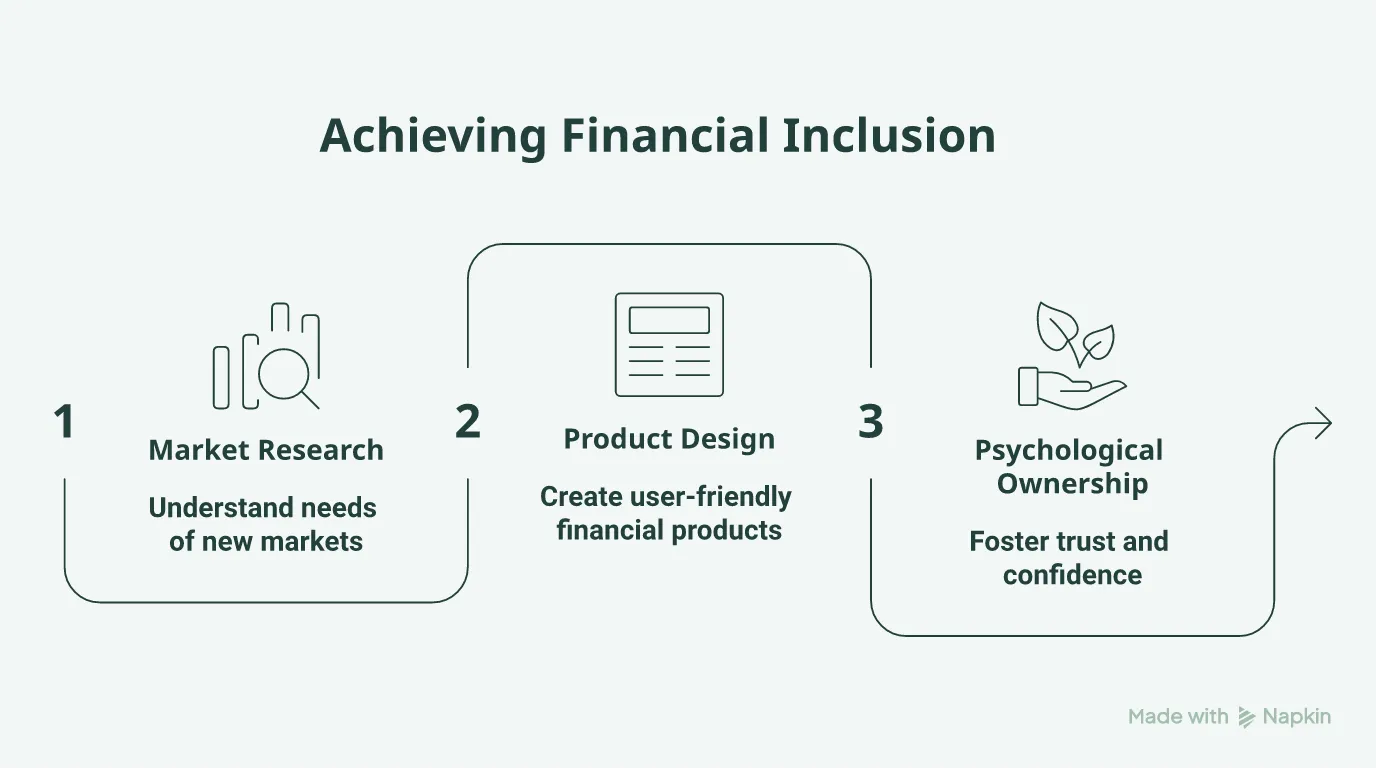
There is a prevailing assumption in the tech industry that putting a digital wallet on a smartphone or replacing loan officers with algorithms automatically democratizes access to financial systems. The logic suggests that if distribution is solved, inclusion will naturally follow. You can see this in how many platforms launch in emerging markets with generic offerings, assuming the technology itself will bridge the gap. But access does not equal participation.
The reality I see in the evidence is that financial inclusion is a product-design problem, not a charity. When we look at how minority-owned businesses are underwritten or how users in cash-constrained markets react to transaction fees, the friction points are systemic. If your product does not explicitly solve for the constraints of the underbanked, it will simply reproduce the inequalities of the traditional system at scale.
Key takeaways
- Algorithmic parity is a myth. FinTech lending models often reproduce the same demographic shortfalls as traditional banks because hard data reflects structural realities.
- Ownership drives engagement. True financial inclusion happens when users develop psychological ownership over the digital tool, leading to active saving and business investment.
- Friction destroys value. Transaction taxes or poorly designed fee structures immediately push vulnerable users back into informal cash economies.
The Algorithmic Illusion in Small Business Lending
One of the loudest promises of digital finance is that algorithms remove human bias. A 2026 study by Tran and Winters looked at small business lending and found that FinTech lenders, despite their digital-first approach, are actually less likely to lend to minority-owned firms than to white-owned firms, mirroring the disparities at large traditional transactional banks. The study analyzed data from the Small Business Credit Survey, focusing on first-time line-of-credit applicants. They found a statistically significant minority shortfall in approval amounts at FinTech lenders, with coefficients ranging from -0.353 to -0.404. Large banks showed a similar negative gap of -0.321 to -0.373.
Here is how I read this: algorithms price and approve based on hard data. When structural inequalities exist, the hard data reflects them. Removing human discretion does not magically equalize access. In fact, the research showed that community banks, which rely on soft information and local context, were better at closing the minority approval gap for first-time borrowers. The product design of the underwriting model matters. If a platform relies purely on standardized scoring without contextual mechanisms, it risks entrenching the very disparities it claims to solve.
This creates a paradox. FinTech platforms often market themselves as the democratizing alternative to legacy banking, explicitly targeting the underbanked. Yet, the data tells a different story. The absence of a loan officer does not mean the absence of bias; it simply means the bias is codified into the variables the algorithm weighs most heavily. When community banks evaluate an applicant, they might look at the business owner’s local reputation or specific operational context, soft data that can offset a thin credit file. Transactional digital lenders discard this soft data in favor of scale and speed. As a result, the very businesses that need the most context are judged on the least.
Interestingly, the study also found that FinTechs are more likely to lend to female-owned firms (with positive coefficients up to 0.559), a result not seen at traditional banks. This implies that alternative data sources used by digital lenders might favor certain profiles over others. For a product leader, the lesson is that algorithmic underwriting is not neutral ground. Building a product for financial inclusion requires examining what data you collect and how the absence of soft, relationship-based information might inadvertently penalize marginalized groups. Furthermore, the researchers found that minority applicants reported lower satisfaction, longer waits, and a more difficult application process at FinTech platforms compared to community banks. The user experience itself becomes a barrier.
Psychological Ownership Matters More Than Reach
Expanding into a new market is a product problem, and distribution is the easy part. The harder challenge is driving actual usage. A 2026 study by Amegbe, Dzandu, and Hanu examined mobile money users in Ghana, analyzing survey data from 630 respondents and 23 qualitative interviews. They found that continuous use of mobile wallets builds “psychological ownership”, the feeling that the platform is personally meaningful and controllable.
When users feel this ownership, the data shows they manage their finances more actively. The researchers conceptualized financial inclusion across three dimensions: financial engagement (managing money and saving), social engagement (supporting relatives and community events), and economic engagement (business-related payments). Psychological ownership had a massive positive impact on all three, with structural equation modeling showing strong coefficients for financial (0.820), social (0.955), and economic (0.879) engagement.
The concept of psychological ownership is critical here. It is not about legal rights; it is about the emotional investment a user makes in the tool. The study highlights that this ownership emerges from three basic psychological needs: autonomy (initiating transactions independently), competence (learning to manage balances confidently), and relatedness (connecting with social networks through remittances). When a mobile money app satisfies these needs, the user stops seeing it as an external service and starts treating it as their own financial agency. If your product roadmap prioritizes acquiring new users but neglects the features that build this competence, such as clear transaction histories, predictable interfaces, and responsive customer support, you will experience massive user churn.
Inclusion is the psychological transition from a passive guest to an active owner. The win comes from treating the new market as its own design problem and building features that reinforce user autonomy and competence. As part of the broader financial OS transition, digital wallets must evolve beyond simple transaction pipes. They need to become integrated environments where users feel absolute control over their resources. The qualitative interviews in the Ghana study revealed that users felt strong ownership specifically because they had secure PIN control and reliable access to their funds without needing to visit a physical bank. When a product team gets these seemingly basic UX elements right, they create the trust necessary for deep financial participation.

How Policy Friction Kills Engagement
The same Ghana study highlights what happens when a government introduces an electronic levy (e-levy), in this case, a 1% tax on transfers. The added transaction cost directly reduced transfer volume and actively deteriorated the social and economic engagement of the users. They stopped using the tool for community contributions and business receipts. The researchers found significant negative effects of the e-levy across financial (-0.094), social (-0.193), and economic (-0.193) engagement. When the cost of using the product increases unexpectedly, low-income users revert to cash. The product loses its value proposition instantly. I would argue that building for emerging markets requires protecting the unit economics of the end-user as fiercely as the company’s own margins. Interviewees in the study explicitly stated they were considering stopping their mobile money usage because the deductions were simply too high for their tight liquidity constraints.
The fallout from the e-levy is a textbook example of how fragile digital adoption can be. For users operating on razor-thin margins, a seemingly small percentage fee completely alters the cost-benefit analysis. The study’s qualitative interviews showed that small business vendors felt the immediate operational strain as customers stopped sending money digitally. This is a universal lesson in pricing strategy for low-income segments. If you treat transaction fees as a simple revenue lever without understanding the liquidity constraints of your users, you will hollow out your active user base. True inclusion requires a product architecture that absorbs as much friction as possible, shielding the user from costs that break their trust in the digital platform.
Whether it is a government tax or a platform fee, friction at the transaction layer destroys the psychological ownership that took months to build. A product leader must work through these external constraints as core design parameters. When a tax is unavoidable, the product strategy must pivot to find other ways to deliver value, perhaps by lowering friction elsewhere in the workflow or adding high-value micro-loan facilities for small businesses. Financial inclusion is an ongoing battle to keep the product accessible, ensuring the platform remains a tool for economic agency rather than an unaffordable luxury.
References
- Tran, A. M., & Winters, D. B. (2026). FinTech small business lending: Do FinTechs provide business loans to under-banked groups? Journal of Financial Stability, 84, 101541. https://doi.org/10.1016/j.jfs.2026.101541
- Amegbe, H., Dzandu, M. D., & Hanu, C. (2026). Forging financial inclusion through psychological ownership of Fintech innovations: Evidence from an emerging economy. Electronic Markets, 36(54). https://doi.org/10.1007/s12525-026-00911-1
Frequently asked questions
Does algorithmic lending eliminate bias in financial services?
No. Research shows that FinTech lenders often reproduce the same demographic shortfalls as traditional banks because automated models rely on hard data that reflects existing structural inequalities.
What is psychological ownership in digital finance?
It is the user's feeling that a digital platform is personally meaningful and under their control. This ownership is a critical driver for active financial engagement, saving, and business investment.
How do transaction fees impact financial inclusion?
Added transaction costs, such as electronic levies, disproportionately harm low-income users. They degrade the perceived value of the platform, pushing users back to informal cash economies and destroying engagement.